
EMS Technology
How EMS Controllers Synchronize Multiple Muscle Channels
Learn how synchronous and alternating EMS channels coordinate muscle zones,
Includes:
BEST FOR
Not Recommended
TECHNOLOGY
Dry Electrode Technology
AVERAGE PRICE
$1,890
CONNECTIVITY
Wireless
Editor's Take
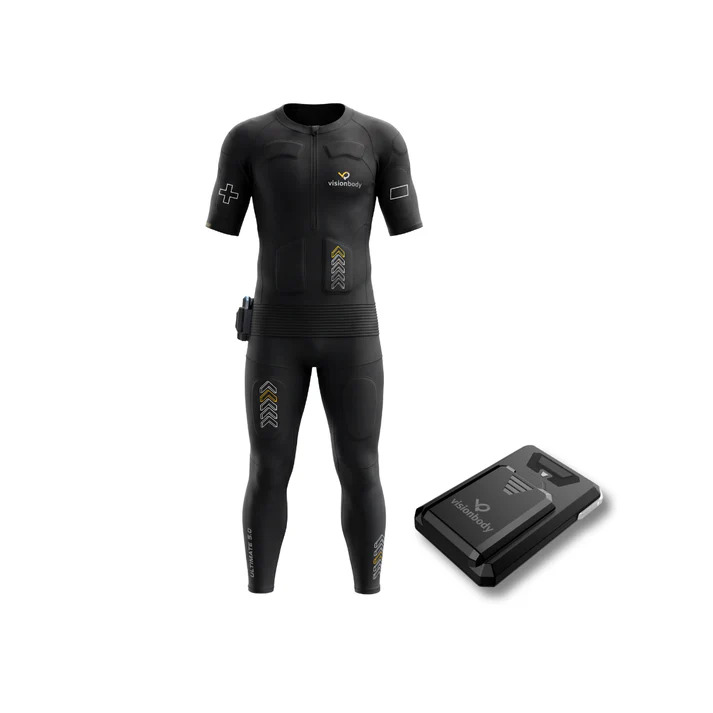
VisionBody is one of the more recognizable names in wireless whole-body EMS and has built much of its reputation around premium positioning, German engineering, and making EMS convenient enough to use at home. Its system uses dry electrodes, so you don’t need to wet the suit or wear conductive base layers before training, and the app gives you control over your workouts and stimulation levels.
Those are some of the reasons we were initially interested in VisionBody ourselves. The suit is lightweight, getting started isn’t particularly complicated, and the overall presentation makes the system feel like the type of premium EMS product you should be able to buy with confidence.
Unfortunately, buying an expensive fitness system isn’t just about whether it can deliver a good workout. You’re also trusting the company to ship it when promised, provide dependable hardware and software, answer when something goes wrong, and stand behind what it sells. That’s where our experience with VisionBody became considerably harder to recommend.
We waited more than four months for our own suit to arrive, experienced concerns with the product and customer support, and found similar complaints appearing repeatedly in public customer feedback. We also came across marketing claims and manufacturing information that we’d want clarified before spending this kind of money.
In this review, we’ll go through the VisionBody suit, app, price, shipping, warranty, customer experiences, and some of the questions we believe you should ask before ordering. Our goal isn’t to tell you what decision to make. It’s to make sure you know the things we wish we’d known before making ours.
VisionBody’s system is a wireless WB-EMS suit designed to bring EMS training outside of a traditional studio. One of its biggest conveniences is its dry-electrode design, which means you don’t need to spray the electrodes with water or wear a separate conductive base layer underneath before every workout.
That makes the preparation relatively straightforward. Put the suit on, connect the system, open the app, and you’re much closer to being ready to train than you would be with a wet EMS system that needs additional preparation.
The suit itself is lightweight and comfortable, and it is capable of delivering an effective whole-body EMS workout. Where we’d be more cautious is assuming the premium presentation automatically means you’re getting premium long-term durability.
Public customer reviews mention premature electrode wear, declining conductivity, connection failures, and components requiring replacement sooner than owners expected. We experienced similar concerns ourselves. That’s something we’d take seriously with any EMS system because the electrodes aren’t an optional accessory. They’re fundamental to how effectively the suit delivers stimulation.
We’d also be cautious with some of VisionBody’s performance claims. The company has promoted figures suggesting up to 98% muscle activation, but we weren’t able to locate independent evidence supporting that specific number. That doesn’t mean the suit can’t provide an effective workout. It means we wouldn’t make a purchasing decision based on that percentage alone.
We had similar questions surrounding VisionBody’s marketing of “high-frequency EMS.” Promotional materials and chatbot responses have referenced frequencies between 10,000 and 50,000 Hz, while publicly available regulatory documentation submitted to the FDA lists operating specifications consistent with approximately 100 Hz.
Again, that doesn’t automatically mean there’s something wrong with how the suit performs. Our concern is much simpler: if you’re spending premium money on technology being marketed as particularly advanced, you should be able to clearly understand what that technology actually does without trying to reconcile different technical descriptions yourself.
The VisionBody app serves as the primary control center for the system. It allows you to select workouts, adjust intensity, and manage the suit through a relatively straightforward interface.
From a usability standpoint, we like the simplicity. If you’re new to EMS, you shouldn’t need to feel like you’re learning an engineering program just to start a workout, and VisionBody does a good job of keeping the basic controls approachable.
Where we’d want improvement is reliability.
During our testing, we experienced occasional connection interruptions between the control unit and app that required reconnecting before training could continue. We also found similar reports from customers describing Bluetooth pairing problems, unexpected disconnections, firmware issues, and inconsistent syncing.
Normally, the occasional app hiccup wouldn’t be enough to change our opinion of an entire fitness system. With EMS, however, the app is controlling the stimulation you’re actively training with. Having to stop, reconnect, or troubleshoot in the middle of a session becomes frustrating quickly.
More importantly, this doesn’t appear to be limited to one or two isolated complaints. Across multiple independent platforms, complaints involving app crashes and connection problems appear repeatedly, including reviews from 2025 and 2026.
If you’re considering VisionBody, we’d look at the most recent app reviews before ordering. Software can improve considerably with updates, so what’s happening with the app when you buy matters more than what someone experienced several years ago.
VisionBody positions itself as a premium EMS system, so we’d evaluate its price based on more than the fact that the suit can deliver a whole-body EMS workout.
When you spend premium money, you’re also paying for what should come with that positioning: dependable hardware, stable software, reasonable fulfillment, accessible customer service, clear warranty protection, and confidence that the company will help you if something goes wrong.
That’s where value becomes more difficult for us to judge in VisionBody’s favor. The dry setup is genuinely convenient, and we like not having to deal with water or conductive base layers. But convenience at the beginning of every workout only goes so far if you later find yourself dealing with connectivity problems, premature component wear, or difficulty reaching support.
We’d therefore compare VisionBody based on the complete ownership experience rather than specifications alone. An EMS suit isn’t something we’d recommend choosing because one brand claims a higher activation percentage or uses more impressive technical language. At this price point, we’d care just as much about what happens six months after you buy it.
This is the section we’d pay particularly close attention to before ordering VisionBody because shipping was where our own concerns started.
Our VisionBody order took approximately four and a half months to arrive.
If that were an isolated experience, we’d be more willing to chalk it up to an unfortunate fulfillment problem. After researching other customer experiences, however, we found reports describing waits of three, four, and even six months.
Some customers describe being repeatedly told their orders would ship soon, only to encounter additional delays with limited explanation. Similar shipping complaints have appeared over an extended period rather than being concentrated around one short-term fulfillment problem.
That’s why we wouldn’t simply place an order and assume the delivery estimate will work itself out. If you’re considering VisionBody, contact the company before purchasing and ask whether your exact size and system are currently in stock. We’d also ask for the expected shipping date in writing.
Hopefully your order arrives exactly when promised. But after waiting more than four months ourselves, this is one precaution we’d rather see you take unnecessarily than wish you’d taken afterward.
VisionBody advertises a one-year warranty, but we’d read the complete terms rather than stopping at the length of coverage.
According to the warranty information we reviewed, coverage is effectively limited to approximately 100 washes. That’s important for a wearable fitness product you’re going to sweat in and clean regularly.
We’d think about that limitation in practical terms. If you’re using the suit consistently, washing isn’t an occasional event. It’s part of owning the product, so we’d want to understand exactly how the wash limitation affects warranty eligibility before purchasing.
Customer feedback surrounding refunds and warranty resolutions also gave us some hesitation. Across multiple platforms, buyers describe lengthy refund timelines, repeated attempts to contact the company, and difficulty getting reimbursement following canceled orders, shipping delays, or product problems.
Not every customer has that experience, and we don’t want to imply that requesting a refund automatically means you’re going to have a problem. But there are enough similar reports that we’d protect ourselves before ordering.
Save your order confirmation, warranty terms, promised shipping date, and correspondence with the company. We’d do that with any expensive EMS purchase, but especially when other buyers have reported difficulty resolving issues after the sale.
VisionBody feedback is mixed, and that’s important because there are parts of the system people genuinely like.
The dry-electrode design receives obvious praise because it removes one of the more tedious parts of traditional wet EMS. Users also like the lightweight feel of the suit, straightforward app interface when it’s working properly, and the ability to complete whole-body EMS workouts without traveling to a studio.
Those positives make sense to us because they’re the same qualities that initially made VisionBody appealing in the first place.
The problem is that customer complaints tend to involve parts of ownership that become important only after you’ve already spent the money.
Trustpilot reviews, Reddit discussions, YouTube videos, and other public forums include complaints about delayed shipping, slow customer service, connectivity problems, premature electrode wear, refund delays, and difficulty getting meaningful updates from the company.
Customer support is one of the areas we’d be most concerned about. In our own interactions, responses could feel generic or scripted rather than addressing the specific question being asked. We also experienced missed scheduled calls and extended periods without useful follow-up.
Other customers describe similar situations involving technical assistance, shipping updates, warranty claims, and refunds. The recurring theme isn’t simply that someone had a problem. It’s that getting the problem resolved sometimes became another problem of its own.
That’s particularly important with EMS equipment because you’re purchasing a combination of wearable electronics, software, electrodes, and a controller. Even a relatively small hardware or connectivity problem can prevent you from using a system you’ve spent a substantial amount of money on.
We also think prospective buyers deserve clarity around VisionBody’s manufacturing and marketing.
VisionBody places considerable emphasis on its German identity and “German engineering.” During our research, however, we found a Chinese recruitment listing identifying Homark (Shenzhen) Textile Co., Ltd. as a German-owned company established in Shenzhen that manufactures wireless wearable fitness apparel, including EMS suits, belts, and wristbands sold internationally.
Manufacturing in China isn’t inherently a negative. Plenty of excellent fitness technology and consumer electronics are manufactured there. Our concern is simply transparency. If German engineering is going to be an important part of why you’re being asked to view a product as premium, we think you deserve a clear explanation of where that product is engineered, manufactured, and assembled.
The same applies to technical claims surrounding muscle activation and high-frequency EMS. We’d rather see straightforward specifications supported by independently verifiable information than impressive numbers that leave us with more questions after researching them.
VisionBody can deliver a whole-body EMS workout, and we understand why people are initially attracted to it. Dry EMS is convenient, the suit is comfortable, and the system presents itself as a polished premium alternative to studio-based training.
Our hesitation comes from everything that happens around the workout. We waited months for our order, experienced customer-service and software frustrations, and found enough similar reports from other owners that we can’t dismiss those issues as one unfortunate experience.
If you’re still considering VisionBody, we’d verify that your system is actually in stock, get the expected shipping timeline in writing, read the warranty carefully, and ask any questions you have about manufacturing and technical specifications before paying. If the answers leave you completely comfortable, you’ll be making the decision with considerably more information than we had going into ours.
And that’s really what we’d want for you with an EMS purchase this expensive. VisionBody may still be the system you decide you want, but we’d rather you choose it knowing where the potential headaches are than discover them months after placing your order.
A standard wireless EMS training suit — nothing it does that newer competitors don’t now do better.
One of the older names in EMS; brand recognition is the main thing it has going for it.
Priced well above newer suits that outperform it, which makes the cost very hard to justify.
Channels:
Available Sizes:
Frequency (Hz):
Charging Time:
Warranty:
Presets:
Learn how synchronous and alternating EMS channels coordinate muscle zones,
Learn how constant-current and constant-voltage EMS devices respond to changing

Compare monophasic and biphasic EMS pulses, learn what balanced waveforms
EMS amplitude and intensity are often used interchangeably. Learn what
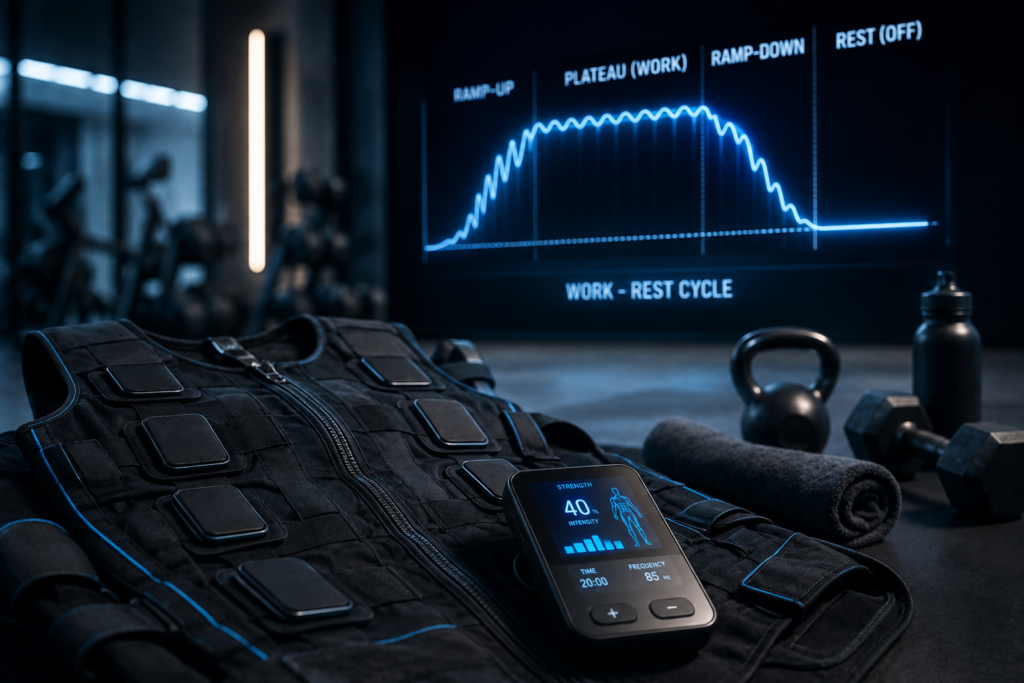
Learn what EMS ramp-up and ramp-down times mean, how they
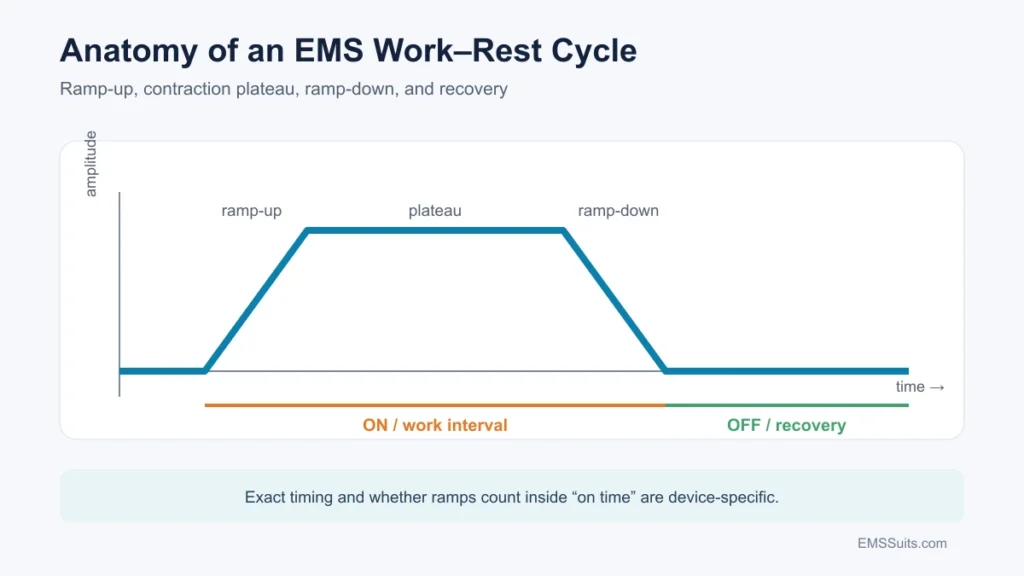
Understand EMS duty cycle, on and off times, work-to-rest ratios,