

EMS specifications may describe a stimulator as constant current or constant voltage. These terms explain what the output circuit attempts to hold steady when electrical resistance—or more precisely, impedance—changes at the electrode-skin interface.
A constant-current device regulates current within its operating limits. A constant-voltage device regulates voltage, allowing current to vary as impedance changes. Neither label proves that a system is more powerful, comfortable, or effective. The device, waveform, electrodes, safeguards, and intended use must be evaluated together.
Current voltage and impedance in plain language
Three electrical quantities are central to this comparison:
- Voltage is electrical potential difference, measured in volts.
- Current is the flow of electrical charge, measured in amperes or milliamperes.
- Impedance is opposition to changing electrical current and is measured in ohms.
For a simplified resistive example, Ohm’s law states that current equals voltage divided by resistance. Human skin and electrodes are more complex than a fixed resistor, and EMS uses time-varying pulses, but the relationship helps explain why contact conditions matter.
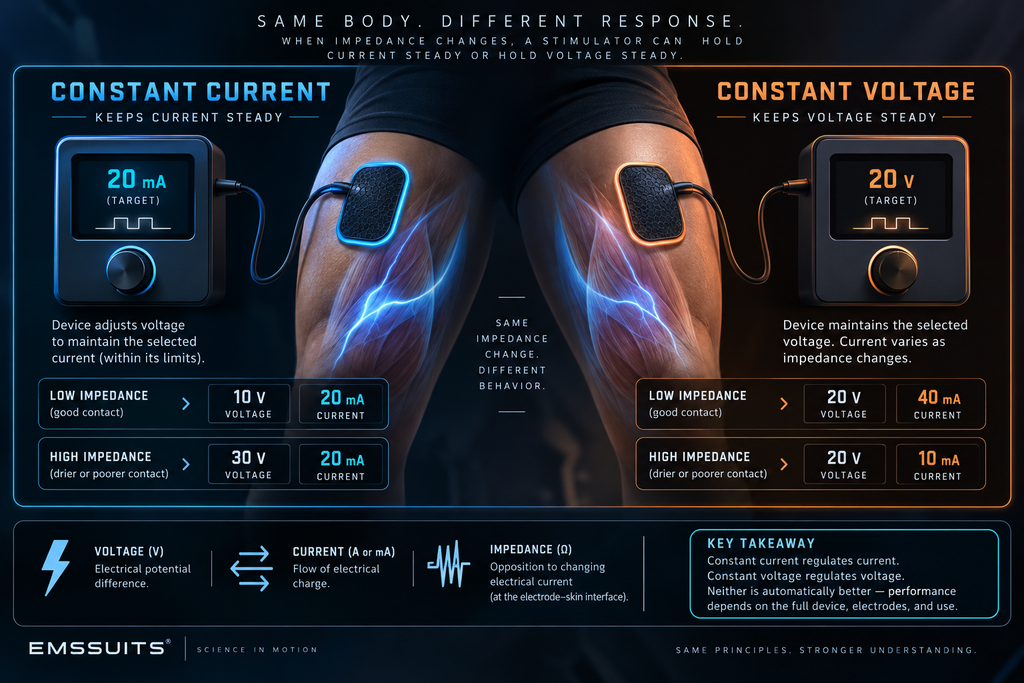
If impedance rises while voltage stays fixed, current tends to fall. If a circuit tries to maintain current, it must increase voltage—up to the device’s allowed limit.
How a constant-current EMS device works
A constant-current stimulator adjusts its output voltage in an effort to maintain the selected current as load impedance changes. This regulation operates only within a defined compliance range. Once the voltage required to maintain current exceeds the device’s capability, current can no longer remain constant.
“Constant” therefore does not mean unlimited or unaffected by all conditions. Device safety limits, maximum voltage, electrode contact, and fault detection still apply.
Clinical and engineering sources commonly distinguish constant-current from constant-voltage stimulators because amplitude must be described in the appropriate unit. A current-regulated device is typically discussed in milliamperes.
How a constant-voltage EMS device works
A constant-voltage stimulator maintains the selected voltage pulse. Current then varies with the impedance presented by the body and electrode interface.
When contact impedance increases, current may decrease. When impedance falls, current may increase, subject to output limits and protective circuitry. A voltage-regulated system can still provide consistent and appropriate stimulation when designed and used correctly.
Why skin and electrode contact change impedance
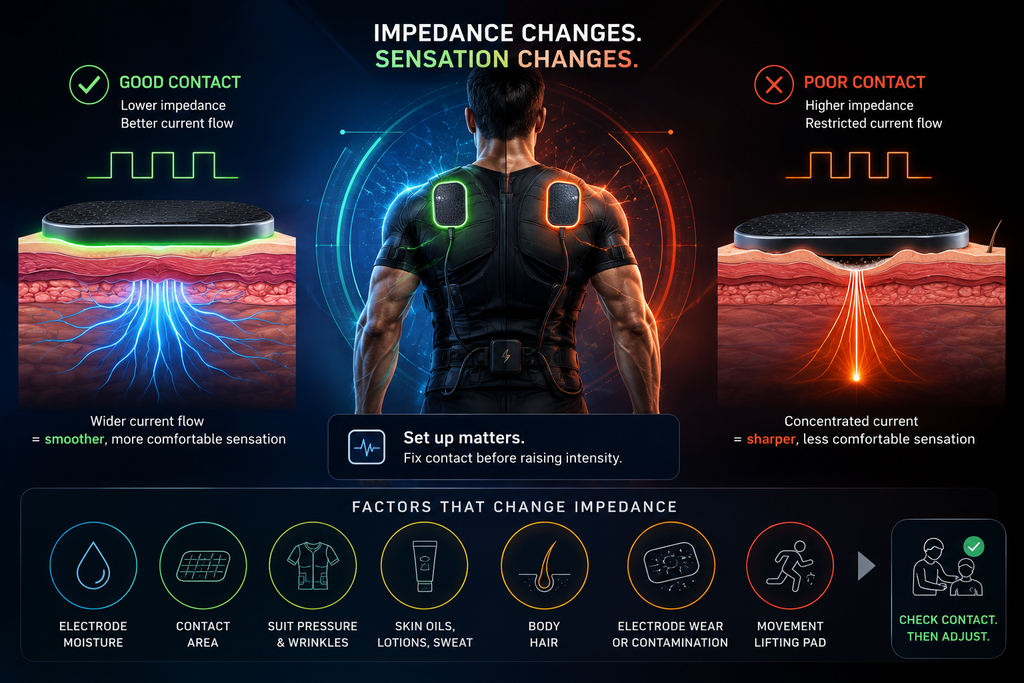
The electrode-skin interface is not perfectly stable. Impedance can change with:
- Electrode moisture.
- Contact area.
- Suit pressure and wrinkles.
- Skin oils, lotions, or sweat.
- Body hair.
- Electrode wear or contamination.
- Movement that partially lifts an electrode.
This is why setup can change sensation even when the displayed level stays the same. A loose or partly dry contact point can also concentrate current over a smaller effective area, causing a sharper sensation.
Before raising intensity to compensate for weak stimulation, inspect fit and contact. The planned EMSSuits guide to patchy electrode contact will provide a step-by-step checklist; until it is live, follow the specific manufacturer’s electrode-preparation instructions.
Does constant current feel more consistent?
Current regulation is intended to reduce variation in current across a range of impedance. Whether a user experiences that as more consistent depends on the full device and electrode system.
Comfort also depends on:
- Pulse duration and waveform.
- Frequency.
- Electrode size and placement.
- Ramp and duty-cycle timing.
- The muscle and body position.
- Individual sensitivity.
A product cannot be evaluated from “constant current” alone. The regulation range and maximum output conditions matter, and manufacturers may use different test loads when reporting specifications.
Output limits and compliance voltage
A constant-current circuit needs enough available voltage to drive the selected current through the load. The maximum voltage available for that job is commonly called compliance voltage.
If impedance becomes too high, a well-designed device may reduce output, alert the user, or report poor contact. It should not be assumed to maintain the selected current under every possible condition.
An error that appears only during movement may point to intermittent electrode or connector contact rather than a defective program. Stop the session and inspect the setup instead of repeatedly increasing the level.
Why device percentages remain non-comparable
Both constant-current and constant-voltage systems may present intensity as a percentage. That interface still does not establish an equivalent dose across brands.
Our guide to EMS amplitude vs intensity explains why a displayed level must be interpreted within the device. To compare specifications responsibly, look for:
- Current or voltage regulation type.
- Maximum output and stated load.
- Pulse width and waveform.
- Frequency and program timing.
- Electrode conductive area.
- Applicable safety standard and regulatory status.
Safety standards and manufacturer documentation
In the United States, powered muscle stimulators are medical devices subject to regulatory requirements based on their intended use and classification. FDA guidance asks manufacturers to provide detailed waveform and output information, including maximum current, pulse width, frequency, and power density.
Internationally, IEC 60601-2-10 specifies particular safety requirements for nerve and muscle stimulators. A manufacturer’s declaration of compliance should be checked in its official technical or regulatory documentation rather than inferred from a retailer’s summary.
Regulatory clearance does not mean every person can use a device. Follow labeling, contraindications, warnings, and operator requirements.
Frequently asked questions
Is constant current better than constant voltage for EMS?
Not categorically. Each can be engineered for its intended purpose. Performance and safety depend on the complete system rather than the regulation method alone.
Does constant current mean the sensation never changes?
No. Electrode contact, pulse parameters, body position, fatigue, and sensory response can change how stimulation feels.
Why does my EMS device report high impedance?
Possible causes include dry or incomplete electrode contact, a loose garment, contamination, damaged connectors, or an electrode that is no longer serviceable. Stop and follow the manufacturer’s contact check.
Can I measure EMS output with a household multimeter?
Do not rely on a household meter or an improvised body connection. Pulsed output requires appropriate test loads, instruments, procedures, and technical expertise. Use manufacturer specifications or qualified service testing.
The practical takeaway
Constant-current EMS regulates current by changing voltage within its operating range. Constant-voltage EMS holds voltage while current responds to impedance. Both designs remain limited by hardware, safeguards, electrodes, and contact conditions.
For users, correct fit and electrode preparation matter more than debating a label. For buyers and professionals, compare the full output specification, measurement conditions, safety documentation, and service support.
For the other variables that shape the delivered stimulus, continue with the EMS frequency guide.