EMS apps often tell users to “increase the intensity.” Research papers are more likely to report current amplitude in milliamperes. Trainers may use both words in the same conversation. They are related, but they do not always describe the same thing.
Amplitude is a measurable electrical parameter. Intensity is often a user-facing control or a general description of how demanding the stimulus feels. Understanding the distinction prevents misleading device comparisons and discourages users from chasing a percentage that has no universal meaning.
What is electrical amplitude?
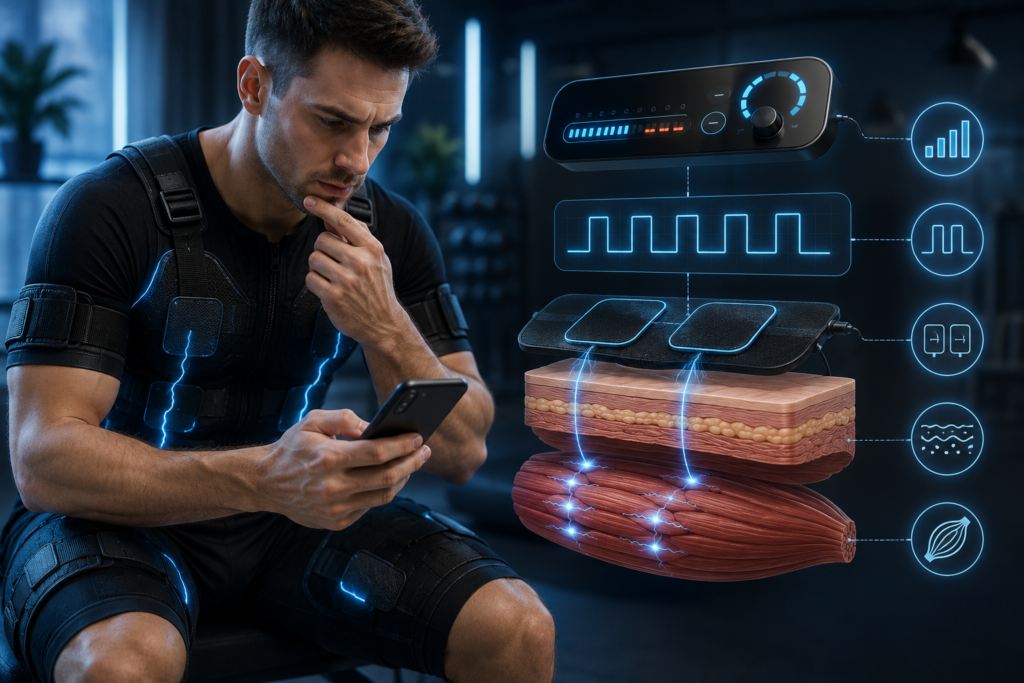
Amplitude is the magnitude of a current or voltage pulse relative to baseline. A constant-current stimulator may report output in milliamperes (mA), while a constant-voltage design is characterized in volts. The physical current that reaches tissue also depends on impedance at the electrode-skin interface.
Amplitude is not pulse width. Pulse width is how long an individual pulse lasts. Frequency is how often pulses arrive. These parameters interact to shape the delivered stimulus.
EMS Amplitude vs Intensity: What does “intensity” mean on an EMS suit?
On a consumer controller, intensity may be a level, percentage, bar, or number chosen by the user. It often adjusts amplitude behind the interface, but the display is not necessarily a direct measurement in milliamperes.
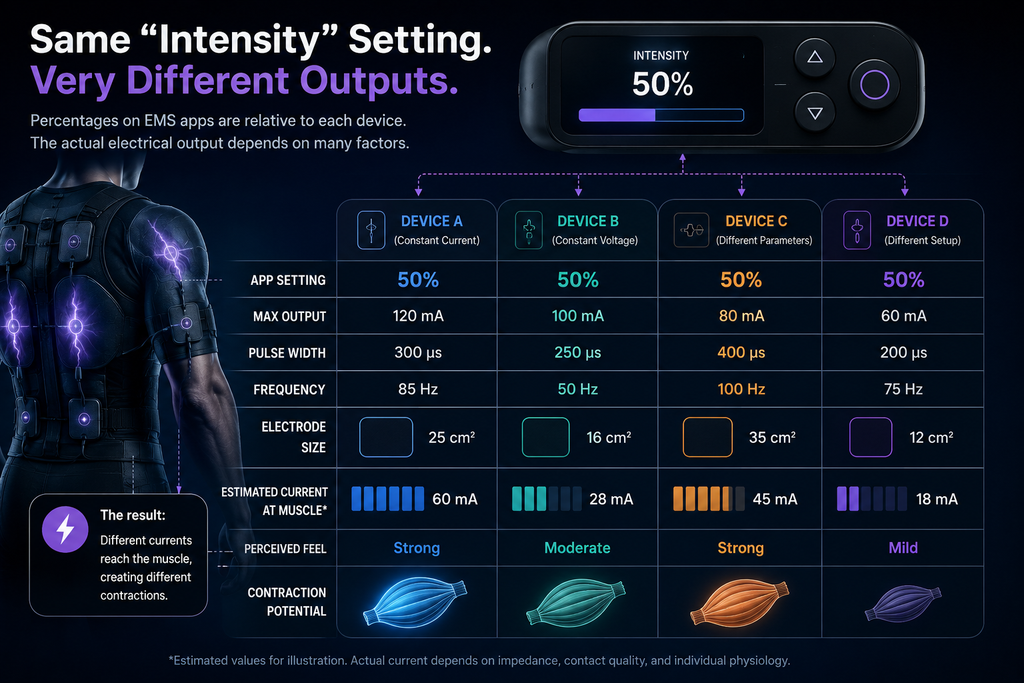
A percentage can mean “this position within the device’s allowed range.” It does not mean a standardized percentage of muscle activation, effort, motor units, or another brand’s output.
Some systems allow each muscle zone to have its own displayed intensity. That improves individual adjustment, but it still does not turn the values into comparable physiological doses.
Why 50% on one device is not 50% on another
Two EMS systems may differ in:
- Maximum current or voltage.
- Pulse duration and frequency.
- Waveform and charge balance.
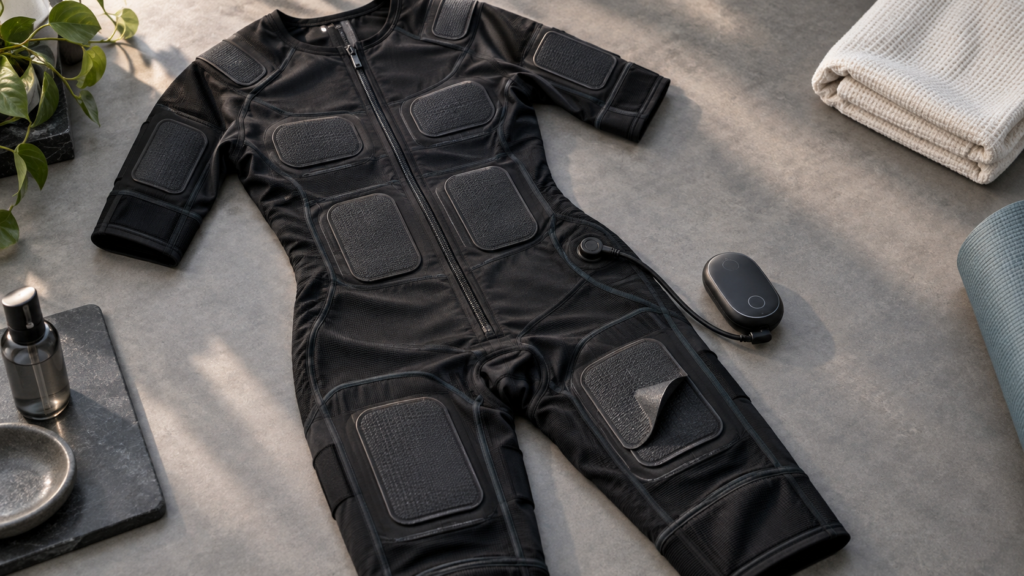
- Electrode size and conductive area.
- Number and placement of electrodes.
- Constant-current or constant-voltage design.
- Software scaling between displayed levels.
- Automatic limits built into each program.
Without those details, comparing percentages is like comparing two volume knobs without knowing the speakers, amplifiers, or scale behind them.
The U.S. Food and Drug Administration’s guidance for powered muscle stimulators asks manufacturers to characterize multiple output parameters, including waveform, maximum output current, pulse width, frequency, and power density. The guidance does not reduce device output to a single consumer percentage.
Sensation is not a laboratory measurement
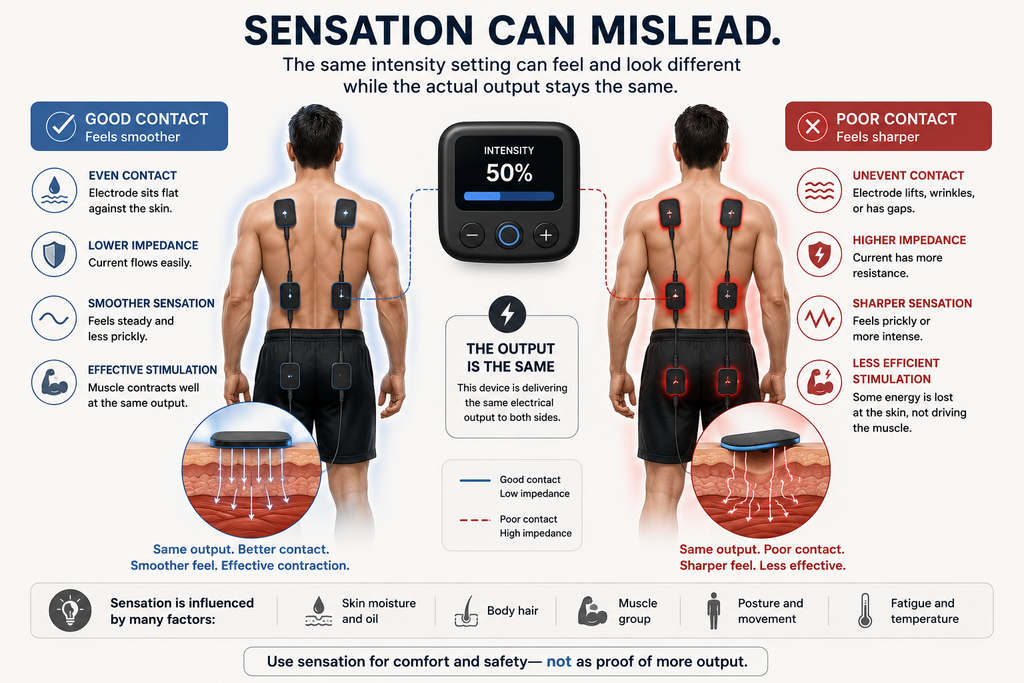
Users often judge intensity by feel. Sensation is useful for comfort and safety, but it changes with electrode contact, skin condition, posture, fatigue, and the muscle zone being stimulated.
The abdomen may feel different from the glutes at the same displayed level. A dry or wrinkled electrode can feel sharper even when the controller has not changed. As a result, “this feels stronger” does not prove that the device is delivering more total current or producing more force.
Visible contraction is not the only goal
Clinical NMES protocols sometimes adjust amplitude to produce a visible contraction or the highest tolerable contraction appropriate to a defined treatment. Whole-body EMS fitness sessions have different total exposure and should not borrow those instructions without context.
More discomfort is not evidence of a more productive workout. A useful setting permits controlled movement and a clear contraction without sharp pain, loss of technique, or an urge to brace unpredictably.
For a practical progression approach, use the existing EMS suit intensity guide and the instructions for the specific device.
Constant-current and constant-voltage systems
A constant-current device is designed to maintain current as impedance changes, within its technical limits. A constant-voltage device maintains voltage; current can change when impedance changes. Neither label, by itself, proves that one product is better.
The difference matters when interpreting specifications. A current value, voltage value, and user-facing percentage are not interchangeable. Our dedicated guide to constant current vs constant voltage EMS examines this engineering distinction in more detail.
A better way to document EMS intensity
For home users, a useful log can include:
- Device and program name.
- Displayed level for each zone.
- Exercise or body position.
- Perceived effort using a consistent scale.
- Whether contact felt even.
- Any pain or unusual response.
- Recovery before the next session.
Professionals should follow the documentation requirements for their system and role. If the device reports physical output, record the unit rather than only writing “high intensity.”
Frequently asked questions
Are amplitude and intensity the same?
They may refer to the same adjustment in casual use, but amplitude is a specific electrical magnitude. Intensity can mean a display setting, perceived sensation, or overall training demand.
Does a higher percentage recruit more muscle?
Raising the control can increase the stimulus, but the exact physiological response is not encoded in the percentage. Electrode contact, pulse parameters, anatomy, and voluntary effort also matter.
Should every muscle zone use the same number?
Not necessarily. Sensitivity, electrode fit, and muscle size differ by zone. Follow the system’s instructions and adjust conservatively rather than forcing numerical symmetry.
Can I compare two suits by their maximum intensity level?
No. A maximum level or percentage is meaningless without the underlying electrical specifications, electrode system, program, and measurement conditions.
The practical takeaway
Amplitude is a physical property of the electrical pulse. Intensity is often the interface users adjust or the sensation they report. Treat an app percentage as device-specific, not as a standardized dose.
Progress by response and movement quality, not by competing with another user’s number. When comparing equipment or research, look at the complete parameter set and how it was measured.