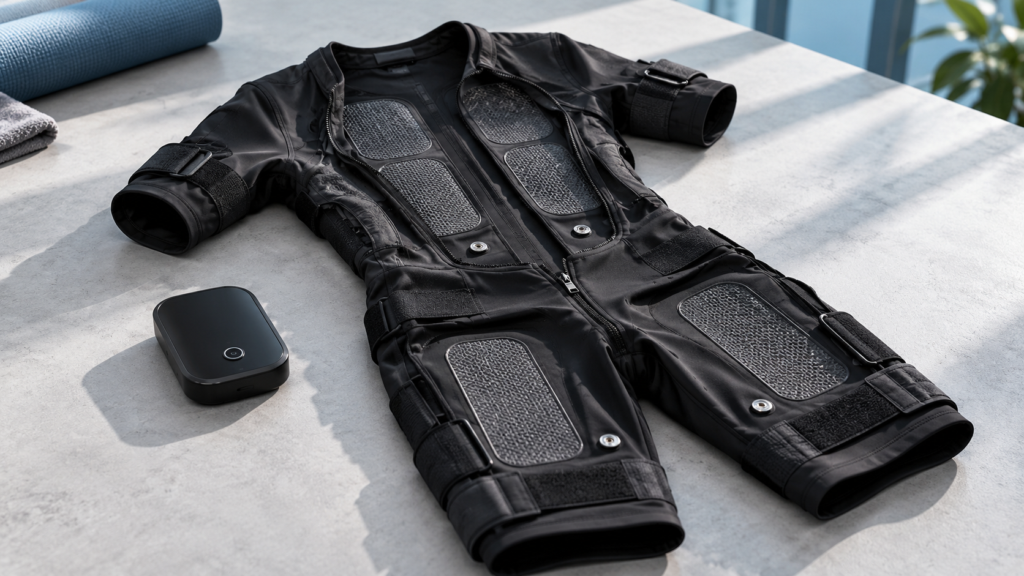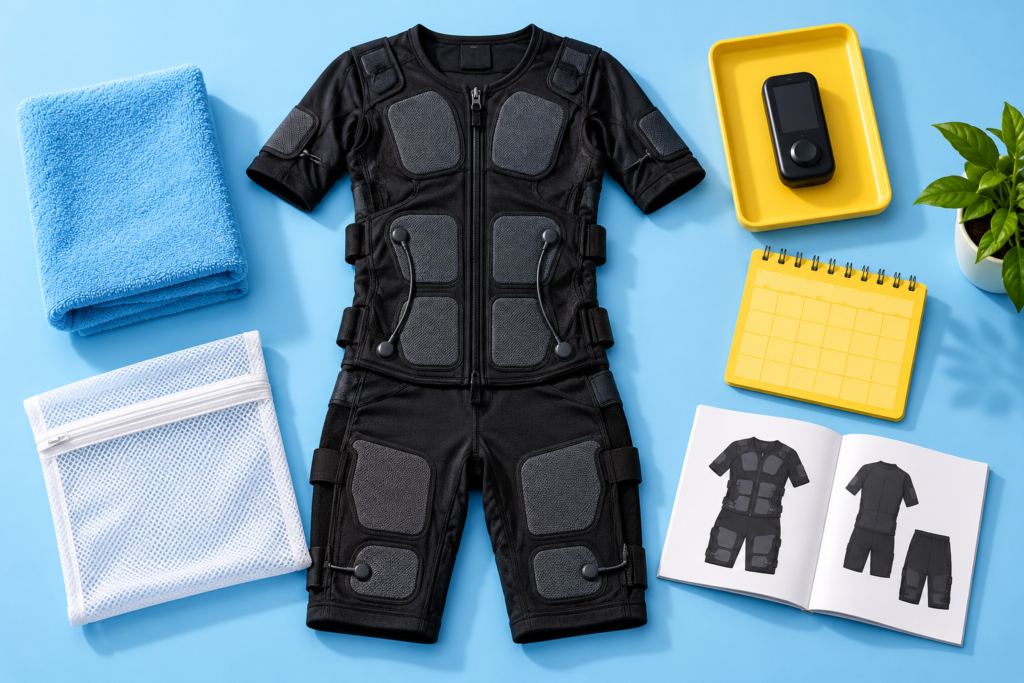
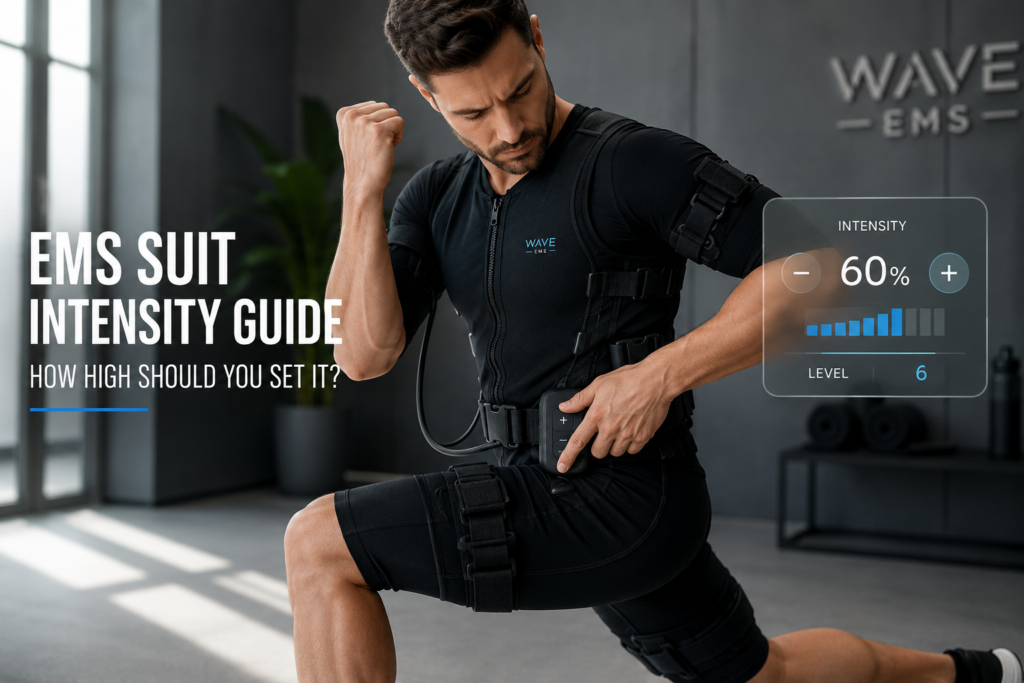
One of the first questions people have when using an EMS suit is simple: how high should you turn it up?
There isn’t one number that works for everyone. The right EMS suit intensity depends on your experience, individual sensitivity, the muscle group being stimulated, and how your body responds during the session.
That means blindly aiming for 50%, 80%, or 100% on an app isn’t particularly useful. Different EMS systems use different hardware and controls, and people can experience electrical stimulation differently.
Instead, research on whole-body electrical muscle stimulation recommends judging intensity by how strong the stimulation actually feels to you.
For beginners, that usually means starting at a moderate level, learning how each muscle group responds, and increasing gradually rather than trying to tolerate the strongest setting possible.
What Does EMS Suit Intensity Actually Mean?
When you increase EMS suit intensity, you’re increasing the strength of the electrical stimulation reaching the targeted muscles.
That electrical impulse causes muscle fibers to contract. As the stimulation becomes stronger, the contraction generally becomes more noticeable and demanding.
Intensity is only one part of an EMS program. EMS systems can also differ in parameters such as pulse frequency, pulse width, duty cycle, and electrode configuration. Those differences are one reason a numerical setting on one EMS device cannot automatically be compared with the same number on another.
A 2023 systematic review published in the Journal of Strength and Conditioning Research found considerable variation between the EMS protocols used in existing research. The researchers concluded that an optimal universal threshold for EMS intensity, treatment duration, pulse characteristics, and frequency could not be established from the available evidence.
In other words, there is no scientifically established rule saying everyone should train at a particular percentage on their EMS app.
How High Should You Set Your EMS Suit?
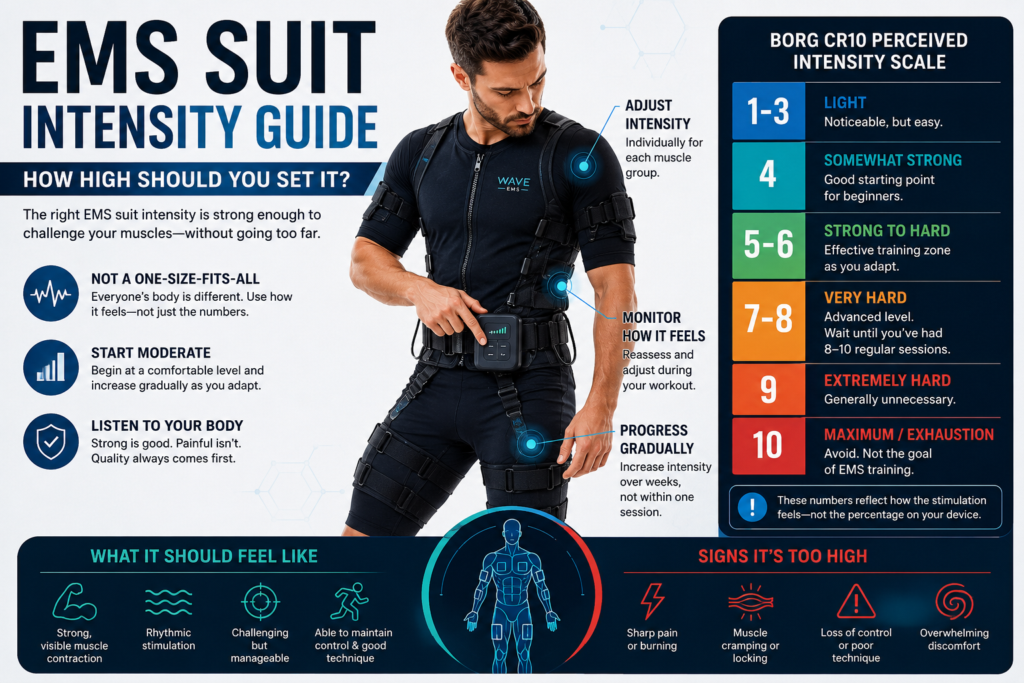
One of the most useful ways to judge EMS suit intensity is by perceived exertion rather than the number displayed on the device.
The updated international guidelines for safe and effective whole-body EMS recommend using the Borg CR10 Rating of Perceived Exertion scale to prescribe and monitor stimulation intensity.
The scale runs from very little effort through extremely demanding stimulation.
A practical way to think about it is:
1–3: Light
The electrical stimulation is clearly noticeable, but the contraction isn’t particularly demanding.
This may be useful while initially becoming familiar with the sensation, but it may not provide the level of stimulus normally targeted during a full training session.
4: Somewhat Strong
This is an important number for beginners.
The international WB-EMS recommendations suggest an initial moderate stimulation intensity of approximately 4 out of 10, described as “somewhat strong,” during the introductory period.
You should definitely feel the muscles contracting, but the stimulation shouldn’t feel overwhelming.
5–6: Strong to Hard
Once you’re accustomed to EMS, the stimulation can progressively become more challenging.
At this level, contractions should feel substantial while still allowing you to maintain control of your movements and complete the session comfortably.
7–8: Very Hard
These are advanced perceived intensities.
According to the international guideline on WB-EMS intensity progression, very-hard stimulation around 7–8 out of 10 should not be introduced until after at least 8–10 regular EMS sessions.
Even then, reaching this level should happen gradually.
9–10: Extremely Hard to Maximum
More isn’t always better.
The same WB-EMS safety guideline states that training to complete exhaustion, represented by 10 out of 10, should be strictly avoided regardless of someone’s training experience.
Importantly, these numbers describe how intense the stimulation feels, not the percentage displayed by your suit.
EMS Suit Intensity for Beginners
The biggest mistake a beginner can make is treating the first session as a test of how much stimulation they can tolerate.
Your first few sessions should be about adaptation.
A beginner’s EMS suit intensity should feel noticeable and moderately strong without becoming painful or difficult to control. Starting around a perceived 4 out of 10 gives you time to understand how electrical stimulation feels across different areas of your body.
The 2023 international WB-EMS position statement recommends gradually increasing stimulation over the following 7–9 weeks rather than jumping immediately to very-high intensities.
This progression matters because EMS can stimulate large amounts of muscle tissue simultaneously. You don’t need to chase extreme stimulation or severe soreness to have a productive workout.
Think of your first sessions as establishing a baseline.
Learn what a comfortable contraction feels like. Pay attention to how you recover. Then make small increases as your body adapts.
Why Different Muscles May Need Different Settings
You may quickly notice that one setting doesn’t feel the same everywhere.
Your glutes might tolerate strong stimulation while your abdomen or arms feel intense at a substantially lower setting.
That’s normal.
Individual sensitivity can differ between people and between electrode locations. The international recommendations for monitoring WB-EMS intensity call for impulse intensity to be monitored individually for different electrode regions during training.
Researchers use a similar approach. For example, a 2025 randomized controlled trial protocol published in JMIR Research Protocols describes individually adjusting pulse intensity for separate regions including the thighs, glutes, abdomen, chest, lower back, upper back, and arms.
That’s why adjustable muscle zones or channels can be useful on a whole-body suit.
Instead of forcing every muscle to tolerate the same EMS suit intensity, each region can be brought to an appropriate level independently.
What Should the Right EMS Intensity Feel Like?
Good EMS training should be challenging, but it shouldn’t feel like you’re being punished by the suit.
At an appropriate EMS suit intensity, you should generally experience:
- A clear and strong muscle contraction
- Rhythmic pressure or tightening during the impulse
- Noticeable stimulation throughout the targeted muscle
- Increasing muscular effort as the workout progresses
- Enough control to maintain proper exercise technique
What you shouldn’t be trying to create is sharp or severe pain.
Reduce the stimulation if you’re experiencing sensations such as sharp pain, burning, an uncontrollable cramp, or contractions strong enough that you cannot perform the intended movement safely.
A useful rule is simple:
Strong is the goal. Painful isn’t.
Increasing the electrical output until you can barely tolerate it doesn’t prove that the workout is more effective.
Is Higher EMS Suit Intensity Better?
Generally, training needs to provide enough stimulus to challenge the muscles if you want them to adapt.
A systematic review examining EMS and muscle strength in healthy adults found significant strength improvements across all ten included studies. However, the researchers also found substantial differences in EMS protocols and could not determine one optimal intensity threshold.
An earlier systematic review of electrical stimulation training parameters also examined the relationship between stimulation parameters and strength development, illustrating why intensity needs to be considered alongside the rest of the EMS protocol.
But there’s an important distinction between progressively challenging and maximally tolerable.
Turning your suit higher simply because you can tolerate it isn’t necessarily better.
It’s similar to conventional resistance training. Gradually adding resistance as you get stronger makes sense. Attempting your absolute maximum every time you enter the gym doesn’t.
The objective is to create an effective stimulus that you can recover from, not to reach the highest number displayed by the device.
How to Increase EMS Intensity Safely
Your EMS suit intensity should progress as you become accustomed to training.
Here’s a practical way to approach that progression.
Your First Sessions
Focus on learning the sensation.
Start moderately and adjust each muscle group until the contractions are clearly noticeable but manageable.
Don’t worry about what percentage another person uses.
Early Training Period
Once you’ve completed several sessions and are recovering normally, gradually increase individual muscle groups when the previous stimulation becomes easier to tolerate.
Make small changes rather than sudden jumps.
After Several Weeks
Continue progressing based on your response to training.
The international progression recommendations for WB-EMS advise gradually increasing stimulation during an initial 7–9 week conditioning period and delaying very-hard stimulation of approximately 7–8 on the CR10 scale until at least 8–10 regular sessions have been completed.
This doesn’t mean session number nine automatically gives you permission to crank every muscle to an 8.
It’s a minimum adaptation period, not a target you need to hit.
Should You Change Intensity During the Workout?
Possibly.
An EMS suit intensity that feels strong during the first few minutes may feel less demanding later in the session as you become accustomed to the sensation.
That’s one reason researchers don’t necessarily choose a setting at the beginning and leave it untouched.
In a recent WB-EMS clinical research protocol, stimulation was individualized for each body region and slightly increased every three minutes in cooperation with the participant to maintain the target perceived intensity.
The international WB-EMS guidelines similarly recommend checking perceived stimulation repeatedly throughout a session.
For a home user, the takeaway isn’t that you need to increase the suit every three minutes.
It’s that the setting doesn’t necessarily need to remain fixed.
If stimulation becomes noticeably easier, a small adjustment may make sense. If your technique starts breaking down or the contractions become uncomfortable, reducing it may make more sense.
Signs Your EMS Intensity May Be Too High
Your body gives you useful feedback.
An excessively high EMS suit intensity may cause:
- Sharp or painful stimulation
- Uncomfortable muscle locking or cramping
- Difficulty maintaining proper exercise technique
- Loss of normal movement control
- Stimulation that becomes intolerable rather than simply challenging
- A feeling that you have to endure each impulse rather than work with it
How you feel after the workout matters too.
Some muscle soreness after unfamiliar exercise can be normal. Severe or unusual symptoms are different and shouldn’t simply be dismissed as evidence of a great workout.
One serious concern associated with excessive WB-EMS exposure is rhabdomyolysis. The international WB-EMS safety recommendations specifically discuss the risk of severe muscle damage following inappropriate initial application and emphasize careful conditioning for new users.
If you develop severe muscle pain or swelling, marked weakness, or dark-colored urine after intense exercise or EMS, stop training and seek medical evaluation.
The safest mindset is not to ask, “How much stimulation can I survive?”
Ask, “How much stimulation gives me a strong, controlled training session?”
Six Common EMS Intensity Mistakes
1. Starting Too High
Your first EMS workout isn’t an intensity competition.
Give your muscles time to become accustomed to the stimulus.
2. Treating a Device Percentage as a Scientific Target
There is no universally established EMS percentage everyone should reach.
Judge the actual stimulation and muscle contraction instead.
3. Using Identical Settings for Every Muscle
Your thighs, glutes, abdomen, back, chest, and arms may all have different tolerances.
Adjust them independently when your EMS system allows it.
4. Assuming Pain Means Better Results
Hard training and painful stimulation are not the same thing.
A productive contraction can feel very strong without being painful.
5. Increasing Every Workout Automatically
Progression should depend on adaptation and recovery, not simply the number of workouts you’ve completed.
6. Trying to Reach 100%
The highest device setting is not a fitness goal.
Your goal is enough stimulation to challenge the muscles while maintaining control, tolerability, and appropriate recovery.
A Simple EMS Intensity Checklist
Before increasing your EMS suit intensity, ask yourself:
- Does the current stimulation feel controlled?
- Can I maintain proper movement and exercise technique?
- Is the muscle contracting strongly without sharp pain?
- Did I recover normally after my previous session?
- Am I making a small progression instead of a huge jump?
- Does this particular muscle group actually need more stimulation?
- Am I increasing the setting because it has become too easy, rather than simply trying to reach a bigger number?
If the answers are yes, a small increase may be appropriate.
If something already feels extremely demanding or uncomfortable, increasing it further isn’t necessary.
The Bottom Line
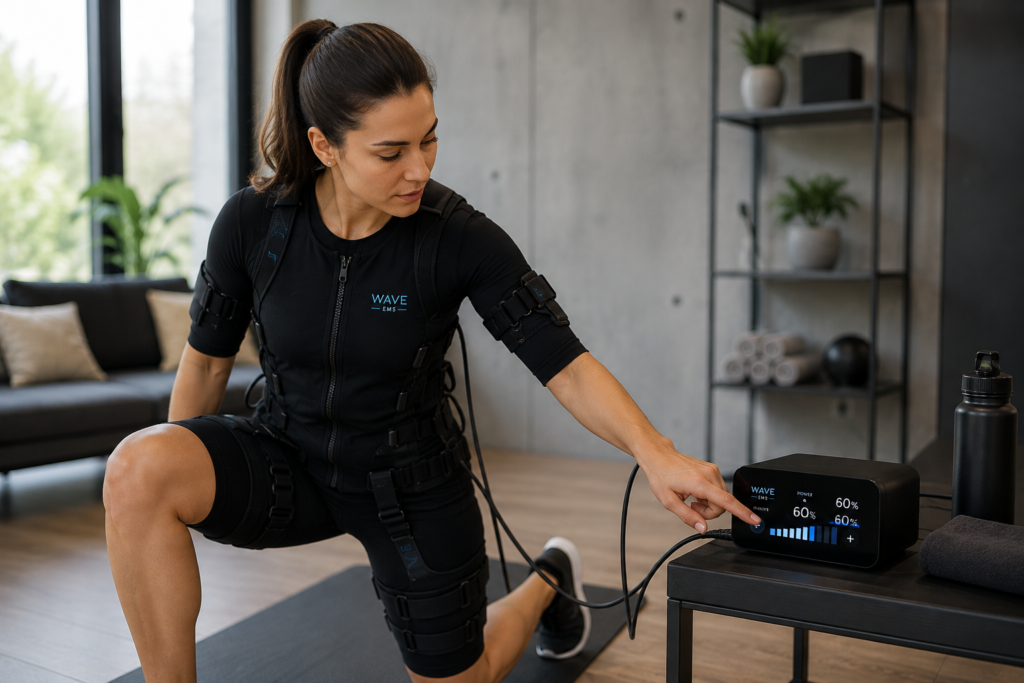
There isn’t a universal EMS percentage that everyone should use.
The best EMS suit intensity is strong enough to create a meaningful muscle contraction while remaining controlled and tolerable.
For new users, the international guideline for safe and effective WB-EMS training recommends beginning around a moderate 4 out of 10 on the Borg CR10 perceived-exertion scale. Intensity can then be increased gradually as the body adapts. Very-hard stimulation around 7–8 out of 10 should generally wait until at least 8–10 regular sessions, while complete exhaustion should be avoided regardless of experience.
Don’t chase percentages, maximum settings, or pain.
Start lower, learn how each muscle responds, progress gradually, and aim for strong contractions you can control.
Frequently Asked Questions
What EMS intensity should a beginner use?
Beginners should start with moderate stimulation rather than trying to reach a particular device percentage. The international WB-EMS guideline recommends approximately 4 out of 10, or “somewhat strong,” on the Borg CR10 perceived-exertion scale during the initial conditioning period.
Should an EMS suit hurt at high intensity?
No. Strong contractions and substantial muscular effort can be expected, but sharp or severe pain isn’t a training target. Reduce the stimulation if it becomes painful or prevents you from controlling your movement.
Is 100% EMS intensity safe?
There is no reason to treat 100% on an EMS device as a training goal. Device scales differ, and the international WB-EMS safety recommendations specifically advise against training to complete exhaustion.
How do I know if my EMS intensity is high enough?
Look at how the stimulation feels and how strongly the muscle contracts rather than relying solely on the displayed percentage. It should be clearly challenging while remaining tolerable and allowing you to maintain control of your movements.
Should every muscle group have the same EMS setting?
Not necessarily. Sensitivity can differ substantially between muscle regions. Published WB-EMS research protocols commonly individualize stimulation for separate body regions rather than applying one identical intensity everywhere.
Does higher EMS intensity build more muscle?
EMS needs to provide a sufficient training stimulus, but a systematic review of EMS intensity and strength gains found that the available research does not establish one universal intensity threshold that produces the best results for everyone. Higher isn’t automatically better, particularly when increases compromise comfort, movement quality, or recovery.
When should I increase my EMS intensity?
Increase it gradually once the existing stimulation feels controlled, your technique remains good, and you’re recovering normally between sessions. The WB-EMS intensity progression guidelines recommend a progressive conditioning period before very-high perceived intensities are introduced.
Ready for your EMS suit? Check out our brand/product reviews or use our product comparison tool to help decide which suit works best for you.