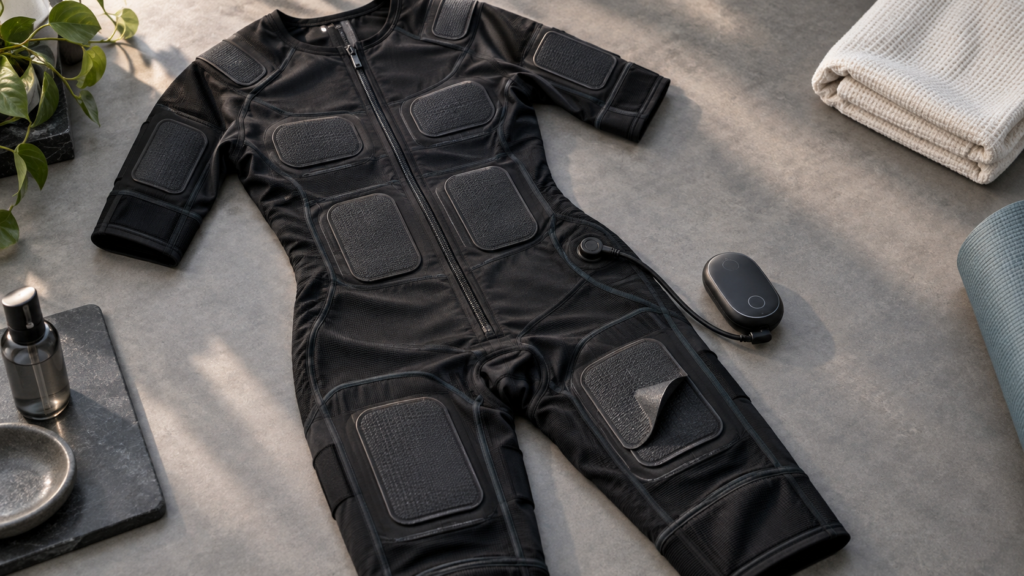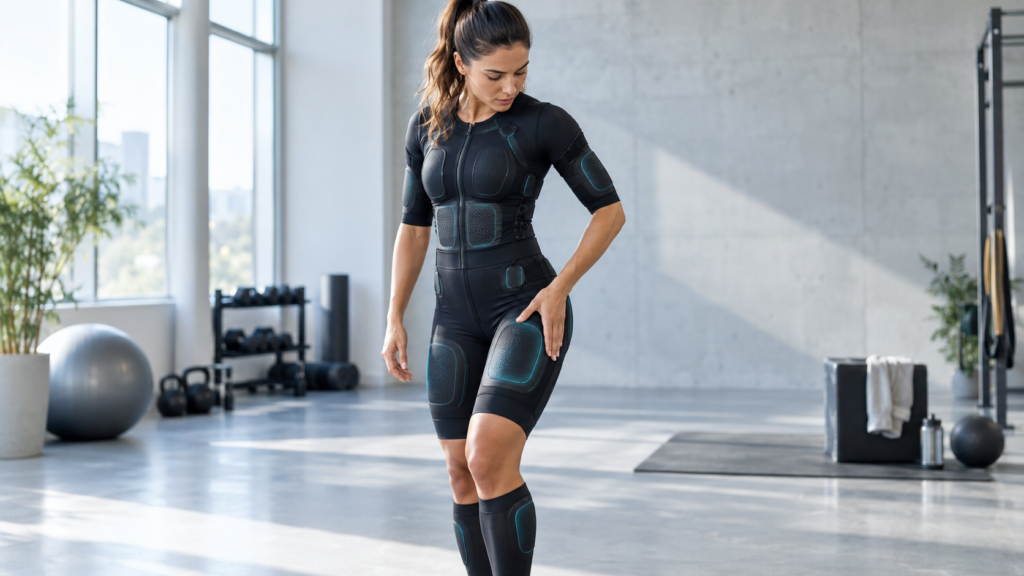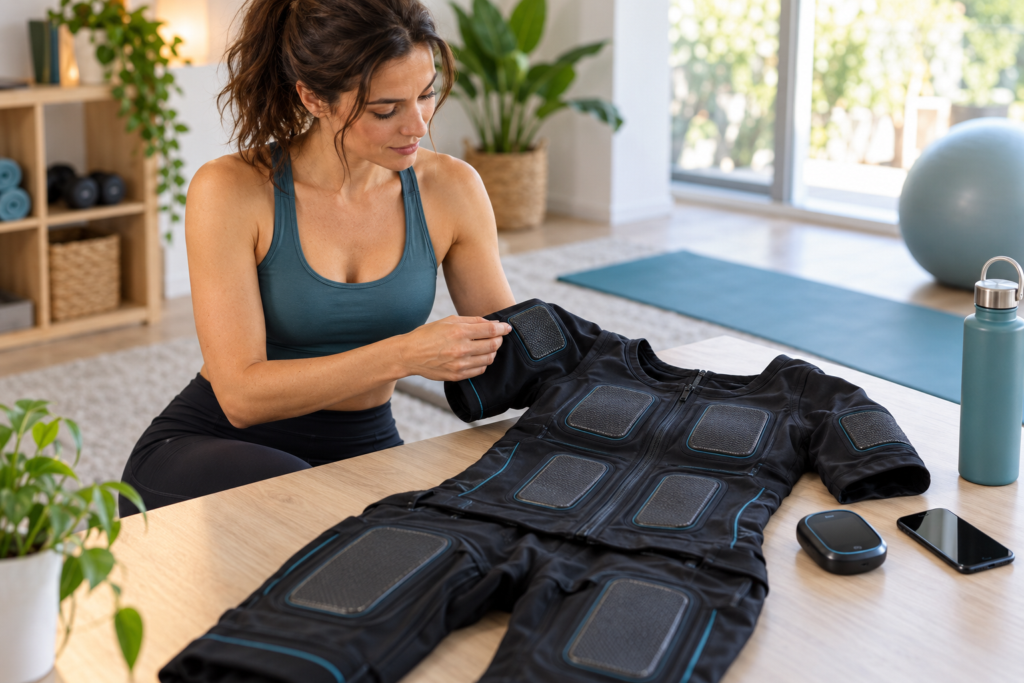
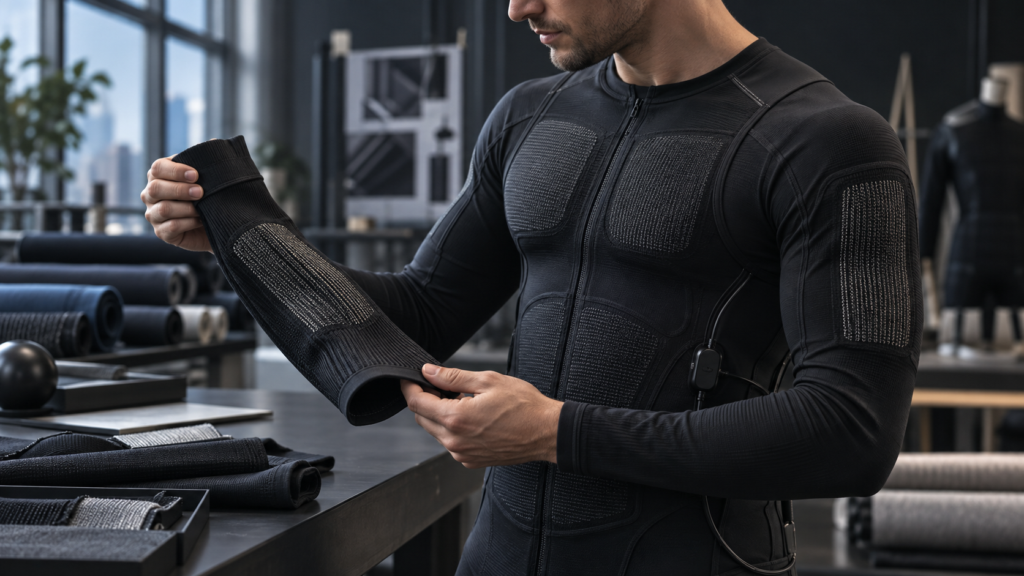
An EMS suit replaces loose adhesive pads with electrodes integrated into a garment. The conductive area may be knitted, woven, embroidered, printed, coated, or assembled from several textile layers. Its job is to carry the device’s electrical pulses to a broad, repeatable area of skin while bending and stretching with the user.
Textile electrodes make wearable stimulation practical, but they introduce engineering challenges. Compression, moisture, skin contact, repeated stretching, detergent, and washing can all change electrical behavior over time.
What makes a fabric conductive?
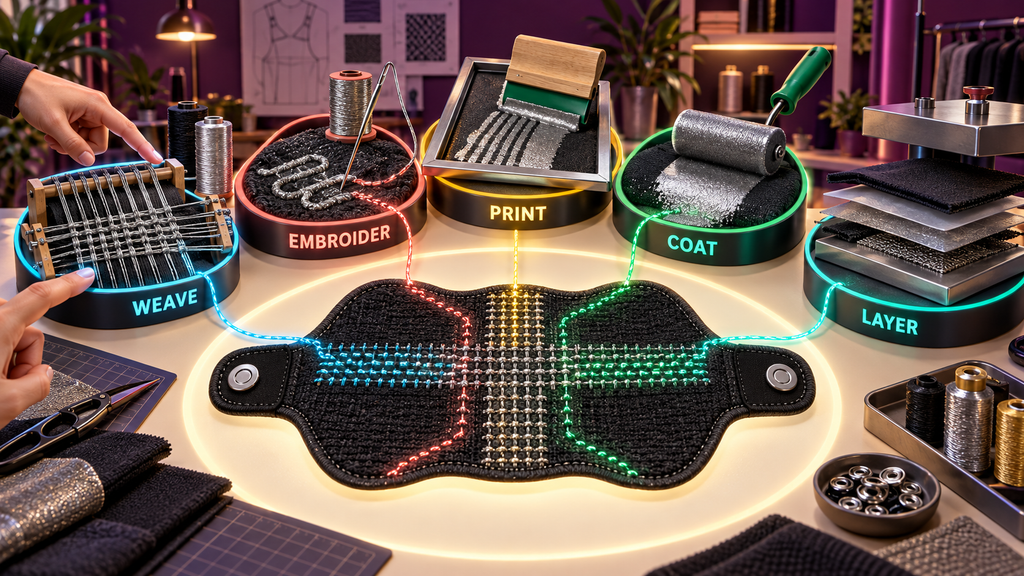
Ordinary polyester or nylon is not sufficiently conductive for an EMS electrode. Manufacturers add conductive materials through methods such as:
- Knitting or weaving metal-coated yarn into fabric.
- Embroidering conductive thread.
- Printing conductive inks or polymers.
- Coating a textile substrate with a conductive layer.
- Laminating conductive fabric into the garment.
Silver-coated polyamide yarn is common in wearable electrodes because silver conducts electricity and can be integrated into flexible textiles. Other research materials include stainless-steel fibers, carbon-based compounds, conductive polymers such as PEDOT:PSS, and composites designed to improve stretch or wash durability.
The material name alone does not establish performance. Yarn structure, coating thickness, electrode geometry, connections, garment pressure, and the stimulation waveform all matter.
Stimulation electrodes vs sensing electrodes
Some smart garments use textile electrodes to record electrical signals such as ECG or EMG. EMS garments use electrodes to deliver current. These are related but different tasks.
A sensing electrode is optimized to capture small biological signals with low noise. A stimulation electrode must deliver controlled current comfortably and withstand the relevant electrical load. Evidence from monitoring textiles can inform materials and contact behavior, but it should not automatically be treated as proof that a fabric is suitable for muscle stimulation.
Wet textile electrodes
Many EMS garments require water on the electrode or a damp base layer. Moisture improves the electrical interface between fabric and skin, lowers contact impedance, and helps current distribute across the intended area.
A study comparing dry textile, wet textile, and hydrogel stimulation electrodes found that the wet textile electrode produced similar motor-threshold and comfort performance to the hydrogel electrode in the tested healthy participants. The dry textile electrode had a lower pain threshold and produced more cutaneous discomfort in that experiment.
That result helps explain why some suits require careful wetting. It does not prove that every wet system is comfortable or every dry system is inferior; materials, compression, waveform, and design differ.

Dry textile electrodes
Dry electrodes are designed to work without deliberately adding water. They may rely on garment compression, surface structure, conductive material, natural skin moisture, or a proprietary interface.
Dry systems can simplify setup, but fit is crucial. If a textile panel bridges over a body contour or shifts during movement, effective contact area may fall. A dry garment may also feel different early in a session as the skin warms and perspiration changes the interface.
Use only the contact method specified by the manufacturer. Adding water, gel, or spray to a dry system can damage materials, alter output, or violate its instructions.
Why compression matters
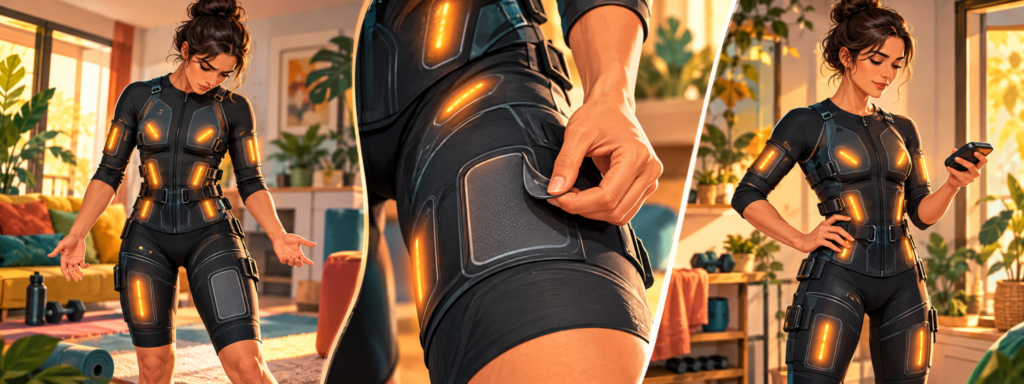
Unlike adhesive hydrogel pads, a fabric electrode depends on the garment to hold it against the body. Compression should be sufficient for full, stable contact without restricting breathing, circulation, or movement.
Wrinkles can create gaps and edges. An electrode that touches only part of the skin has a smaller effective area, increasing local current density. This can produce a sharp or uneven sensation.
The planned EMSSuits guide to EMS suit fit problems will cover alignment in detail. In the meantime, use the brand’s sizing and fastening instructions and stop if a zone feels patchy.
Stretch and movement
Conductive paths must continue working while the suit stretches. Repeated strain can change resistance, crack printed coatings, loosen embroidery, or fatigue the transition between soft fabric and a rigid connector.
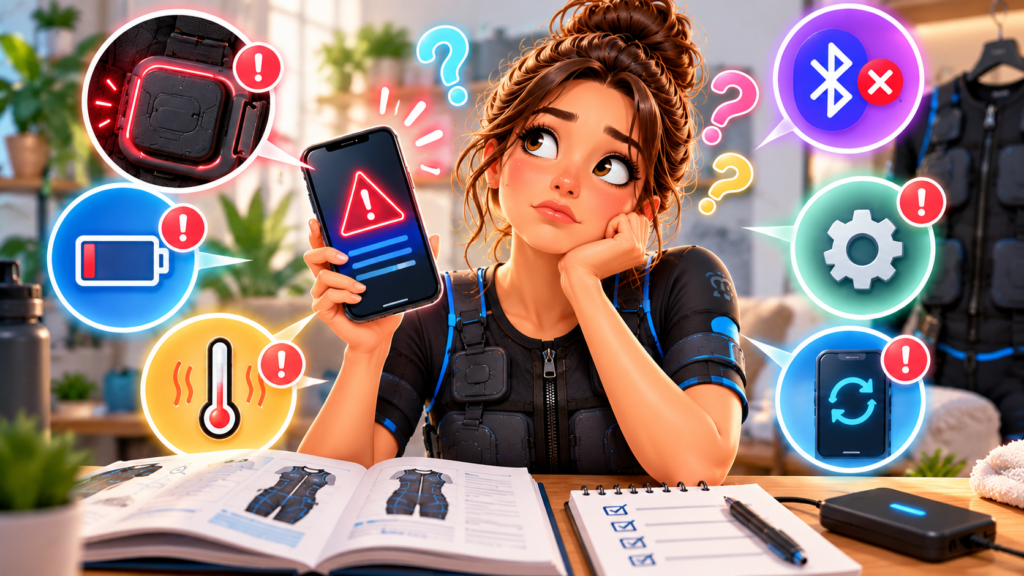
Wear may first appear intermittently: a zone works while standing but drops out during a squat or torso rotation. That pattern deserves inspection. Do not keep exercising while a connection repeatedly cuts in and out.
Washing and durability
Textile-electrode research identifies wash durability and repetitive mechanical stress as continuing design challenges. Water, heat, agitation, detergent chemistry, and bending can affect coatings, metal fibers, adhesives, and connectors.
Follow the suit label exactly:
- Remove controllers and batteries when instructed.
- Fasten closures that could snag the electrode fabric.
- Use only permitted detergent.
- Avoid bleach and fabric softener unless explicitly allowed.
- Select the stated temperature and cycle.
- Air-dry or machine-dry only as directed.
- Do not wring conductive panels.
The existing EMSSuits article on wireless EMS suit maintenance and care provides a broader maintenance overview.
How to inspect a textile electrode
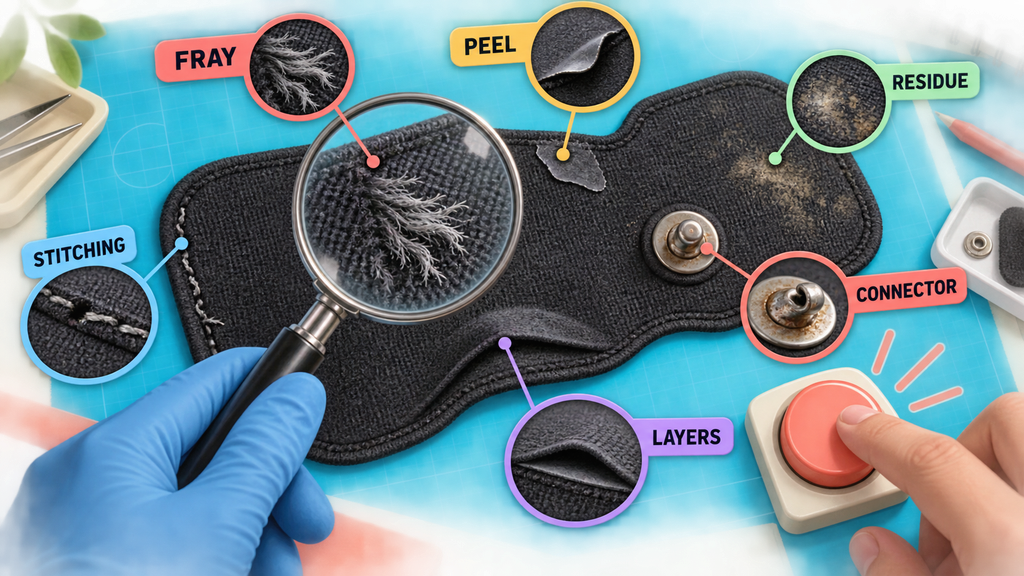
With the system powered off and disconnected, look for:
- Fraying, thinning, cracks, or peeling coatings.
- Discoloration or residue that remains after approved cleaning.
- Broken stitching around the conductive area.
- Corroded, bent, or loose snaps and connectors.
- Delamination between fabric layers.
- Zones that have become movement-dependent.
Do not test continuity or resistance through the body. If the manufacturer provides an automated contact check, use it as instructed. Otherwise, contact qualified service support.
Frequently asked questions
Are conductive fabric electrodes made of metal?
Many use metal-coated fibers, often silver-coated yarn, but conductive polymers, carbon materials, stainless steel, and composites also exist. Construction is product-specific.
Do textile electrodes need gel?
Some require water, some use a damp base layer, and others are designed for dry contact. Use only the interface specified for the suit.
Can conductive electrodes wear out?
Yes. Stretching, washing, abrasion, chemical exposure, and connector stress can change performance. Service life depends on design and care.
Can a damaged textile electrode be sewn or patched?
Do not make an improvised repair. Stitching or patch material can alter conductive area and current distribution. Use an authorized repair or replacement process.
The practical takeaway
Conductive textile electrodes turn an EMS system into wearable equipment, but their performance depends on more than fabric composition. Full skin contact, appropriate moisture, stable compression, stretch durability, and correct washing all matter.
Treat the electrode panels as electrical components, not ordinary sportswear. Follow the exact care label, stop when a zone becomes sharp or intermittent, and use manufacturer-approved repair or replacement options.
Sources
- Zhou H et al. Stimulating the Comfort of Textile Electrodes in Wearable Neuromuscular Electrical Stimulation. Sensors. 2015.
- Patel S et al. Comfort, consistency, and efficiency of garments with textile electrodes versus hydrogel electrodes. Randomized crossover trial. 2025.
- Singh JP et al. Recent Advances and Challenges in Textile Electrodes for Wearable Biopotential Signal Monitoring. Sensors. 2023.
- McAdams E et al. A review of e-textiles in neurological rehabilitation. Journal of NeuroEngineering and Rehabilitation. 2016.