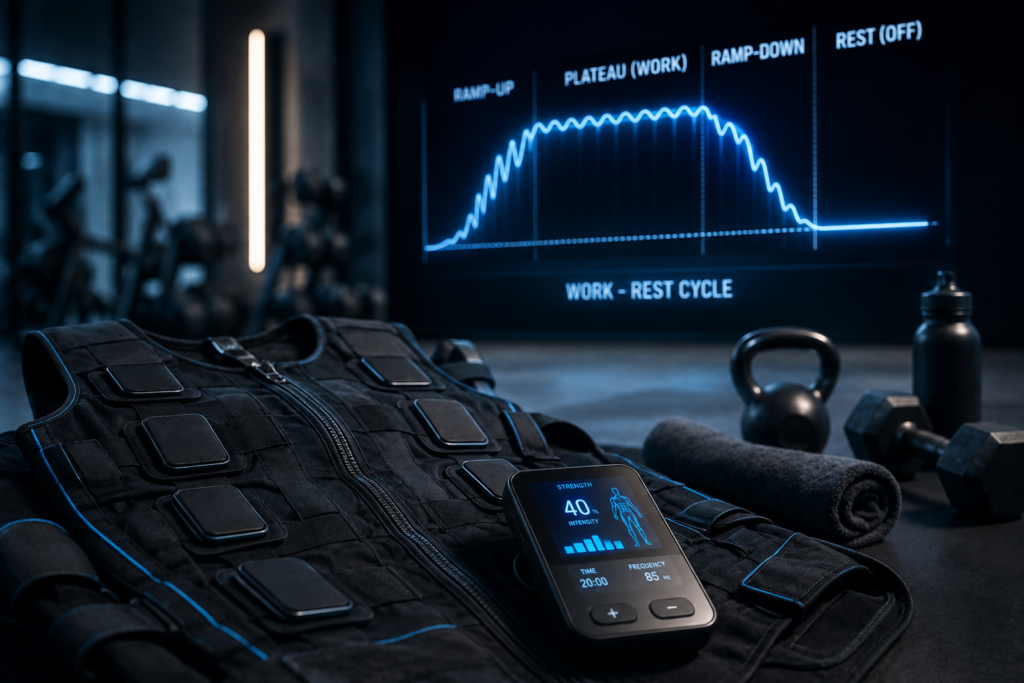
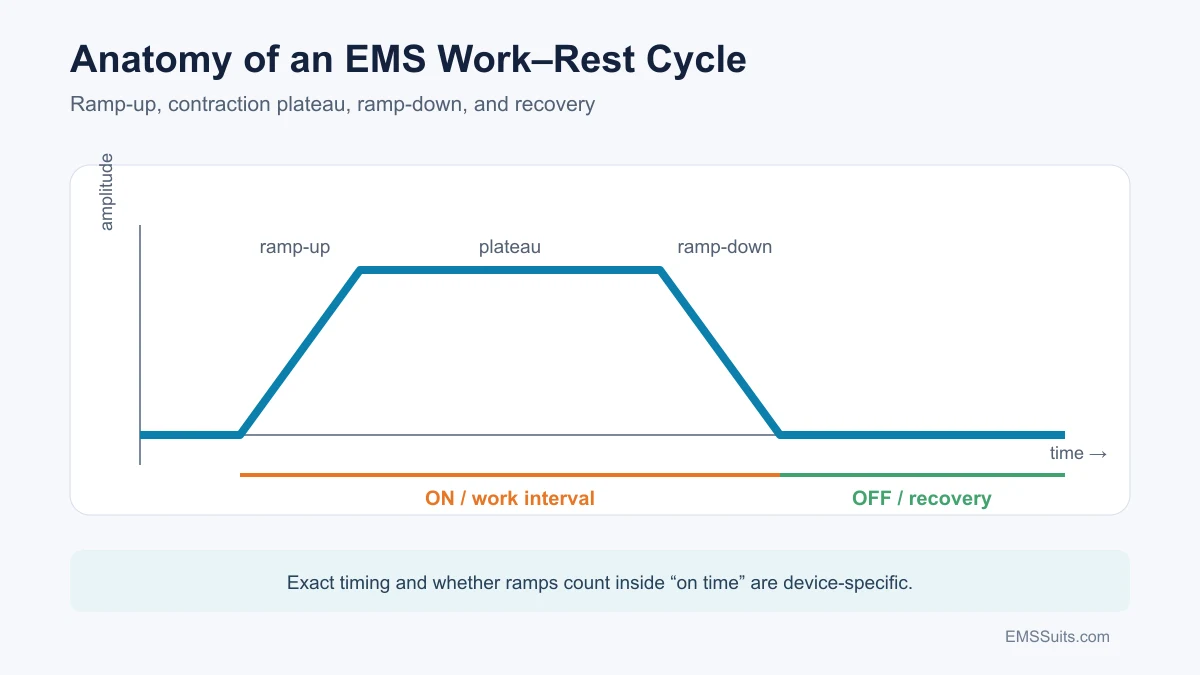
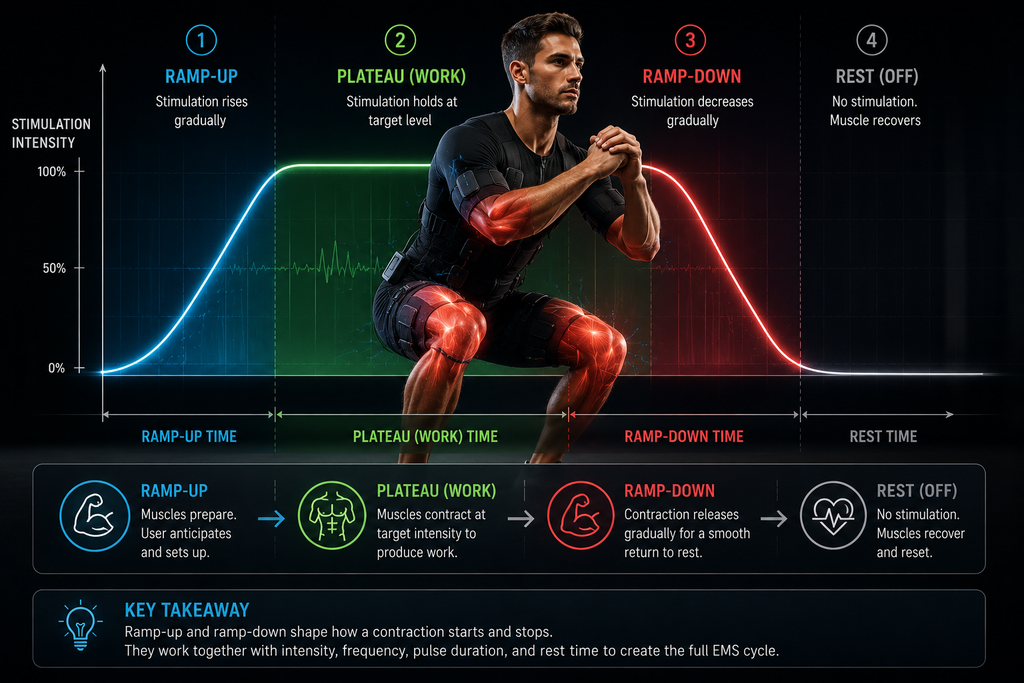
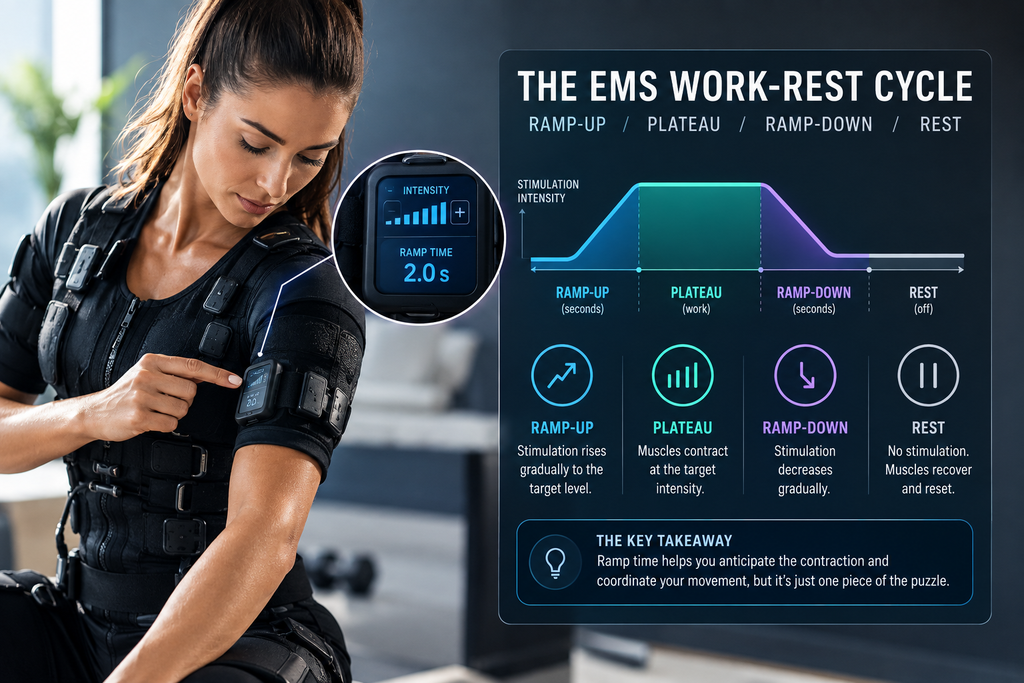
An EMS contraction does not always begin at full force. Many programs raise the stimulation gradually, hold it for a work period, and then reduce it gradually. Those transitions are called ramp-up and ramp-down time.
Ramp time helps the user anticipate a contraction and coordinate a movement, but it is only one parameter. It must be read alongside amplitude, frequency, pulse duration, on/off timing, and the equipment instructions.
What is ramp-up time?
Ramp-up time is the interval during which stimulation rises from its starting level toward the programmed amplitude. A longer ramp produces a more gradual increase. A very short ramp makes the contraction arrive more abruptly.
The ramp does not necessarily change the maximum level reached. Two programs can arrive at the same target amplitude but take different amounts of time to get there.
What is ramp-down time?
Ramp-down time is the transition from the contraction level back toward zero or the resting level. It allows the contraction to release gradually instead of ending suddenly.
Ramp-up and ramp-down do not have to be the same length. Manuals and research reports should state them separately when that distinction matters.
Ramp time vs pulse rise time
These terms are easy to confuse. Program ramp time usually refers to a transition lasting a fraction of a second or several seconds across many pulses. Pulse rise time describes how quickly an individual electrical pulse reaches its peak and may be measured in microseconds.
A device manual might therefore list a very small electrical rise-time specification while a training protocol describes a two-second ramp into a contraction. They are not interchangeable.
Why ramp time matters for movement
A predictable ramp gives the user time to set posture, brace, and begin the intended movement before full stimulation arrives. In a squat, for example, a trainer might use the transition as a cue to establish foot pressure and trunk position.
An abrupt contraction can be harder to coordinate, particularly for a new user. A longer ramp, however, is not automatically superior. If it consumes much of a short on period, less time remains at the target level. The appropriate timing depends on the program’s purpose and how its manufacturer defines the work interval.
How ramp time appears in research
Clinical NMES studies use varied ramp settings. A National Institute for Health and Care Excellence evidence review describes one stroke-rehabilitation protocol with a two-second ramp up, ten seconds of symmetric biphasic stimulation, and a two-second ramp down. That is an example from a specific clinical context, not a whole-body EMS recommendation.
Broader NMES reviews list ramp-up and ramp-down among the parameters that should be reported because they affect how a contraction is delivered. Unfortunately, studies do not always report every setting, making protocols harder to compare or reproduce.
How ramp time interacts with duty cycle
Suppose a display shows ten seconds on and ten seconds off. Does the on period include the ramp? Some devices include both transitions within those ten seconds. Others may report a plateau separately.
Before comparing programs, determine:
- Whether ramp time is included in the on time.
- How long the stimulus remains at its target level.
- Whether there is stimulation during the nominal rest phase.
- Whether the next repetition begins automatically or requires a trigger.
Our guide to EMS duty cycle explains how the complete work-and-rest sequence is calculated.
Ramp time does not make excessive intensity safe
A gradual transition may feel more manageable, but it does not justify an amplitude that is painful or inappropriate. Once the ramp reaches its target, the user still experiences the programmed output.
Increase zone intensity conservatively and only while stimulation is active if the device instructions require that method. Stop if there is sharp pain, loss of movement control, dizziness, chest discomfort, or another unusual symptom. The existing EMS suit intensity guide provides a broader progression framework.
Synchronous and alternating channels
Multi-channel stimulators may activate channels together or alternate them. If channels alternate, their ramps can shape a reciprocal movement pattern. A clinical device might alternate stimulation of opposing muscle groups; a whole-body suit may synchronize multiple zones for a single contraction block.
Users should not infer channel behavior from the ramp display alone. Read the program description and confirm which zones are active before beginning a loaded movement.
Practical timing cues for a session
When using a preset whole-body program:
- Adopt the starting position before the ramp begins.
- Move smoothly rather than racing the stimulation.
- Avoid adding heavy external load while learning the timing.
- Return to a stable position during ramp-down.
- Use the off period to reset posture and breathing.
If the movement and stimulus repeatedly fall out of sync, pause and reduce complexity. A simple isometric position or controlled bodyweight pattern can be easier to coordinate than a fast sequence.
Frequently asked questions
Is a longer ramp more comfortable?
It can make the onset feel more gradual, but comfort also depends on amplitude, electrode contact, waveform, pulse duration, and the individual user.
Does ramp time count as work time?
Sometimes. Device and study reporting conventions vary, so check how the program defines its on interval.
Can I change the ramp on a home EMS suit?
Only if the manufacturer provides that control and instructions for using it. Many home systems keep ramp timing inside preset programs.
Why does a program feel sudden even with a ramp?
High amplitude, poor contact, a short ramp, or an unexpected body position can all contribute. Stop, inspect the fit and electrodes, and restart at a lower setting according to the manual.
The practical takeaway
EMS ramp time controls how gradually a contraction builds and releases. It can improve anticipation and movement timing, but it is not a safety override and cannot be interpreted separately from the rest of the program.
Use preset programs as designed, learn the timing with simple movements, and document both ramp and plateau duration when operating adjustable professional equipment.