EMS training has attracted enthusiastic supporters and vocal skeptics in equal measure, and somewhere between those two extremes lies the actual evidence. Like many fitness technologies that gain mainstream attention quickly, EMS training myths have accumulated on both sides, some overstating the benefits dramatically and others dismissing the technology as ineffective or dangerous without examining what the research actually shows.
Here are eight of the most persistent EMS training myths, examined honestly and head-on, with what the science says, what experienced professionals observe, and what a realistic read of the evidence actually supports.
Myth 1: EMS Suits Do the Work for You
This is arguably the most widespread of all EMS training myths, and one that certain marketing has unfortunately encouraged. The idea that you can stand still in an EMS suit and have the electricity build your muscles for you does not accurately represent how EMS training works or how its results are produced.
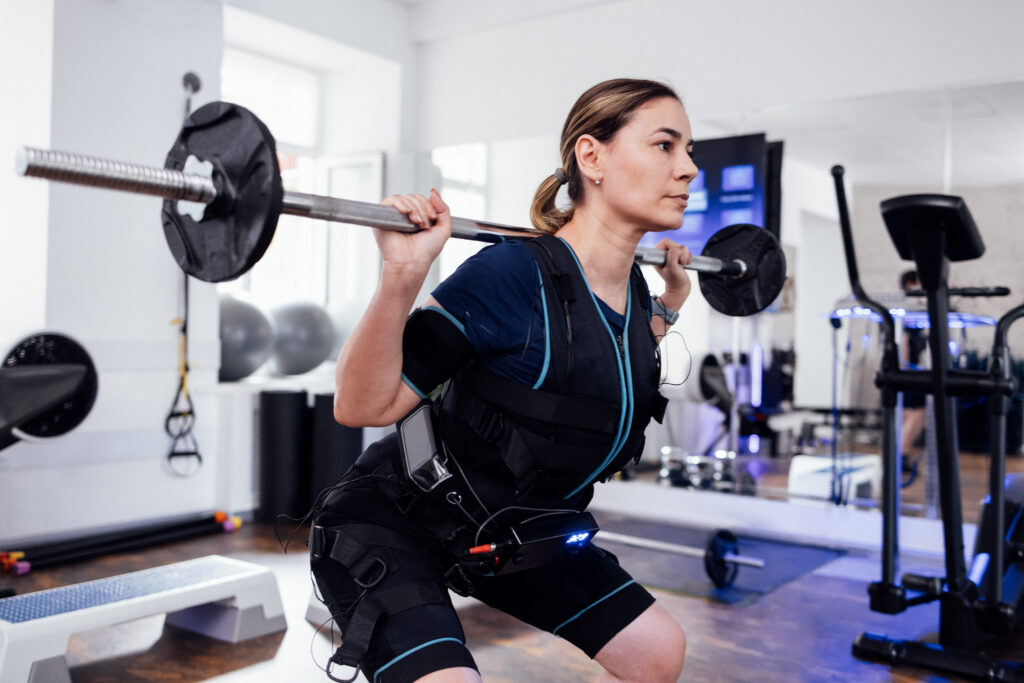
In both research and professional practice, EMS training is most effective when combined with active voluntary movement, including squats, lunges, rows, and core exercises. The electrical stimulation supplements and amplifies your own muscular effort. It does not replace it. Sessions where users actively engage in the prescribed movements produce significantly better outcomes than passive EMS use.
Fact: EMS training requires genuine physical effort. The electrical stimulation enhances the training effect of movement, not the other way around.

Myth 2: EMS Training Is Dangerous for Everyone
Some critics suggest EMS training is broadly dangerous or carries prohibitive health risks for all users. This is one of the EMS training myths that overstates the risk profile significantly. Kemmler et al. (2023) in Frontiers in Physiology are clear that EMS training, when properly administered by certified trainers following established protocols with appropriate health screening, is safe for healthy adults.
The documented adverse events, most notably exercise-induced rhabdomyolysis, are associated almost exclusively with sessions that were excessively intense, conducted without proper health screening, or performed on beginners without adequate progressive warm-up. These are failures of practice, not failures of the technology.
Fact: EMS training carries real contraindications for specific populations that should be taken seriously. For healthy adults without contraindications, properly supervised EMS training has a solid safety profile.
Myth 3: A 20-Minute EMS Session Equals a Four-Hour Gym Workout
This is one of the EMS training myths that studio marketing has made particularly prominent. Claims that 20 minutes of EMS training replaces four or more hours of conventional exercise are not supported by comparative research and represent a significant overstatement.
What the research does support is that EMS training produces meaningful muscle activation across a short session. But a 20-minute EMS session and a four-hour training program are not interchangeable. They involve different training volumes, loading patterns, energy system demands, and physiological stimuli.
Fact: EMS sessions are genuinely time-efficient and produce significant muscle activation in a short period. Specific equivalence claims comparing them to many hours of conventional training are marketing, not science.
Myth 4: EMS Training Melts Fat Without Diet or Exercise
One of the most financially motivated EMS training myths is the idea that EMS causes fat loss in isolation. No training modality does. Fat loss requires a sustained caloric deficit combined with lifestyle factors that support it over time. EMS training can contribute to energy expenditure and may support muscle development that modestly increases resting metabolic rate, but it cannot produce meaningful fat loss if diet and overall physical activity are not addressed.
Rodrigues-Santana et al. (2023) in Medicine found that body composition improvements in EMS research typically involved structured programs combined with nutritional guidance, not EMS in isolation.
Fact: EMS training can be a meaningful component of a body composition program. It does not cause fat loss independently of diet and overall physical activity.
Myth 5: EMS Training Is Only for Elite Athletes
This myth goes in the opposite direction from most EMS training myths. Some people assume EMS is reserved for professional athletes or elite facilities. In reality, whole-body EMS training in fitness studio settings is designed and actively used across a wide range of fitness levels, from complete beginners to active older adults to recreational exercisers.
The intensity settings on EMS equipment are fully adjustable and calibrated to match any fitness level. A beginner’s session uses significantly lower intensity than an advanced athlete’s session on the same equipment. The technology scales to the user, not the other way around.
Fact: EMS training is accessible across a wide spectrum of ages and fitness levels. Health screening and appropriate intensity calibration, not elite fitness status, determine suitability.
Myth 6: EMS Training Is a Medical Treatment
Some people approach EMS training expecting it to treat or cure a health condition such as back pain, arthritis, or poor posture. This is one of the EMS training myths that can lead to genuinely harmful decisions. While EMS technology does have legitimate clinical applications in physiotherapy and rehabilitation settings under medical supervision, fitness-oriented EMS training is not a medical treatment.
As the FDA notes in its consumer guidance on electronic muscle stimulators, EMS devices cleared for fitness use are not cleared to treat medical conditions. An EMS fitness session is a structured workout, not a therapeutic intervention.
Fact: Fitness EMS training is a conditioning tool, not a medical treatment. Anyone with a health condition should consult a healthcare professional rather than using EMS as a substitute for appropriate medical care.
Myth 7: You Will Feel EMS Working Immediately and Dramatically
Many first-time EMS users arrive expecting an overwhelming sensation. The actual experience at appropriate training intensities is considerably more controlled: a strong tingling, an involuntary muscle tightening, a sensation that takes some adjustment but is not alarming or out of control. This gap between expectation and reality is itself one of the more common EMS training myths in circulation.
Similarly, physical results from EMS training do not appear overnight. Like all forms of exercise, adaptations develop over weeks and months of consistent training combined with appropriate nutrition.
Fact: EMS produces a noticeable and novel sensation, but it is manageable at appropriate intensities. Physical results develop gradually with consistent, well-supported training.
Myth 8: All EMS Studios Are the Same
There is meaningful variation in the quality of EMS training across different studios, trainers, and equipment, and assuming otherwise is one of the more consequential EMS training myths. The certification, experience, and professionalism of the trainer delivering your session has a significant impact on safety, effectiveness, and your overall experience.
The quality of EMS equipment also varies considerably across manufacturers. Professional-grade devices designed for fitness studio use are built to different standards than low-cost consumer devices. Choosing a reputable studio with certified trainers and professional equipment is a meaningful decision.
Fact: The quality of EMS training varies significantly based on trainer expertise, studio professionalism, and equipment quality. Due diligence in choosing a studio matters for both safety and results.
Conclusion
EMS training sits in an interesting middle ground. It has genuine scientific support and real practical benefits, but it has also attracted EMS training myths on both sides that do it no favors. The honest reality is that EMS training can be a valuable, time-efficient fitness tool when used appropriately, and a source of disappointment or risk when approached with unrealistic expectations or inadequate professional oversight.
Separating EMS training myths from what the research actually shows is the best foundation for a productive, safe, and sustainable experience with the technology.
Ready to find the best EMS suit for you? Check out our brand reviews and product reviews to help inform your decision. You can also use our product comparison tool to find the option that best fits your goals and budget.
Frequently Asked Questions
Is EMS training a gimmick?
No. EMS technology has a decades-long history in clinical and rehabilitation settings, and a growing body of peer-reviewed research supports its use in fitness contexts. The skepticism it sometimes receives is usually directed at specific exaggerated marketing claims rather than the technology itself.
Does EMS training really activate 90 percent of muscle fibers?
The specific percentage claims made in some EMS marketing are not consistently supported by peer-reviewed research and fall squarely into the category of EMS training myths. EMS does activate muscle fibers broadly, but exact percentage figures should be viewed as illustrative rather than precise scientific claims.
Can EMS replace physical therapy for a specific injury?
No. EMS fitness training is not physiotherapy and should not replace professionally supervised rehabilitation. If you have a specific injury or condition, work with a qualified physiotherapist or sports medicine professional to design an appropriate plan.
Why do some people report that EMS did nothing for them?
EMS training outcomes vary by individual, program design, consistency, and supporting lifestyle factors. Users who experience minimal results may have trained at insufficient intensity, attended too infrequently, or not combined EMS with adequate nutrition and broader physical activity.
Are the before-and-after photos in EMS marketing real?
Transformation photos in fitness marketing should always be interpreted with caution. Dramatic changes in before-and-after images are often influenced by lighting, posing, timing, and significant dietary changes alongside training. They do not represent typical results.