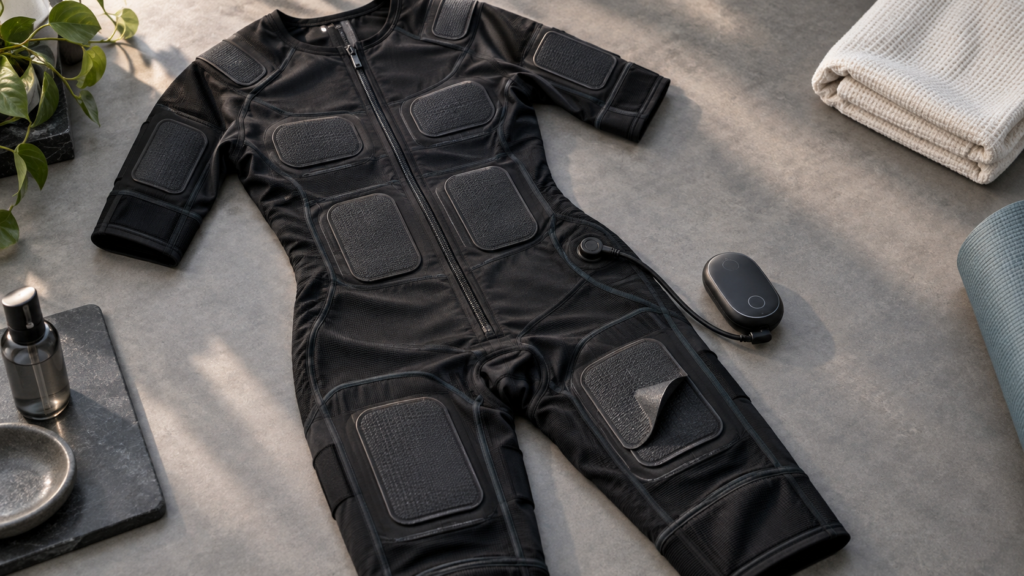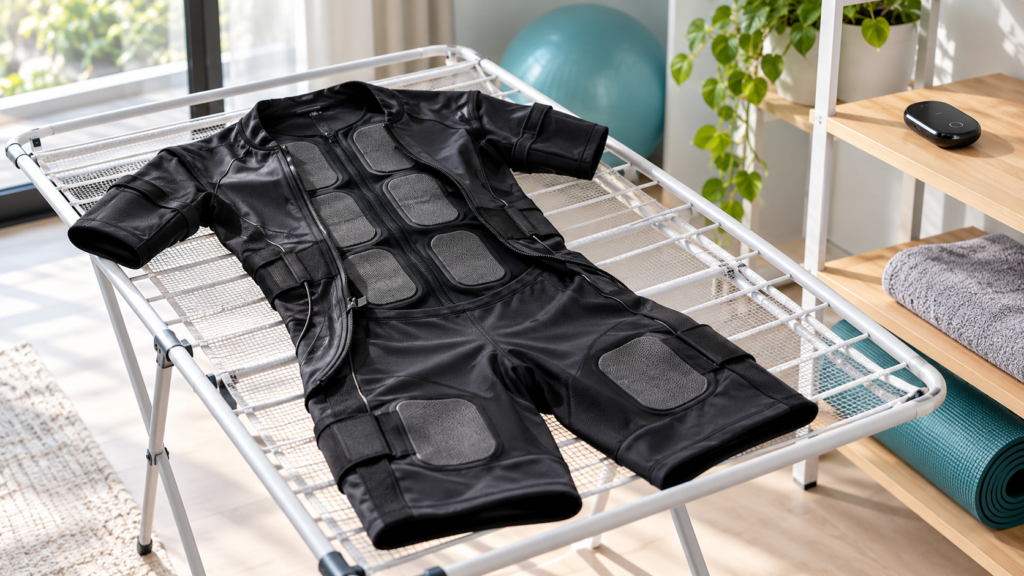

A multi-channel EMS system can deliver stimulation to several electrode pairs, but the channels do not always fire in the same pattern. They may activate together, alternate, or follow a programmed sequence. This timing is channel synchronization.
In a whole-body suit, synchronization helps coordinate broad muscle zones during one work interval. In clinical systems, alternating channels may be used to produce reciprocal joint movement. Users should understand which pattern a program uses before adding complex or loaded exercise.
What is an EMS channel?
An electrical stimulation channel is an independently controlled output path connected to an electrode pair or defined electrode circuit. A two-channel portable NMES device may stimulate two locations. A whole-body system can manage many garment electrodes through more complex hardware.
The number of visible muscle zones in an app is not always the same as the number of physical output channels. Software may group multiple electrodes under one control, and one garment connector may carry several circuits. Manufacturer documentation is the authoritative source for the architecture.
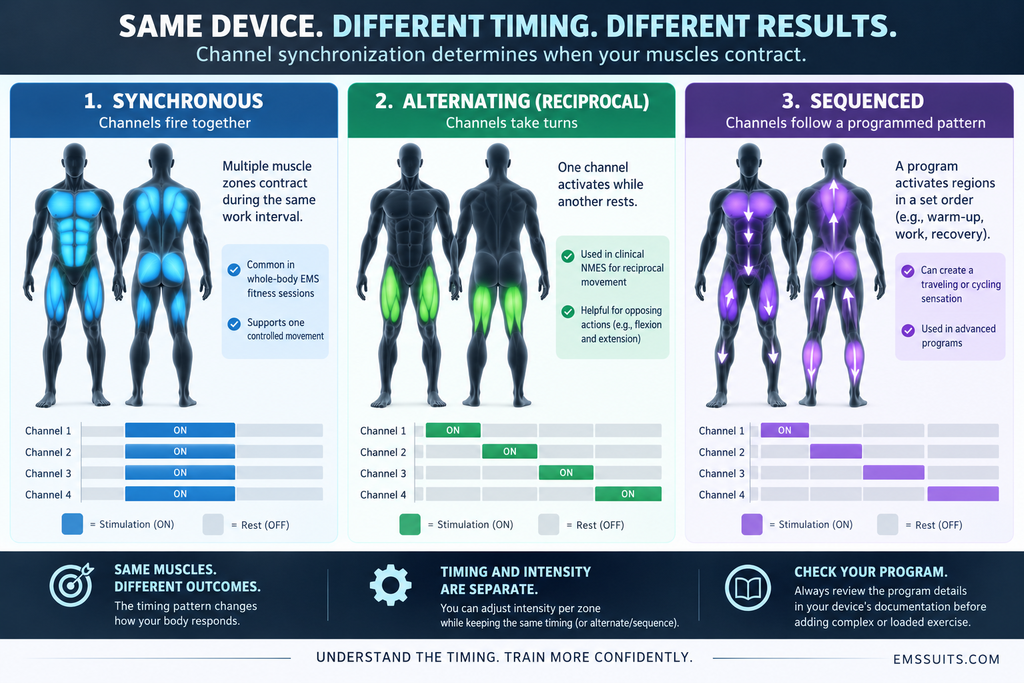
Synchronous channel operation
In synchronous operation, selected channels enter their stimulation and rest phases together. Multiple muscles can therefore contract during the same work interval.
This pattern is common in whole-body EMS fitness sessions because the user performs one controlled movement while several regions receive stimulation. “Synchronous” does not mean every muscle zone receives identical amplitude. A system may synchronize timing while allowing zone-specific intensity.
Alternating or reciprocal operation
In alternating operation, one channel or group activates while another rests. Clinical NMES devices may use reciprocal timing to coordinate opposing muscle actions, such as flexion followed by extension.
A critical review of NMES practice describes two-channel devices that can switch between simultaneous and reciprocal modes. Reciprocal stimulation is useful when a task requires muscles to act in different directions rather than contracting together.
The mode should match the intended movement. Simultaneously activating opposing muscles at high levels can make a joint feel rigid, while an alternating pattern can produce movement that the user did not expect if posture is not controlled.
Sequenced multi-zone programs
Some systems use more than a simple together-or-alternate choice. A program can sequence regions through warm-up, work, or recovery patterns. For example, a recovery mode might create a traveling or cycling sensation across zones.
Do not infer therapeutic benefits from the animation shown in an app. Verify the intended use and program description in official documentation. A visual sequence may be an interface representation rather than a literal map of every electrical pulse.
Timing includes more than on and off
Electrical stimulation systems can involve several programmable timing parameters, including:
- Start time.
- Ramp-up duration.
- Plateau duration.
- Ramp-down duration.
- Rest interval.
- Phase offset between channels.
- Triggering by a user, trainer, sensor, or automatic timer.
Two channels may share the same frequency and pulse width yet produce different movement because their contraction blocks begin at different times.
Our guides to EMS duty cycle and EMS ramp time explain the timing inside each channel.
Independent intensity is different from independent timing
A system can offer separate intensity controls while keeping all zones synchronized. Conversely, a device can alternate two channels that share similar parameter settings.
Ask two separate questions:
- Can the amplitude of each zone be adjusted independently?
- Can the timing or program of each channel be controlled independently?
The first concerns output level. The second concerns when a region contracts. Marketing material sometimes uses “independent channels” without clarifying which capability it means.
Wireless synchronization
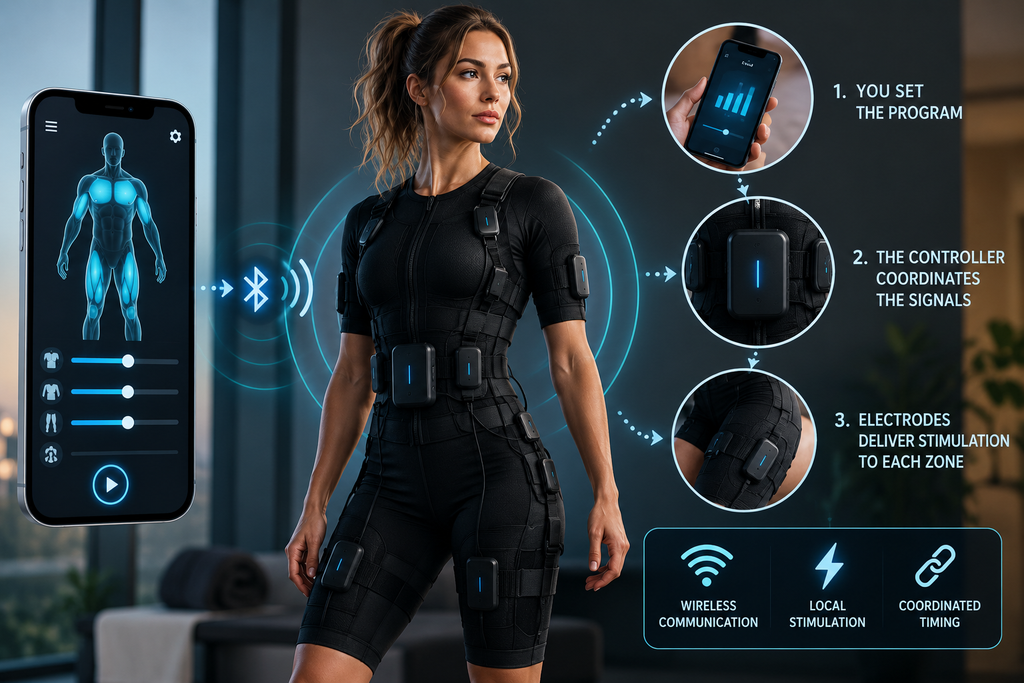
Wireless EMS systems must coordinate commands between the app, controller, and garment electronics. That does not mean every pulse is transmitted over Bluetooth. In many architectures, a local control unit generates stimulation while the wireless link sends program and level commands.
Because designs differ, users should not guess how a lost phone connection affects active stimulation. Follow the manufacturer’s documented behavior for disconnects, emergency stop controls, and controller buttons.
If zones fall out of time or a program behaves unexpectedly, stop stimulation before troubleshooting. Restarting an app while remaining in a loaded exercise position is not a safe diagnostic method.
Movement considerations
Before a synchronized work interval:
- Establish a stable stance.
- Know which zones are active.
- Learn the ramp and contraction timing without external load.
- Keep the first movements simple and controlled.
- Make sure the stop or pause control is immediately accessible.
Do not use stimulation timing to force speed. If the pulse arrives before a safe position is established, reduce movement complexity or choose a more appropriate program.
Frequently asked questions
Do all EMS suit electrodes fire at once?
Not necessarily. Timing depends on the system and program. Some zones may be synchronized, grouped, alternated, or inactive.
Is synchronous EMS better than alternating EMS?
Neither is universally better. Synchronous timing suits simultaneous multi-muscle work, while alternating timing can support reciprocal actions. The correct mode depends on the intended task.
Can each zone have a different intensity while staying synchronized?
Many systems allow this, but the exact controls are device-specific. Check the manual or app documentation.
What should I do if a channel activates unexpectedly?
Stop or pause the session, return to a stable position, and inspect the program and connections. Do not continue a loaded movement while diagnosing unexpected stimulation.
The practical takeaway
Channel synchronization determines when muscle zones contract relative to one another. Synchronous channels work together; reciprocal channels alternate; advanced programs may sequence groups in more complex patterns.
Separate timing control from intensity control when comparing systems. Learn the program without heavy loading, keep a stop control accessible, and use official documentation to understand how wireless disconnects or channel faults are handled.