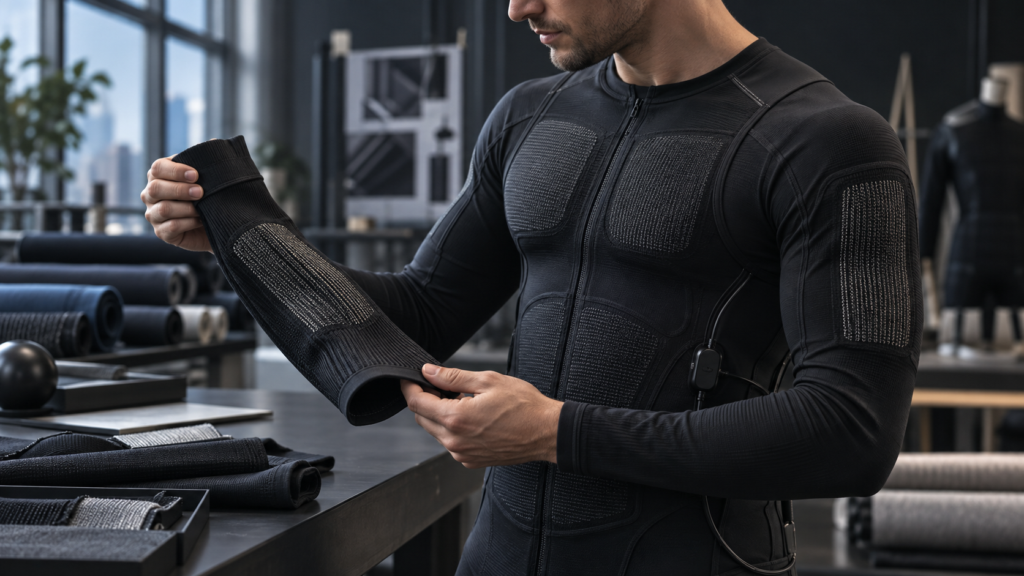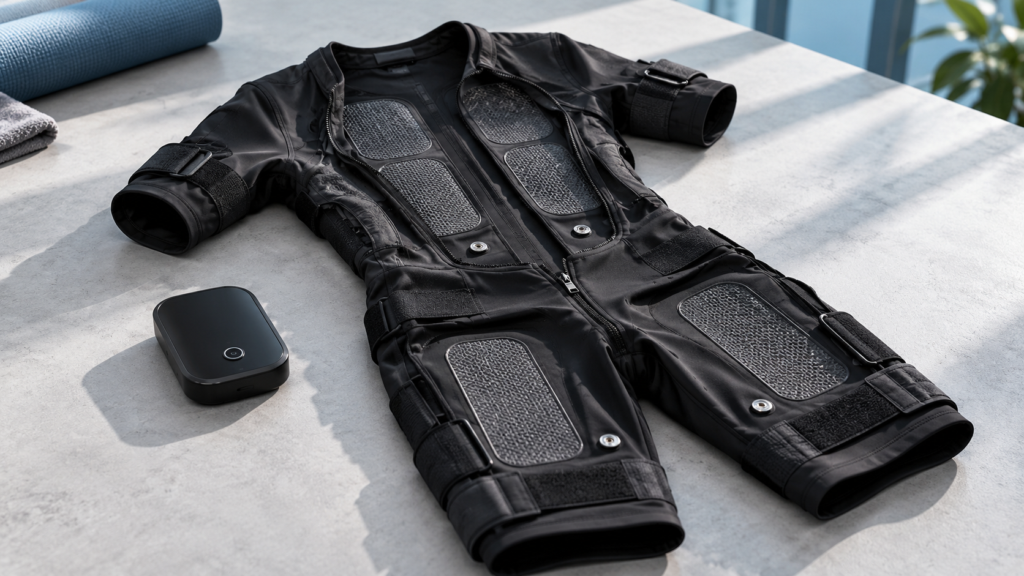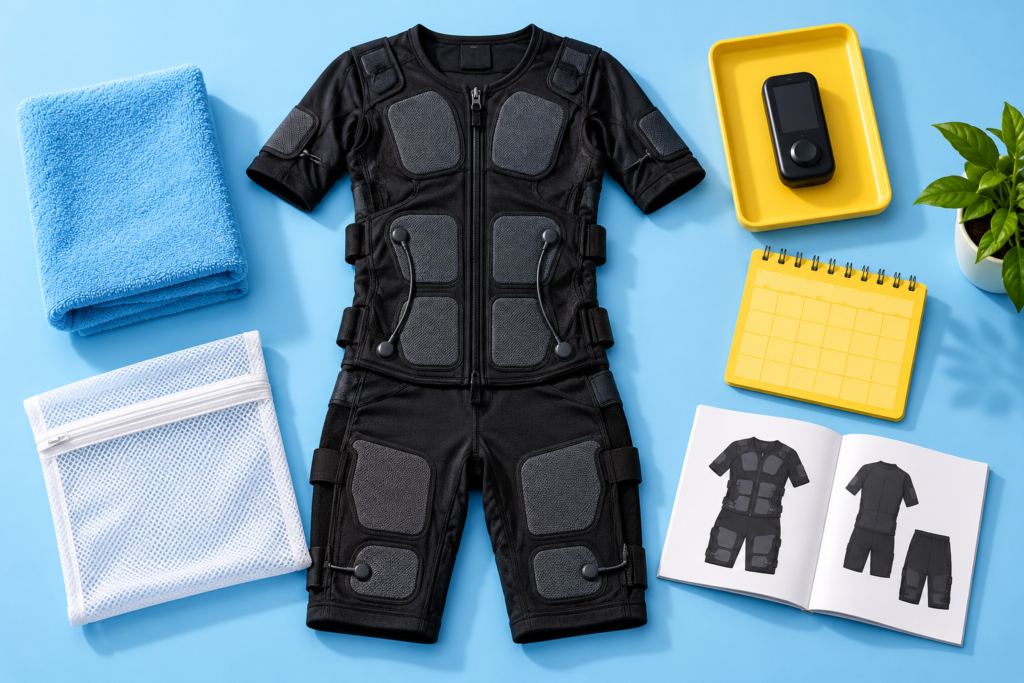
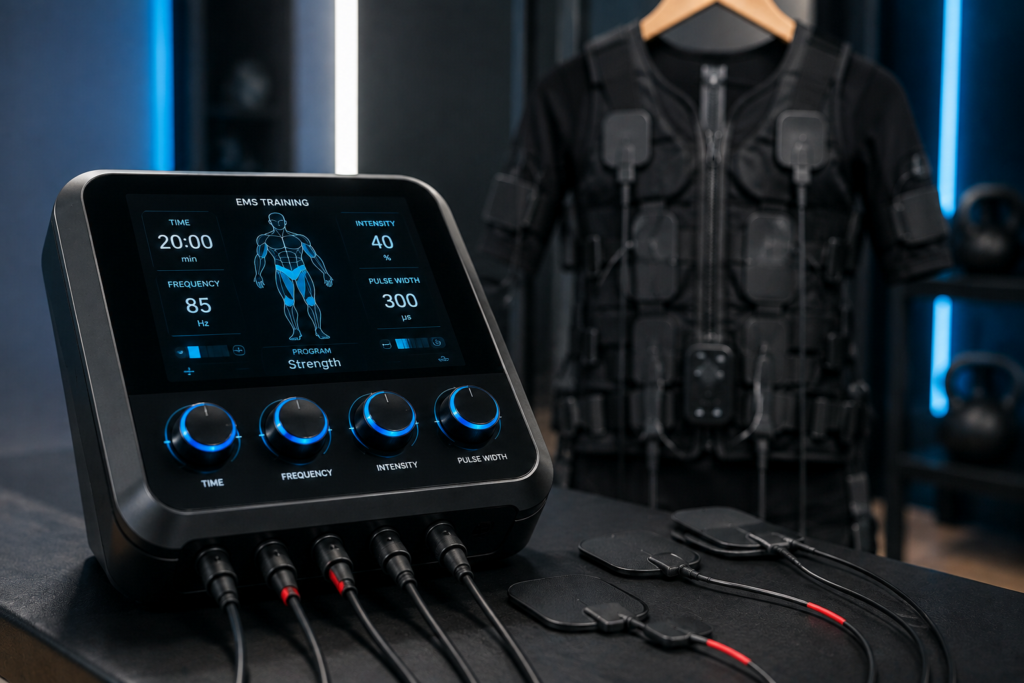
If you have ever used an EMS suit or another electrical muscle stimulation device, the contraction probably didn’t feel quite like flexing the same muscle on your own.
There may be a buzzing or tingling sensation first. Then the muscle tightens. At higher intensities, the contraction can feel strong even though you aren’t consciously telling that muscle to contract in the usual way.
There is a physiological reason for that difference.
Electrical muscle stimulation (EMS) uses electrical current to activate nerves that cause skeletal muscles to contract. During a normal voluntary contraction, the command starts within your nervous system. With EMS, an external electrical stimulus is introduced through electrodes on or near the muscle.
Both can end with the same basic result, a contracting muscle, but the route taken to get there isn’t exactly the same. That’s the main reason an EMS muscle contraction can feel different from a normal one.
What Happens During a Normal Muscle Contraction?
Before getting into EMS, it helps to understand what your body normally does.
A muscle isn’t one big unit that simply switches on or off. Skeletal muscles contain many muscle fibers, and the nervous system controls them through motor units.
A motor unit consists of a motor neuron and the muscle fibers controlled by that neuron. When you decide to move, signals from the nervous system eventually reach these motor neurons and cause their associated muscle fibers to contract.
The amount of muscle needed depends on the task.
Picking up an empty coffee cup doesn’t require the same amount of force as lifting a heavy dumbbell. Your nervous system adjusts accordingly.
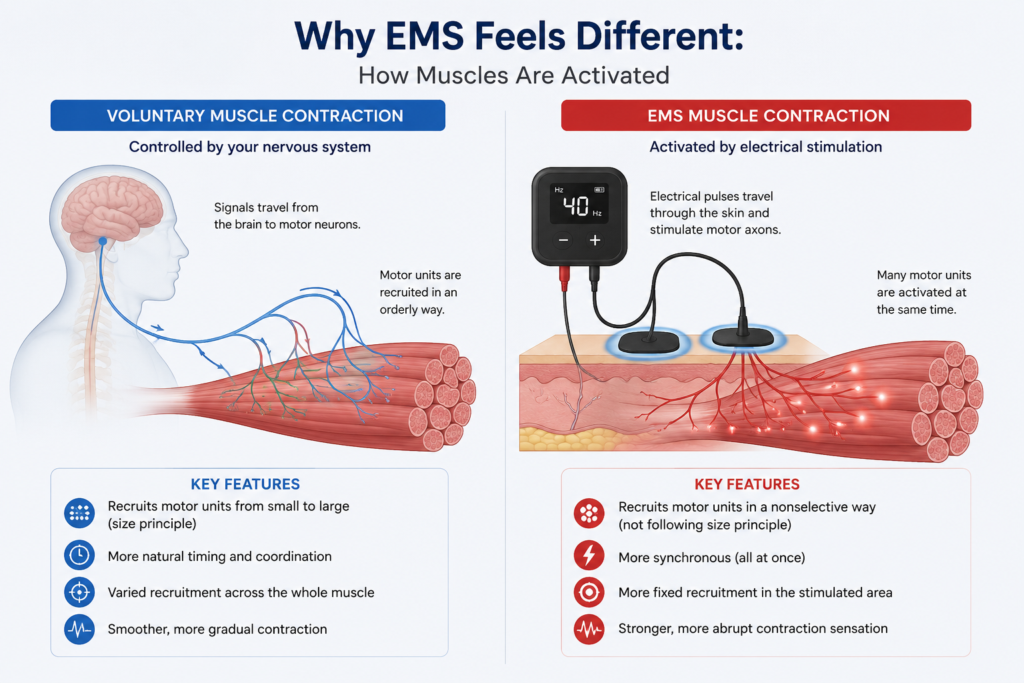
In general, voluntary movement follows what’s known as the size principle. Lower-threshold motor units are recruited first. As more force becomes necessary, the nervous system brings additional, higher-threshold motor units into the contraction.
This gives your body a fairly organized way to control force. You can gently bend your arm, hold something steady, or contract the same muscles much harder without consciously thinking about which individual motor units need to turn on.
An EMS muscle contraction doesn’t necessarily follow this same recruitment pattern.
What Does EMS Do Differently?
EMS introduces electrical pulses through electrodes placed against the body.
Those electrical pulses can depolarize motor axons. Once a motor axon reaches the necessary threshold, it can cause the muscle fibers associated with that nerve to contract. This is one of the main ways an EMS muscle contraction is produced.
That does not mean EMS completely “bypasses the nervous system.”
That description is too simple.
EMS works by electrically stimulating excitable nerves, and depending on the stimulation parameters, both motor and sensory pathways can be involved. Research has shown that electrical stimulation can directly activate motor axons, while activation of sensory axons can also contribute to muscle contractions through pathways involving the spinal cord. Research into neuromuscular electrical stimulation has examined how changing stimulation parameters can affect these different pathways.
So the difference isn’t that one contraction uses nerves and the other doesn’t.
The important difference is how those nerves and motor units are being activated.
EMS Doesn’t Recruit Motor Units Exactly Like Voluntary Movement
This is one of the biggest differences between EMS and a normal muscle contraction.
There is a common claim that EMS simply reverses the body’s normal recruitment order. You may have heard this explained as “EMS activates the largest fast-twitch fibers first.”
The actual research is more complicated.
A review of recruitment patterns during electrical stimulation concluded that conventional EMS recruitment is better described as nonselective, spatially fixed, and temporally synchronous. The authors found that the available evidence did not support a simple rule where EMS always recruits muscle fibers in reverse order.
“Nonselective” is the important word here.
Rather than neatly progressing through motor units according to the same order normally used during voluntary movement, conventional EMS can activate motor units without an obvious sequence based on fiber type.
That makes an EMS muscle contraction different from the organized recruitment your nervous system normally uses.
It also means we shouldn’t make the opposite mistake and say that EMS always recruits fast-twitch fibers first. Some forms and parameters of electrical stimulation can produce different recruitment behavior, including greater involvement of central pathways. Research into NMES training and stimulation parameters helps show why there isn’t one recruitment rule that describes every EMS protocol.
EMS Can Activate Motor Units at the Same Time
Timing is another major difference.
During a normal voluntary contraction, motor units are coordinated by the nervous system and don’t simply fire as one large group every time you move.
Conventional electrical stimulation can produce something more synchronous.
When a stimulation pulse directly depolarizes multiple motor axons, the motor units affected by that pulse can respond at predictable times after the pulse. Researchers describe this as synchronous or time-locked recruitment.
Imagine several people pushing a car.
During voluntary muscle activity, it is more like having someone coordinate who pushes, when they push, and how much help is needed.
An EMS muscle contraction can be more like giving several of those people the same signal to push at once.
The analogy isn’t perfect, but it gets at the basic difference.
This more synchronized activation is one reason electrically induced muscle activity can behave differently from voluntary muscle activity, even though the muscle itself is still performing the contraction.
EMS Can Keep Stimulating the Same Area of Muscle
There is also a spatial difference.
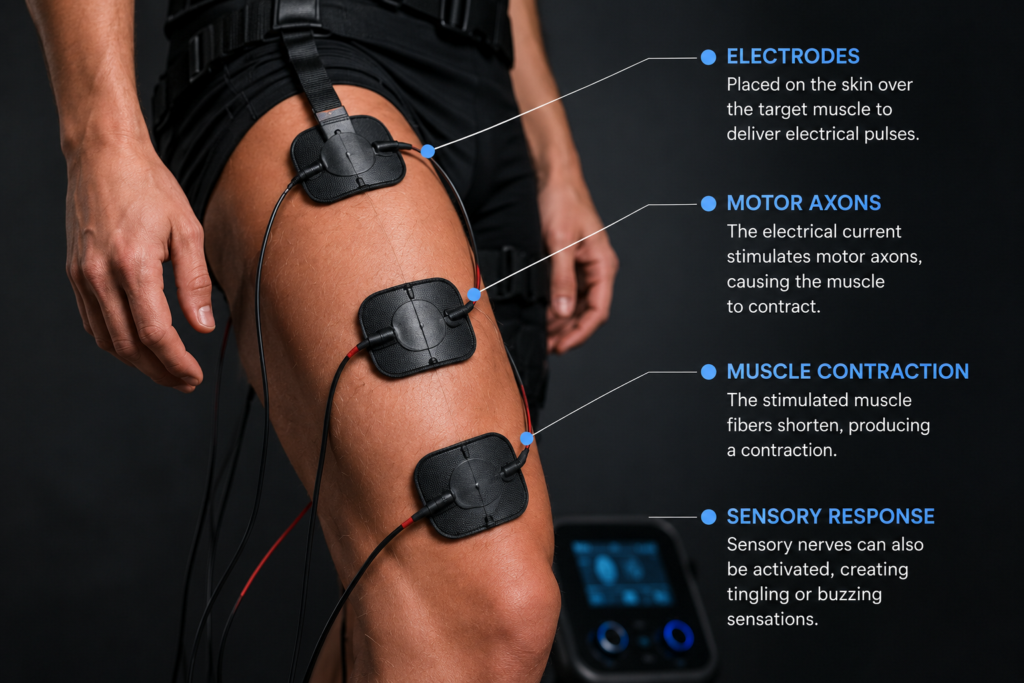
Where the electrodes sit affects where the electrical current travels and which excitable nerves are reached.
With conventional neuromuscular electrical stimulation, recruitment can therefore be spatially fixed. In other words, the same populations of motor units may be repeatedly activated by the electrical stimulus. This recruitment behavior has been discussed in research examining neuromuscular electrical stimulation.
This makes electrode placement more important than it may appear.
Research on NMES has found that placing an electrode near an appropriate motor point can affect the quality of the contraction, comfort, and amount of current required. Research into motor-point identification during NMES found that electrode positioning can have a meaningful effect on stimulation.
This is particularly relevant when thinking about EMS suits.
An EMS suit uses multiple electrode areas to stimulate different muscles or muscle groups. The placement and contact of those electrodes help determine where stimulation is delivered. It isn’t simply electricity being spread evenly across every muscle underneath the suit.
So when an EMS muscle contraction feels particularly noticeable in one area, electrode position and individual anatomy can be part of the reason.
Why Does EMS Cause Tingling or Buzzing?
This is where the word “feel” in the title becomes important.
The muscle contraction isn’t the only thing you are experiencing during EMS.
Electrical stimulation can also activate sensory axons. These nerves carry sensory information toward the central nervous system. Research on NMES training describes the role sensory-axon activation can play during electrical stimulation.
That’s part of why EMS can produce sensations such as tingling, buzzing, tapping, or pulsing.
The sensory experience and the actual muscle contraction are related, but they aren’t exactly the same thing.
At a lower setting, for example, you might clearly feel the electrical stimulation without seeing a strong muscle contraction. As stimulation changes, the motor response may become much more obvious.
The parameters used by the device matter here.
Pulse duration and frequency can change how electrical stimulation interacts with motor and sensory pathways. Research has found that certain combinations of wider pulses and higher frequencies can increase sensory-axon activation and produce more contribution from central pathways.
This is one reason two EMS settings don’t necessarily feel identical, even when the electrodes haven’t moved.
The unusual sensation is therefore not just your muscle “feeling electricity.” Your sensory nervous system is part of the experience.
Why Does Increasing EMS Intensity Make the Contraction Stronger?
Turning up EMS doesn’t simply make the same sensation louder.
As stimulation amplitude increases, the electrical field can bring additional excitable axons to threshold. That can increase the amount of muscle recruited and the force of the resulting EMS muscle contraction.
But intensity is only one part of the equation.
EMS devices can vary in several ways, including:
- Current amplitude
- Pulse duration
- Pulse frequency
- Electrode size
- Electrode position
- Stimulation pattern
Individual anatomy matters as well.
Reviews of NMES research describe stimulation intensity, pulse width, and frequency as important factors affecting muscle recruitment, force production, fatigue, and comfort.
This is why an intensity number on one EMS device shouldn’t automatically be compared with the same number on a completely different system.
Even two people using the same equipment may not perceive the same setting identically.
Why Can EMS Fatigue a Muscle Quickly?
This is another noticeable difference.
A hard EMS muscle contraction can become tiring surprisingly quickly.
The recruitment pattern helps explain why.
With conventional surface stimulation, motor units can be recruited synchronously and repeatedly. Because recruitment can also be spatially fixed, some of the same motor units may be activated over and over again. The research on electrically stimulated motor-unit recruitment identifies these characteristics as important differences between electrically induced and voluntary contractions.
That isn’t the same fatigue-management strategy used during voluntary movement.
The result is that electrically evoked contractions can experience relatively rapid fatigue. Research into electrode placement and NMES identifies this rapid fatigue as one of the practical challenges associated with electrical stimulation.
There is an important distinction here, though.
Faster fatigue does not automatically mean a better workout.
Muscle fatigue simply tells us that the muscle’s ability to continue producing the same force is declining. It shouldn’t be used on its own as evidence that an EMS session was more effective than conventional exercise.
It does, however, give us another example of how electrically stimulated and voluntary contractions can behave differently.
Does EMS Activate More Muscle Fibers Than a Normal Contraction?
This needs some clarification because EMS marketing can get carried away here.
You may see claims that EMS activates nearly all of a muscle’s fibers or that it recruits some huge percentage that can’t be reached voluntarily.
The physiology doesn’t support such a simple universal statement.
Surface electrical stimulation has limitations. Electrode location and the distribution of current affect which nerves are stimulated. Research has described conventional NMES recruitment as both spatially fixed and incomplete. Studies of NMES recruitment help illustrate why electrical stimulation shouldn’t be described as automatically activating every fiber in a muscle.
An EMS muscle contraction can recruit motor units differently from a voluntary contraction, including motor units that might not normally be recruited at the same level of voluntary effort.
That is not the same as saying every muscle fiber is activated.
It is also worth separating different recruitment from more recruitment.
Those aren’t interchangeable.
A voluntary maximal contraction can already involve extensive motor-unit recruitment. EMS changes how activation is produced, but that does not mean an electrical device automatically activates “more muscle” than the nervous system can.
Does EMS Replace Your Brain’s Control of the Muscle?
Not completely.
This is another area where simple explanations can become misleading.
When EMS directly activates motor axons, that part of the contraction can occur through a peripheral pathway without the same voluntary command that would normally initiate the movement. Studies examining motor-unit recruitment during electrical stimulation have looked at both these direct responses and responses involving central pathways.
Electrical stimulation can activate sensory axons too.
Those sensory signals can enter the spinal cord and contribute to motor-unit recruitment through central pathways. Under certain stimulation parameters, researchers have observed motor activity that isn’t simply locked to each individual electrical pulse.
This matters because EMS isn’t one single physiological mechanism.
Pulse width, frequency, electrode location, and other stimulation characteristics can change how much of the response comes from direct motor-axon stimulation versus sensory and central pathways. A review of NMES training approaches discusses how stimulation parameters can be manipulated to change these responses.
So an EMS muscle contraction shouldn’t be described as the electricity directly “forcing the muscle fibers to fire” while the nervous system sits on the sidelines.
The nerves are central to how EMS works.
Why Can Two Muscles Feel Different at the Same EMS Setting?
You may also notice that one area feels comfortable while another feels much stronger, even during the same session.
There are several reasons this can happen.
Electrodes may sit differently relative to the motor points of each muscle. Muscles differ in size, shape, and depth. The tissue between the electrode and the target nerves isn’t identical across the body either.
Electrode positioning alone can have a meaningful effect on the amount of current needed to produce a contraction. Research into motor-point placement found that more precise positioning can reduce the current needed to reach a given level of muscle response.
This is another reason EMS intensity is personal.
The number displayed by the device tells you something about what the device is delivering. It doesn’t perfectly describe what every individual nerve and muscle underneath the electrode is experiencing.
EMS Muscle Contraction vs. Voluntary Muscle Contraction
The easiest way to put all of this together is to compare the two directly.
| Normal voluntary contraction | EMS muscle contraction | |
| Initial command | Comes from voluntary neural control | External electrical stimulus is introduced |
| Motor-unit recruitment | Generally follows an orderly recruitment pattern | Conventional EMS tends to be more nonselective |
| Timing | Controlled and coordinated by the nervous system | Can be more synchronous |
| Recruitment location | Nervous system controls activation across the muscle | Can be spatially fixed around stimulated nerves |
| Sensation | Familiar sense of muscular effort | May include tingling, buzzing, tapping, or pulsing |
| Fatigue | Recruitment is naturally managed | Repeated electrical activation can produce faster fatigue |
| Force | Nervous system adjusts recruitment and firing | Influenced by intensity, pulse parameters, and electrode placement |
These aren’t absolute divisions. EMS can involve both peripheral and central neural pathways, and different stimulation parameters can change the recruitment pattern. The research into NMES mechanisms and training provides a more detailed look at those differences.
So, Why Does EMS Feel Different From a Normal Muscle Contraction?
An EMS muscle contraction feels different because the muscle isn’t being activated in exactly the same way as it is during a normal voluntary movement.
When you voluntarily contract a muscle, your nervous system controls motor-unit recruitment according to the amount of force you need.
Conventional EMS introduces electrical pulses that can activate peripheral motor axons in a more nonselective, spatially fixed, and synchronous pattern. At the same time, sensory nerves can respond to the stimulation, creating the buzzing, tingling, or pulsing sensation associated with EMS. These differences are well described in the research comparing electrical and voluntary motor-unit recruitment.
Electrode placement, intensity, pulse duration, frequency, and individual anatomy can further change what the contraction feels like and how much force it produces.
So although voluntarily flexing your quadriceps and electrically stimulating your quadriceps can both make the muscle contract, they aren’t simply two ways of sending an identical command.
The muscle may be doing something familiar. The way the nervous system gets it there is what makes EMS feel different.
Ready to find your EMS suit? Check out our brand/product reviews, or use our comparison tool to help decide the best suit for you.