Quick Answer
How often to wash an EMS suit depends on the exact model’s instructions, sweat, skin contact, and whether the garment is shared. Follow the manufacturer’s schedule, clean sooner when needed using an approved method, and follow a suitable hygiene process between users. Air drying does not replace required cleaning.
Key Takeaway
Deciding how often to wash an EMS suit starts with its care label and current manual. There is no universal schedule for every garment. Check for sweat, residue, odor, contamination, and shared use, then follow the approved cleaning and drying process before reuse.
You finish your workout, take off your EMS suit, and wonder whether it needs washing or just some time to air out.
It’s a reasonable question. You want the garment clean, but you also want to protect the electrodes, fabric, and connections.
Knowing how often to wash an EMS suit means balancing those needs without guessing. The answer depends on your exact suit, what touches your skin, how much you sweat, and whether anyone else wears it.
There is no universal “every three sessions” rule. Start with the instructions, then check what happened during your workout.
Start with the manufacturer’s washing schedule
For example, eaglefit’s Swiss distributor says its suit does not need washing after every workout because of its antibacterial finish. Its cleaning guidance specifies washing when needed, using a delicate cycle at a maximum of 30°C, a laundry bag, and no spin. It recommends hand washing to extend the garment’s lifespan.
The first step in deciding how often to wash an EMS suit is checking the care label and current manual for your model.
Meanwhile, the WiemsPlus guide recommends hand washing its Slim Plus personal suit with cold water and pH-neutral soap every three uses or two weeks.
These are product-specific examples. Neither schedule should be transferred to a different garment.
Even within one brand, instructions may differ. PEPPER’s manual page provides separate manuals for its Original and Nova suits and asks customers to select the appropriate version.
If you’re unsure how often to wash an EMS suit because the label and manual appear to disagree, contact the manufacturer before choosing your own schedule.
🧺 Is it wash day?
Wondering how often to wash an EMS suit? Check the instructions, then check what happened during your session.
📖 Start with the instructions
Find the current manual for your exact model. You need its washing schedule and permitted cleaning method before deciding whether the suit can be reused.
This checklist does not establish that a garment is hygienically safe. Your suit’s instructions and any applicable studio hygiene process determine the required action. Drying does not replace required cleaning.
1. Check how much sweat the suit collected
A light session in a cool room can leave your garment in a different condition from a sweaty workout outdoors.
When considering how often to wash an EMS suit, inspect it after each session rather than relying only on a calendar.
Look for damp areas, visible residue, transferred skin products, and noticeable odor. If cleaning is needed, use the approved process.
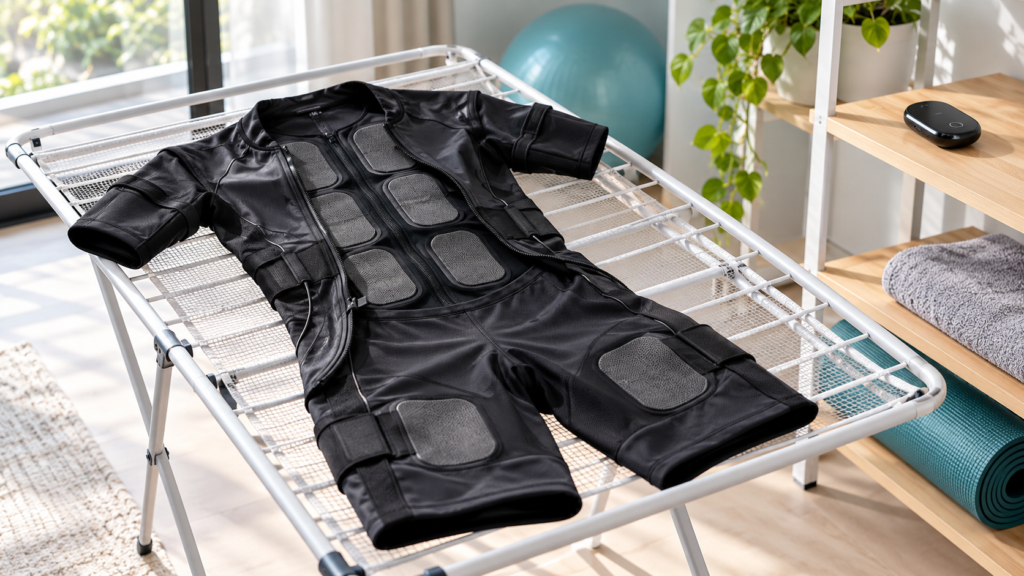
Don’t leave a damp suit sealed inside its storage bag while you decide what to do. Remove the electronics as instructed and follow the manufacturer’s drying guidance.
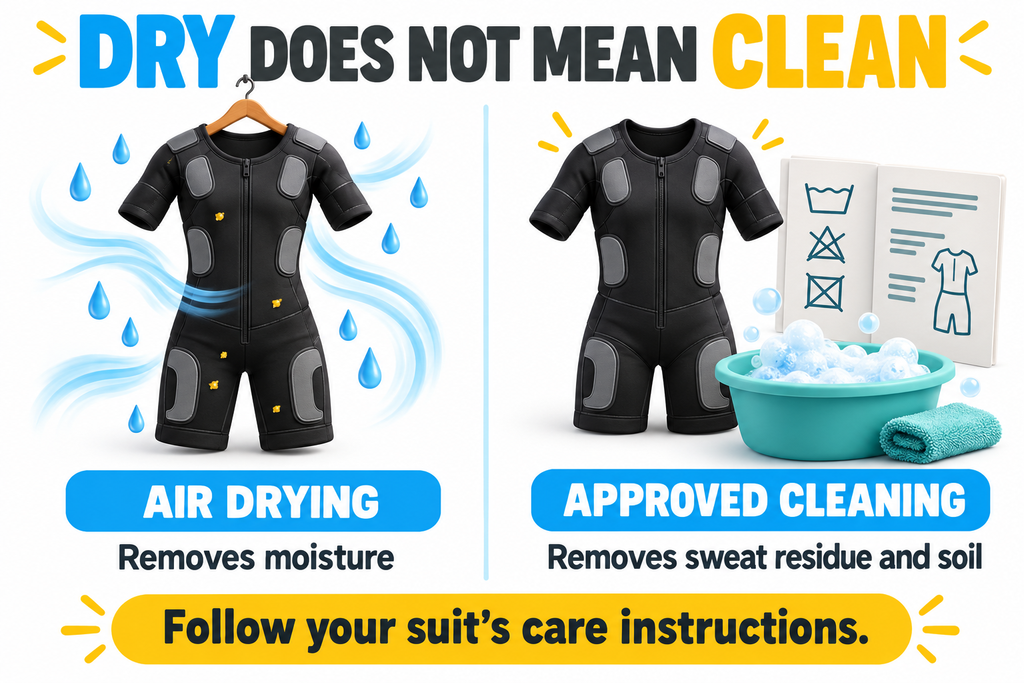
Drying helps remove moisture. It does not remove the salts, oils, and other material left in the fabric.
2. Treat shared suits differently
If several people wear the same garment, how often to wash an EMS suit becomes part of a broader hygiene process.
The CDC’s guidance for athletic facilities recommends cleaning shared equipment after each use and allowing it to dry before reuse.
That does not mean every EMS garment can tolerate the same wash or disinfectant. A studio needs a process that meets hygiene requirements while remaining compatible with its equipment.
Depending on the system, this may involve clean approved undergarments, manufacturer-approved cleaning or disinfection, and enough spare garments to allow complete drying.
Do not spray a general-purpose disinfectant onto conductive panels unless the manufacturer permits it.
If a suit cannot be cleaned appropriately between clients, keep it out of service until it can. A base layer alone should not be treated as proof that the outer garment is ready for another user.
3. Consider what touches your skin
An approved base layer can change how often to wash an EMS suit, but it does not remove the need to inspect the outer garment.
The undergarment may absorb some sweat and reduce direct skin contact. Wash it after use according to its own care instructions.
The outer suit still needs attention. Moisture may reach it, particularly in systems that require wetting the garment or interface.
Also, only wear a base layer if your EMS system allows one. Some dry-electrode suits require direct skin contact, so adding an ordinary shirt or leggings may interfere with their intended use.
The manufacturer’s instructions should explain what belongs between your skin and the electrodes.
4. Clean after spills or contamination
Sometimes, deciding how often to wash an EMS suit has little to do with the number of workouts.
A spill or contamination can require attention before the next session, even if the garment was recently washed.
Check the approved cleaning instructions when the suit contacts:
- Lotions, oils, or skin products that leave residue.
- Dirt or outdoor debris.
- Food or spilled drinks.
- Blood or other potentially infectious material.
- A cleaning chemical that the manufacturer has not approved.
If an unapproved chemical reaches the garment, stop using it and ask the manufacturer how to proceed. Washing alone may not resolve chemical damage or compatibility concerns.
For blood or other potentially infectious contamination in a shared setting, follow the facility’s incident and sanitation procedure. Do not assume an ordinary delicate wash is sufficient.
5. Don’t use smell as your only guide
Odor can help you recognize a cleaning problem, but it should not be your only way of deciding how often to wash an EMS suit.
A garment can contain sweat residue or contamination without smelling strongly. The absence of odor does not establish that a shared suit is hygienically ready for another person.
Likewise, fragrance spray does not remove the material causing an unpleasant smell. It adds another product to a garment that may have specific chemical restrictions.
If odor returns quickly after an approved wash, review the cleaning process, drying conditions, and storage routine. Our guide to removing persistent EMS suit odor covers the next steps to investigate.
6. Pay attention to skin irritation
Skin discomfort may prompt you to review how often to wash an EMS suit, but cleaning frequency is only one possible factor.
Detergent residue, transferred products, friction, fit, and the stimulation itself may also need consideration. Don’t assume repeated redness means the suit simply needs more detergent.
Stop using the garment if it causes irritation. Check whether you followed the permitted detergent amount, rinse process, and drying instructions.
If irritation persists, becomes painful, or involves broken skin, seek appropriate medical advice. The CDC advises athletes to get care for signs of skin infection, including painful sores, pus, swelling, redness, or warmth.
Contact the manufacturer about garment care and fit rather than repeatedly experimenting with new cleaning products.
7. Protect the garment during every wash
Understanding how often to wash an EMS suit also means understanding how it can be washed.
The correct frequency will not protect it from an unsuitable cycle.
A review of textile electrodes identifies repeated use, washing, and mechanical stress as durability challenges. The paper focuses on electrodes used for monitoring body signals, so it does not establish a wash limit for your EMS training suit. It provides relevant background on why conductive textiles need carefully specified care.
Follow the approved temperature, detergent, agitation, spin, and drying instructions. Remove detachable electronics and accessories exactly as directed.
If you are deciding how often to wash an EMS suit because you’re worried about wear, ask the manufacturer about an appropriate routine. Don’t reduce necessary hygiene or substitute harsher cleaning to compensate for less frequent washing.
For the washing method itself, see our guide to machine-washing an EMS suit.
A practical checklist for how often to wash an EMS suit
After each workout, ask:
- Does the manual require washing now?
- Was the garment shared or scheduled for another user?
- Was a clean, manufacturer-approved base layer used?
- Is the suit heavily damp or visibly soiled?
- Is there odor, residue, a spill, or contamination?
- Has the wearer developed irritation that needs assessment?
- Can the garment complete its approved cleaning and drying process before reuse?
These checks help you decide how often to wash an EMS suit without inventing a universal session count.
If cleaning is required, follow the appropriate process. If it is not yet required, inspect, dry, and store the garment according to its instructions.
When contamination or chemical exposure leaves you unsure what is safe, keep the suit out of use while you obtain guidance.
Keep a cleaning log for shared equipment
Studios can make decisions about how often to wash an EMS suit easier to manage by keeping a simple garment log.
Record the garment ID, use time, cleaning method, drying completion, inspection result, and any reported fault.
A log can help staff distinguish equipment awaiting cleaning from equipment ready for use. It also creates a record when investigating recurring odor, damage, or electrode problems.
Personal users may find a simpler record useful. Note wash dates and any problems if you are troubleshooting care or discussing the garment with support.
There is no need to turn this into extra work when the routine is straightforward.
Frequently asked questions
How often to wash an EMS suit if I use it alone?
Follow the exact model’s instructions, then account for sweat, residue, contamination, and skin contact. Personal ownership does not mean the garment can go indefinitely without cleaning.
Should I wash my EMS suit after every workout?
Some manufacturers may require it, while others publish a different personal-use schedule. Check your manual. Shared use requires an appropriate cleaning process between wearers, regardless of a personal-use schedule.
Can I just air it out?
Air drying removes moisture but does not remove oils, salts, or contamination. It cannot replace washing or sanitation when those steps are required. Follow the instructions for drying an EMS suit safely before storage.
Does antibacterial fabric change how often to wash an EMS suit?
It may form part of the manufacturer’s care guidance, but it does not eliminate cleaning. An antibacterial finish does not physically remove sweat, dirt, or product residue, and it should not replace an appropriate shared-use hygiene process.
Can frequent washing damage the electrodes?
Repeated washing can contribute to wear, depending on the materials and process. Incorrect settings or incompatible chemicals can create additional problems. Use the approved method and inspect the garment afterward.
What if the instructions don’t explain how often to wash an EMS suit?
Contact the manufacturer for written guidance covering your model and whether it is used personally or commercially. Explain how it is worn and what cleaning issue you are trying to address.
The practical takeaway
Knowing how often to wash an EMS suit means following its instructions while responding to the condition of the garment.
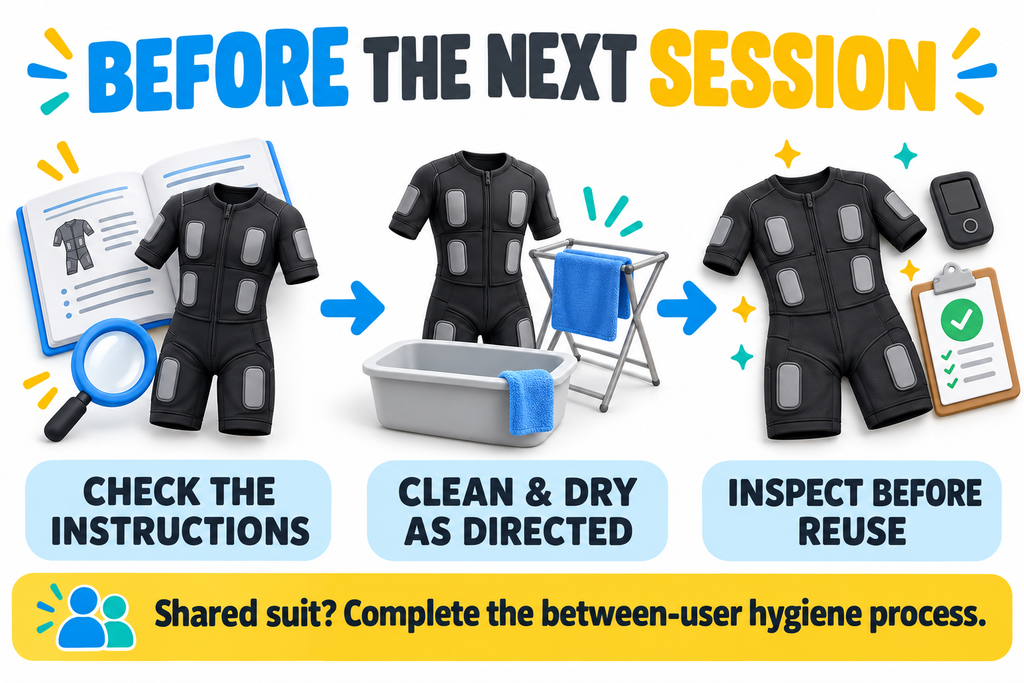
Check sweat, sharing, base-layer use, contamination, odor, and skin response. Use the approved cleaning process, allow complete drying, and inspect before reuse.
If a shared suit cannot be cleaned and dried appropriately before the next client, keep it out of service. Protecting the garment matters, and so does making sure it is ready for the person wearing it.