Quick Answer
Some EMS suits can be machine washed, but only when the exact model’s care label and manufacturer instructions allow it. Remove all components identified as non-washable, use the approved detergent and laundry bag, and follow the specified temperature, cycle, and spin settings. Machine-washable does not mean tumble-dryable. If the instructions are missing or unclear, contact the manufacturer before washing.
Key Takeaway
- Follow the care label and current manual for your exact EMS suit. There is no universal safe wash cycle.
- Remove the controller, battery, and every other component the manufacturer identifies as non-washable.
- Use the approved detergent, closures, laundry bag, temperature, and cycle. If spinning is prohibited, turn it off.
- Washing chemistry and mechanical stress can damage conductive materials before visible wear becomes obvious.
- Follow the separate drying instructions, then inspect the fully dry suit before use.
- If the label is missing or the instructions conflict, ask the manufacturer before choosing a washing method.
Can You Machine Wash an EMS Suit? What the Care Instructions Really Mean
Some EMS suits can be washed in a machine after electronics are removed. Others require hand washing or a specialized studio process. There is no universal wash cycle that is safe for every conductive garment.
The sewn-in care label and current manufacturer manual decide the answer. Product-category advice should never override them. For example, PEPPER provides separate manuals by suit model and region, so you should select the instructions for your actual equipment.
Why EMS suits have different washing rules
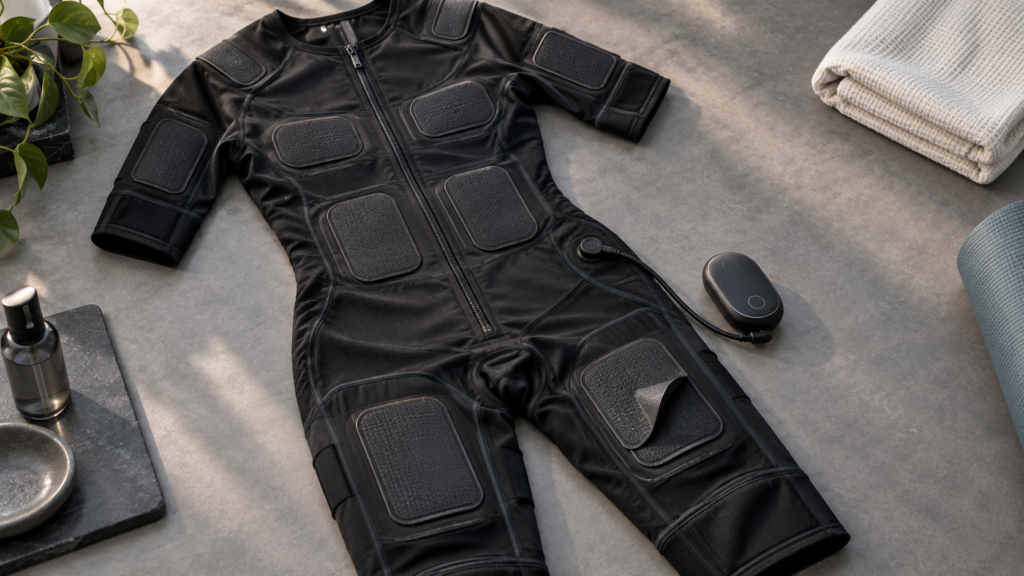
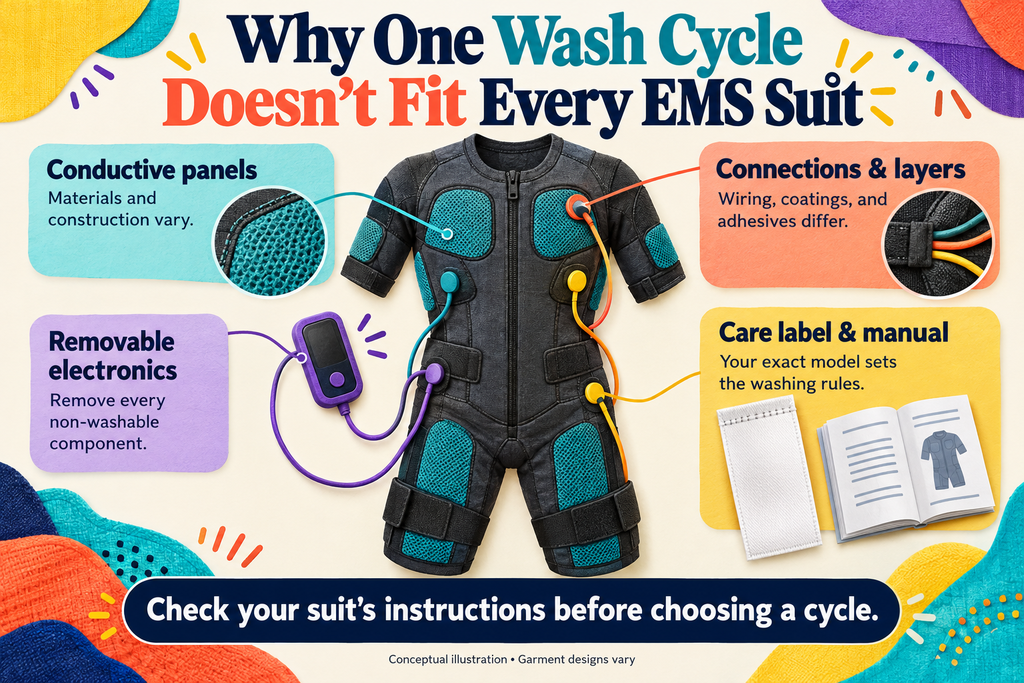
Textile electrodes use different materials and manufacturing methods. Conductive panels can be knitted, coated, printed, or integrated into layered structures. Garments also differ in:
- Electrode material.
- Waterproofing of connections.
- Adhesives and laminations.
- Compression fabric.
- Detachable or integrated electronics.
- Approved detergent chemistry.
- Tested wash-cycle durability.
A process safe for silver-coated knitted electrodes may damage a printed conductor or adhesive layer in another suit.
Read every part of the label
Look for:
- Maximum water temperature.
- Normal, gentle, or hand-wash symbol.
- Whether spinning is allowed.
- Bleach restriction.
- Tumble-dry restriction.
- Ironing and dry-cleaning restriction.
- Required laundry bag.
If a symbol is unclear, use the manufacturer’s official manual or support team. The PEPPER Nova manual includes a care-symbol glossary, covering restrictions such as ironing, tumble drying, and bleaching. Do not guess from a similar-looking garment.
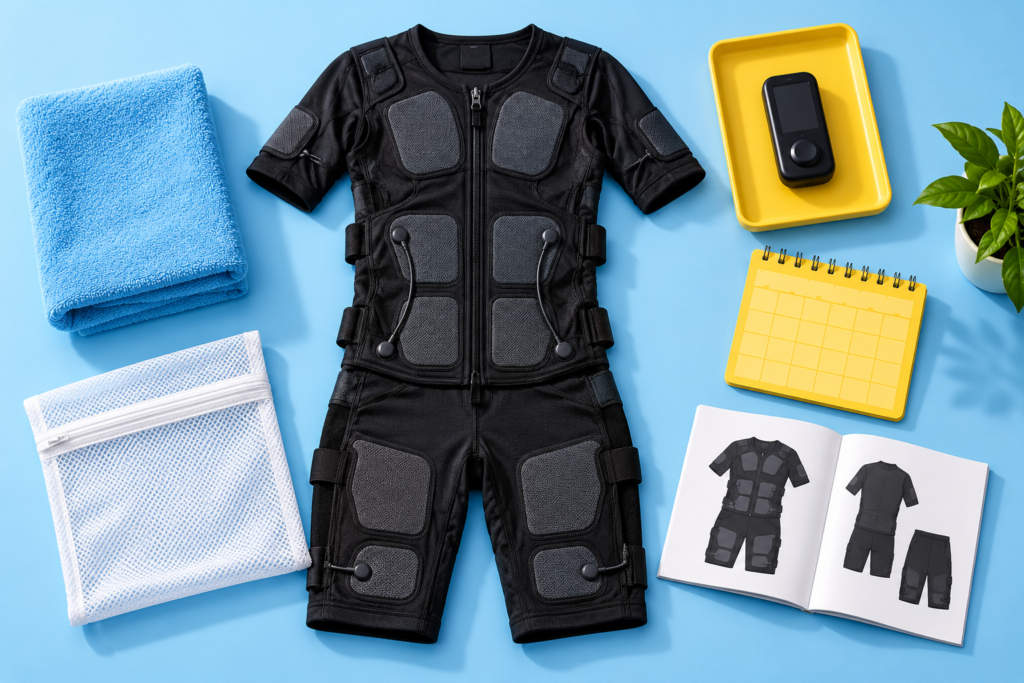
Remove electronics and accessories
Power off and detach every component listed in the instructions. Check pockets, connector docks, and cable channels.
Never put a controller, battery, charger, or non-washable cable into the machine. The PEPPER Nova maintenance instructions, for example, distinguish washing the suit from cleaning the power box with a soft, dry cloth.
If an electronic module was washed accidentally, do not power or charge it. Contact support.
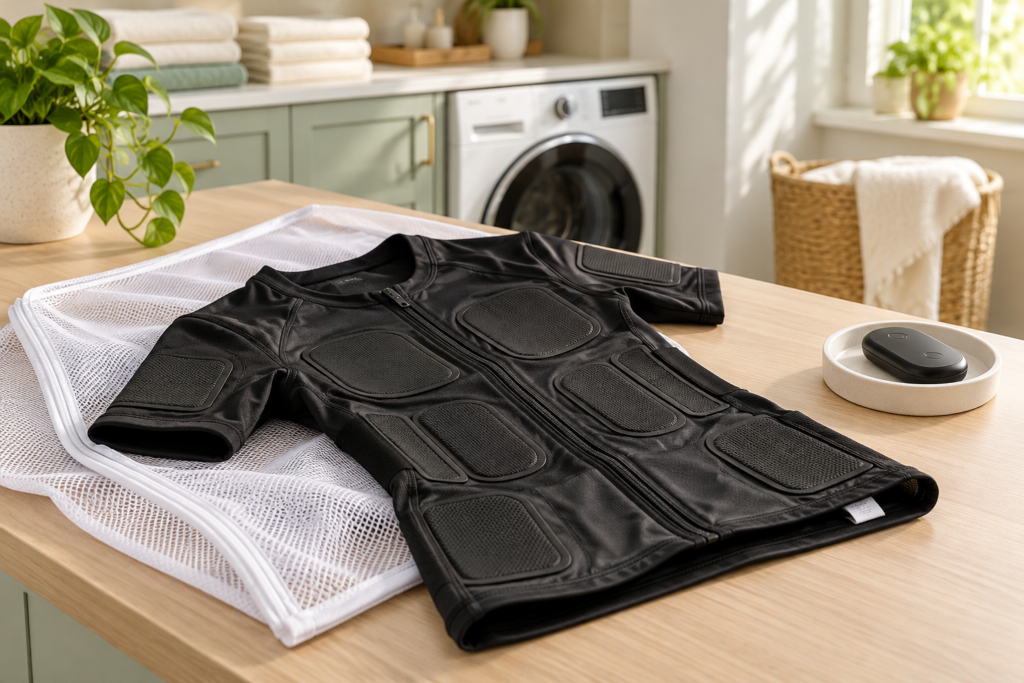
Prepare closures and the laundry bag
Some brands instruct users to fasten zippers and hook-and-loop tabs to prevent snagging. Others specify turning the garment inside out or using a supplied mesh bag.
Follow that sequence exactly. An ordinary mesh bag is not automatically equivalent if the manufacturer supplies one designed for the garment’s size and hardware.
Use only approved detergent
Fabric softener, bleach, stain remover, disinfectant, enzymes, and fragrance products may leave residues or affect materials, depending on their formulation and the garment’s construction. Use the detergent type and amount allowed by the brand.
Research on washing silver-plated textile electrodes demonstrates why detergent chemistry matters, particularly when bleaching agents are combined with mechanical washing.
More detergent does not create better electrode hygiene. Incomplete rinsing can leave residue on the garment.
Select the stated cycle and temperature
eaglefit’s cleaning instructions advise a delicate cycle at a maximum of 30°C in the supplied laundry bag and without spinning, while also recommending hand washing to extend the suit’s life. That is evidence for eaglefit equipment, not a universal rule.
Enter the exact settings required for the actual garment. If the machine cannot provide them, hand wash or use the alternative named by the manufacturer.
Avoid unapproved spinning
High-speed spin cycles place mechanical loads on wet conductive fabric. They can also make rigid connector pieces strike the drum.
If spinning is prohibited, turn it off. Do not assume “low spin” is close enough. If a gentle spin is allowed, use the stated maximum.
What laundering does at the material level
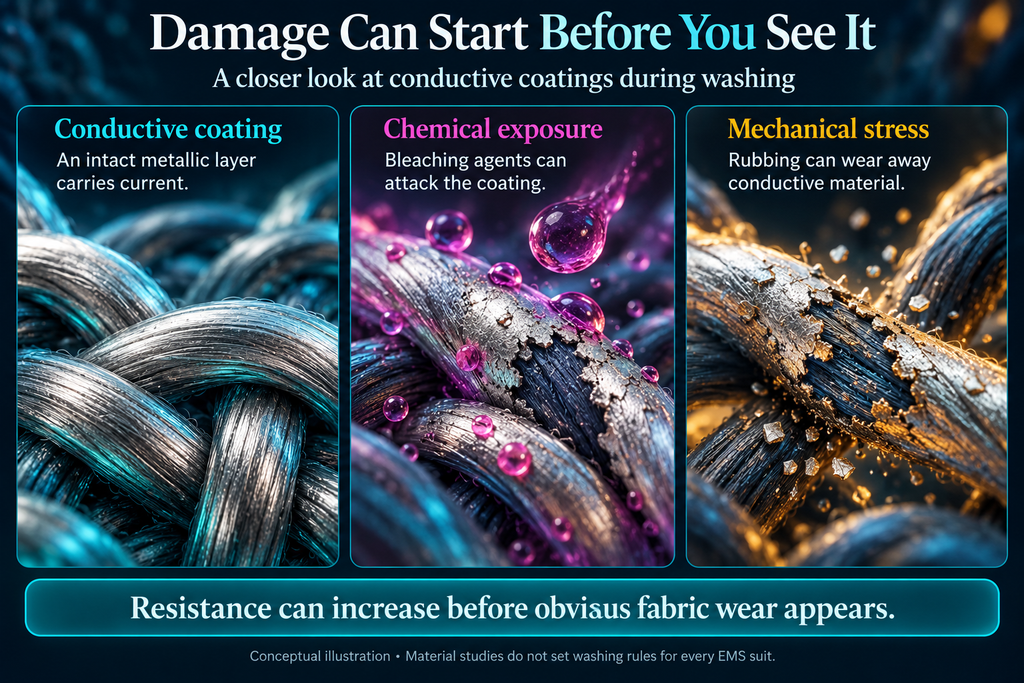
Machine washing combines chemical exposure with mechanical stress. Water and detergent enter the knit; flexing and rubbing strain conductive yarns and junctions; oxidizing ingredients can attack metallic coatings. Electrical damage may appear as higher resistance or broken conductive pathways before the fabric looks severely worn.
In a laboratory study of silver-plated nylon textile electrodes, researchers separated soaking chemistry from machine abrasion over as many as 30 cycles. Scanning electron microscopy and resistance testing showed that bleaching agents combined with mechanical rubbing progressively damaged the silver layer. Liquid detergent without bleaching agents caused less damage than the tested powder and sodium-percarbonate conditions, but resistance still depended on yarn construction and wash exposure.
A later study combining artificial-perspiration exposure with washing found changes in electrical resistance and different durability between silver-coated yarn and surface-coated fabric constructions. These experiments explain why detergent chemistry and washing conditions matter, but they do not validate a home recipe for every EMS suit. The studies evaluated conductive textiles, not every stimulation garment, connector, laminate, or manufacturer safety limit.
Dry using the separate care instructions
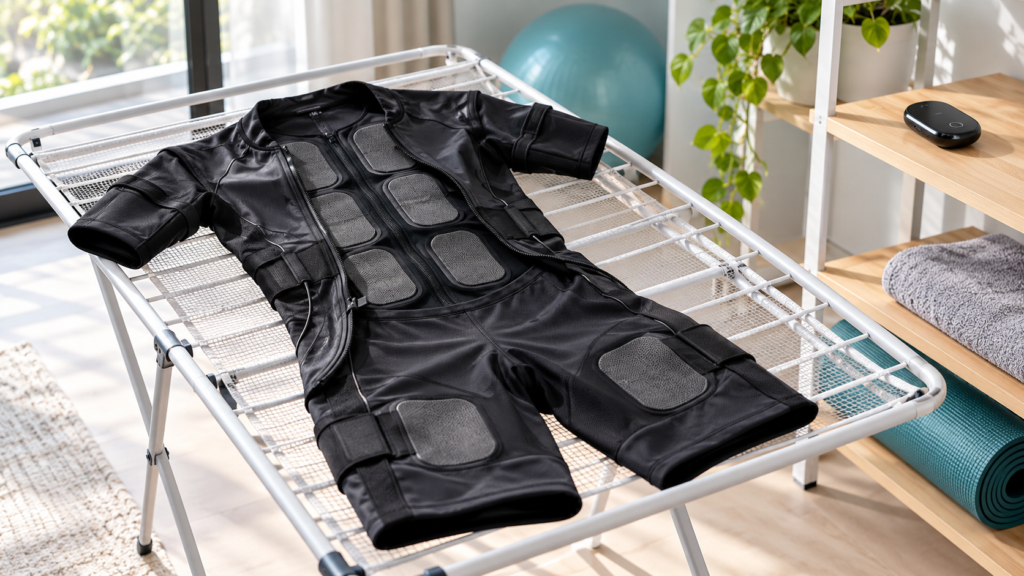
Machine-washable does not mean tumble-dryable. Remove the garment promptly, reshape it, and use the approved drying method.
For example, PEPPER’s Nova manual requires air drying and prohibits using a dryer.
The EMS suit drying guide explains why direct heat, wringing, and storing while damp can damage or shorten the life of conductive textiles.
Inspect after washing
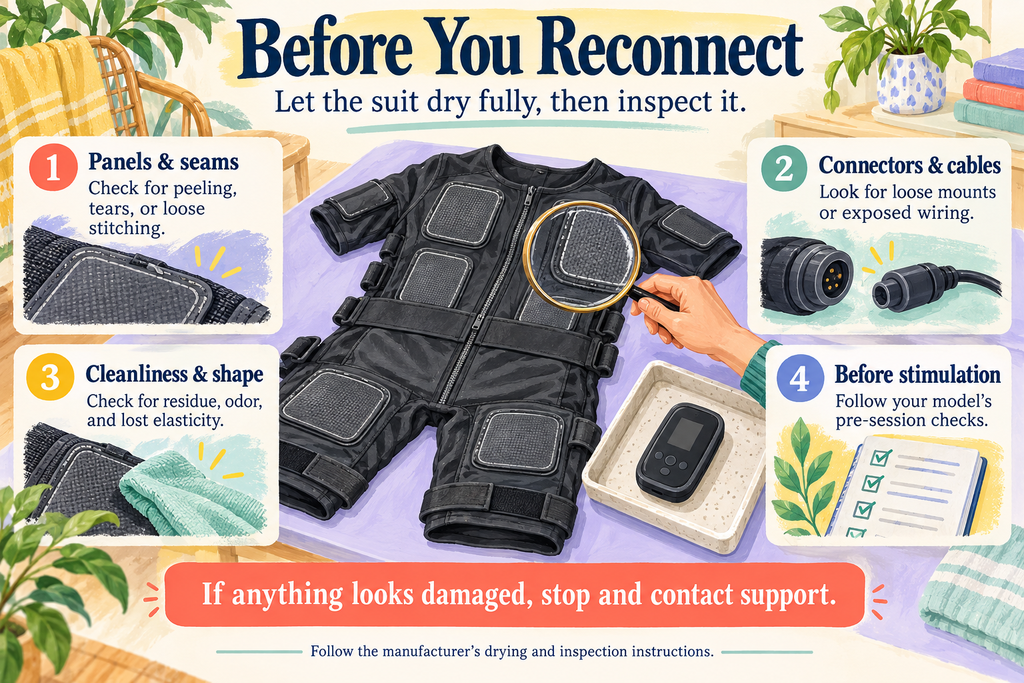
Before the controller is attached, inspect:
- Electrode panels and seams.
- Connector mounting.
- Delamination or peeling.
- Residue and odor.
- Garment shape and elasticity.
- Any cable that shifted or protrudes.
The StimaWELL garment manual specifically calls for electrode-conductivity checks in commercial use, especially after washing. Follow the inspection method required for your equipment.
After full drying, perform a low-level pre-session equipment check. Stop if a zone is sharp, intermittent, or inactive.
What if the label is missing?
Do not select a generic delicate cycle. Identify the exact model and obtain the official care instructions for that model from the manufacturer. Model revisions can use different materials even under a similar product name.
If the suit cannot be identified, professional inspection or replacement may be safer than experimenting with a wash.
Keep a copy of the care instructions
Care labels can fade, and a studio may operate several garment generations with different rules. Save the official manual with the equipment record and note the exact model on the laundry process.
Do not copy a temperature or cycle from memory when multiple suits share a laundry area. A simple model-specific checklist helps prevent controllers from entering the wash, incompatible garments from being combined, and a spin or drying setting from being applied to equipment that prohibits it.
Frequently asked questions
Can every wireless EMS suit be machine washed?
No. Wireless describes communication, not garment washability.
Is cold water always safe?
No. Mechanical action and detergent can still damage a garment that requires hand washing or special care.
Can I use fabric softener?
Only if explicitly allowed. Softeners can leave coatings or residues on fibers, so follow the garment manufacturer’s instructions.
How should I wash a studio suit shared by clients?
Follow the commercial system’s validated sanitation process, applicable local requirements, and manufacturer instructions. A household cycle may be inadequate or damaging.
The practical takeaway
Machine washing is a product-specific feature. Confirm it on the care label, remove every electronic component, prepare closures, use the approved detergent, and match the temperature, agitation, and spin settings exactly.
Then dry and inspect the suit before a low-level test. When the label is missing or ambiguous, ask the manufacturer instead of experimenting.