
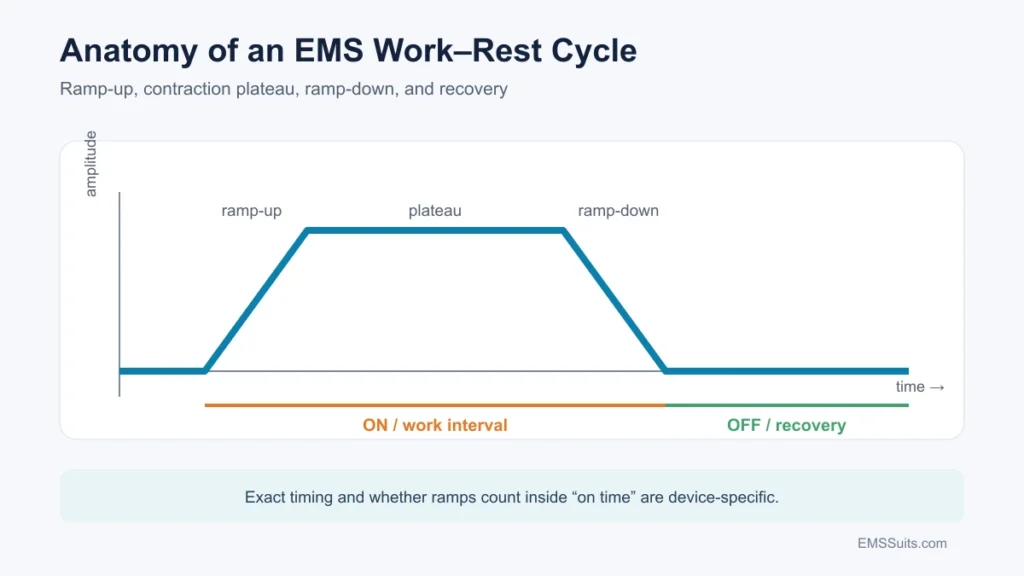
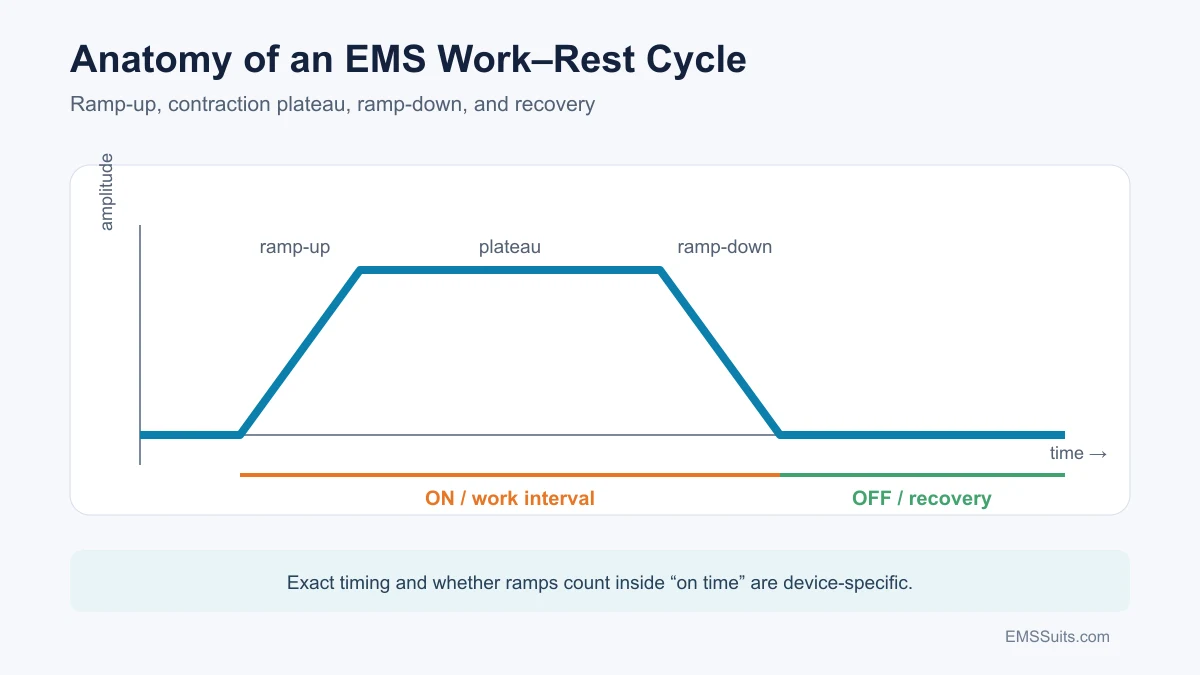
An EMS contraction is usually delivered in repeating blocks: stimulation turns on, the muscle contracts, stimulation turns off, and the muscle recovers. The timing of those blocks is the duty cycle. It is one of the main reasons two programs with the same frequency and session length can feel very different.
Duty cycle is not a universal prescription. Research protocols vary by muscle, population, equipment, and goal. Consumer whole-body EMS users should follow the program supplied with their system rather than copying a clinical protocol from a paper.
What does duty cycle mean in EMS?
Duty cycle describes how much of a repeating cycle is spent in the active phase. In EMS literature, it is often reported as separate on and off times or as an on-to-off ratio.
A simple example is 5 seconds on and 10 seconds off. The complete cycle lasts 15 seconds, and stimulation is active for one-third of that time. Expressed as a percentage, the duty cycle is about 33%.
The calculation is:
Duty cycle = on time ÷ (on time + off time) × 100
That percentage does not describe pulse width or frequency. Hundreds of individual pulses may occur inside one on period.
On time: the contraction block
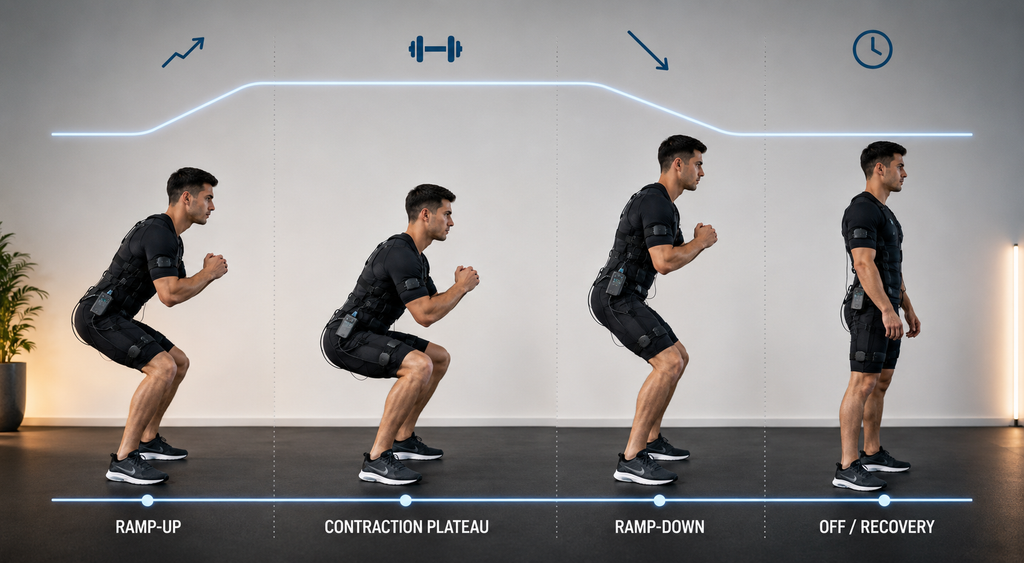
During the on period, pulses arrive rapidly enough to produce a sustained contraction. Depending on the system, this may coincide with a squat, press, hold, or another controlled movement.
Longer on periods are not automatically more effective. A stimulated contraction can fatigue quickly, especially when amplitude is high, a large muscle mass is active, or recovery is short. Technique may deteriorate before the timer ends if the movement is too demanding for the selected program.
Off time: recovery is part of the program
The off period is not wasted time. It allows force to recover before the next electrically evoked contraction. Reviews of NMES practice commonly describe work periods separated by equal or longer recovery periods, but the exact ratios vary substantially.
A critical clinical review reports on:off timing ranging from approximately 5–10 seconds of work to 6–30 seconds of rest in some gait and strengthening applications. A Cochrane review of NMES for weakness in advanced disease found wide variation between studies, with a median target duty cycle of 33%. These findings demonstrate variation; they do not establish one best ratio for a whole-body suit.
How duty cycle affects fatigue
Electrical stimulation can recruit motor units in a pattern that differs from voluntary exercise. The activated fibers may fatigue rapidly when repeated contractions are delivered with insufficient rest. Frequency, amplitude, pulse duration, body position, and voluntary effort all interact with duty cycle.
Shortening the off time increases contraction density: more active work is packed into the same session. That may raise fatigue and reduce the force produced in later repetitions. Extending the off time can preserve contraction quality, but it also reduces the number of contractions completed within a fixed session.
The practical goal is not to maximize on time. It is to use a program that permits controlled, repeatable contractions without escalating intensity faster than the user can tolerate.
Duty cycle vs work-to-rest ratio
The terms are closely related but expressed differently:
- On/off time: 5 seconds on, 10 seconds off.
- Work-to-rest ratio: 1:2.
- Duty cycle: about 33%.
When comparing studies or manuals, convert the figures carefully. A notation such as 1:3 can be ambiguous if the author does not specify which number represents work. Prefer sources that state the actual seconds.
Ramp time changes the edges of each cycle
Many programs do not jump instantly from zero to the target amplitude. A ramp-up phase gradually introduces the contraction, and a ramp-down phase gradually releases it. Some manuals count ramp time inside the on period; others list it separately.
That reporting difference can make two apparently identical duty cycles behave differently. Our separate guide to EMS ramp time explains how those transition periods affect movement timing and comfort.
Why whole-body EMS needs conservative progression
Whole-body EMS activates several large regions in the same session. A local quadriceps protocol from a rehabilitation study cannot be assumed to deliver the same total training stress as a suit stimulating the legs, glutes, trunk, back, and arms.
Beginners should use the manufacturer’s introductory program, keep movements simple, and leave adequate recovery between sessions. The existing EMSSuits guide on how often EMS training should happen covers session-level recovery. Duty cycle concerns recovery within a session; weekly frequency concerns recovery between sessions.
Can users change the duty cycle?
Some professional devices allow trained operators to set on time, off time, and ramp time. Many home systems package those choices inside named programs and expose only zone intensity.
Do not override program timing through unsupported software or copy a ratio from a different machine. The displayed percentage, waveform, output limits, and electrode configuration may not be comparable.
If a program feels too demanding, reduce amplitude or choose the appropriate beginner or recovery program specified by the manufacturer. Stop if contractions become painful, technique cannot be maintained, or an unusual symptom develops.
Frequently asked questions
Is a higher duty cycle better?
No. A higher duty cycle means proportionally more stimulation time, but it can also increase fatigue. Effectiveness depends on the full program and the training goal.
Is duty cycle the same as frequency?
No. Frequency is the number of pulses delivered per second. Duty cycle describes the timing of contraction and rest blocks.
What duty cycle should a beginner use?
Use the beginner program and instructions provided for the specific EMS system. There is no device-independent percentage appropriate for every user.
Does recovery mode have a duty cycle?
It may use different timing or continuous low-level pulse patterns. Check the manual because the word “recovery” does not define one standardized waveform.
The practical takeaway
EMS duty cycle is the balance between stimulation and rest inside a session. More work is not automatically better: the off phase helps preserve contraction quality and manage fatigue. Read on/off time together with ramp time, frequency, pulse duration, amplitude, electrode contact, and the number of muscle zones involved.
For everyday use, select the intended program rather than rebuilding its timing. For professional systems with adjustable parameters, document actual on seconds, off seconds, ramps, frequency, pulse duration, and amplitude so the session can be understood and repeated.