If most of your workday happens in front of a computer, staying active can be a challenge. You may exercise before work or hit the gym afterward, but that still leaves hours in between spent sitting at a desk. Learning how to stay fit with a desk job means looking beyond a single workout and paying attention to how much you move throughout the entire day.
Desk work itself does not automatically make someone unfit. The bigger issue is that it creates long stretches with very little movement. Sedentary behavior generally refers to waking activities performed while sitting, reclining, or lying down with very low energy expenditure. Importantly, being sedentary is not exactly the same thing as being physically inactive. Someone can meet weekly exercise recommendations and still spend a large portion of each day sitting, a distinction reflected in the WHO physical activity guidelines.
That distinction matters when figuring out how to stay fit with a desk job. Rather than trying to “undo” a workday with one intense workout, a better strategy is to combine regular movement throughout the day with deliberate aerobic and strength exercise. For people looking to add another challenge to their workouts, whole-body electrical muscle stimulation (WB-EMS) may also have a place.
What Actually Happens When You Sit for Hours?
Sitting gets blamed for everything from “inactive glutes” to poor posture, but the reality is more nuanced. Your muscles do not simply switch off when you sit. They are still working to some degree, but sitting requires much less movement and muscular effort than activities such as walking, climbing stairs, or resistance training.
Over the course of a desk-heavy day, that adds up to a lot of time when major muscle groups are not being meaningfully challenged.
The World Health Organization recommends that adults limit sedentary time and replace it with physical activity whenever possible. Higher amounts of sedentary behavior have been associated with poorer long-term health outcomes, although current guidelines do not establish one universal number of sitting hours that everyone must stay below.
That is why understanding how to stay fit with a desk job starts with a simple principle: spend less of the day inactive and create more opportunities to move.
Why Desk Workers Often Feel Stiff
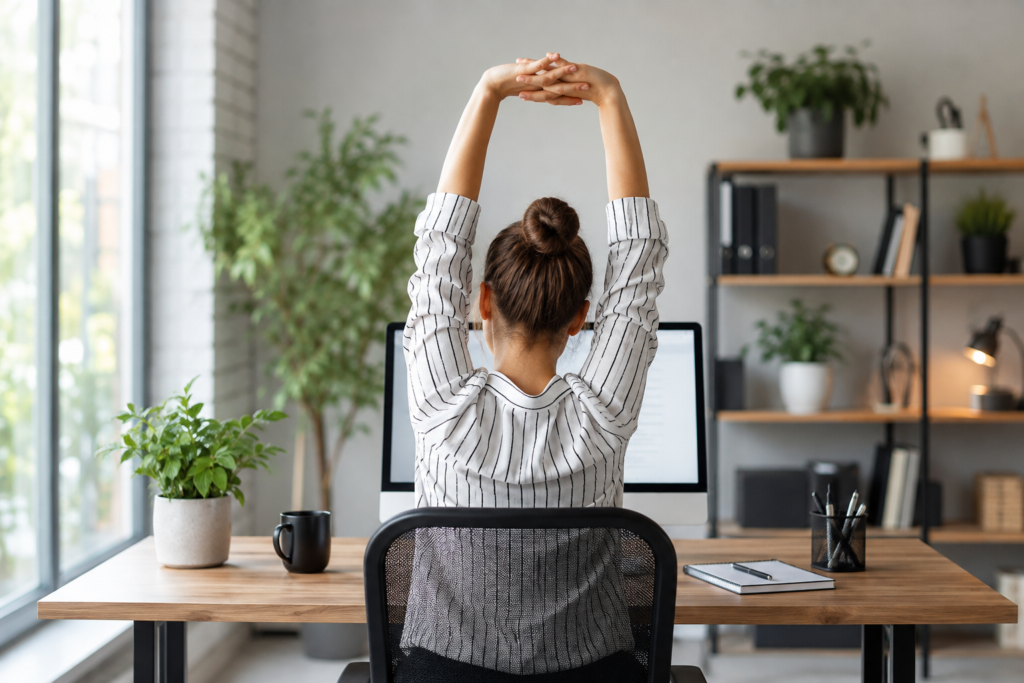
Anyone who has stood up after several hours at a computer knows the feeling: tight hips, a stiff back, or tense shoulders and neck.
It is tempting to blame sitting alone, but musculoskeletal discomfort is more complicated. Workstation setup, time spent in one position, physical activity, strength, workload, and individual factors can all play a role.
Research examining occupational sitting and musculoskeletal discomfort has found associations between workplace sitting and complaints such as neck, shoulder, and lower-back discomfort. However, an association does not prove that sitting by itself caused the problem.
The more useful takeaway is that your body benefits from movement and variation. When considering how to stay fit with a desk job, regularly changing positions makes more sense than trying to hold one supposedly perfect posture for an entire workday.
Break Up Your Workday
One of the easiest changes does not require a gym, workout clothes, or much extra time.
Get out of your chair.
Current physical activity recommendations encourage adults to reduce sedentary behavior and replace some of that time with physical activity. Even light-intensity movement contributes to reducing the amount of time spent completely sedentary.
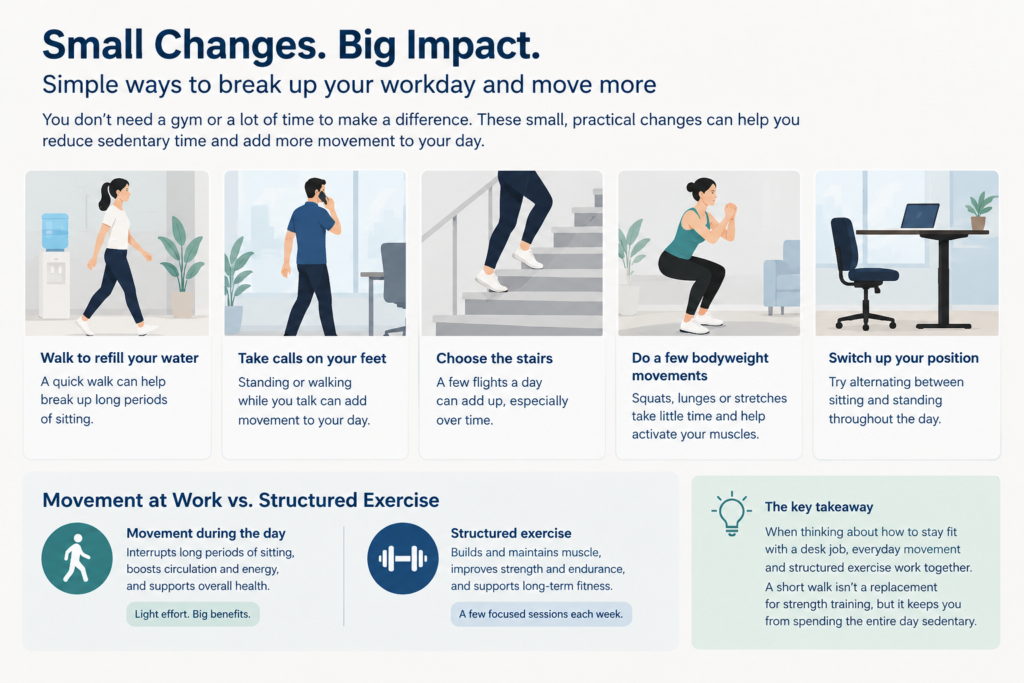
That could mean:
- Walking to refill your water
- Taking a short walk between meetings
- Standing during a phone call
- Walking to speak to a coworker instead of sending a message
- Taking the stairs
- Doing a few bodyweight movements
- Alternating between sitting and standing during the workday
These actions may seem insignificant compared with a full workout, but they serve a different purpose. When considering how to stay fit with a desk job, everyday movement and structured exercise should complement each other. A short walk is not supposed to replace strength training. It simply prevents another long stretch of uninterrupted sitting.
Do You Need to Get Up Every 30 Minutes?
You may have seen recommendations telling office workers to stand or walk every 20 or 30 minutes. There is some science behind taking frequent activity breaks, but there is no single magic interval that applies to everyone.
A systematic review examining different frequencies of activity breaks during prolonged sitting found that more frequent breaks could improve some acute metabolic responses. However, the researchers also noted limitations in the available evidence.
So, a practical approach to how to stay fit with a desk job is not to panic when a timer reaches exactly 30 minutes. Instead, build movement into the natural breaks in your schedule and avoid remaining seated for hours at a time when possible.
Consistency matters more than obsessing over an exact timer.
Moving More Is Only Part of the Equation
Taking walking breaks is a useful habit, but there is an important distinction between moving your body and actually training your muscles.
Adults are advised to perform muscle-strengthening activities involving all major muscle groups on at least two days per week. The WHO guidelines also recommend 150 to 300 minutes of moderate-intensity aerobic physical activity per week, 75 to 150 minutes of vigorous activity, or an equivalent combination.
That gives us another major piece of how to stay fit with a desk job: some of your weekly activity should actually challenge your muscles.
Research specifically involving sedentary office workers supports the value of resistance exercise. A recent systematic review and meta-analysis examined resistance training among office workers and reported improvements in muscular strength along with some favorable musculoskeletal outcomes. The researchers also rated the overall certainty of evidence as low, so the results should not be interpreted as proof that resistance training eliminates every problem associated with desk work.
What it does show is that strength training deserves a place alongside your walking breaks.
Strength Exercises for People Who Sit All Day
You do not need a complicated workout designed exclusively for office workers. Fundamental exercises can train the major muscle groups that spend much of the workday relatively underchallenged.
Useful movements can include:
- Squats
- Split squats
- Lunges
- Glute bridges
- Hip hinges
- Rows
- Push-ups
- Planks and other trunk exercises
Depending on the movement, these exercises can challenge the glutes, quadriceps, hamstrings, back, chest, shoulders, and core.
For someone learning how to stay fit with a desk job, the specific exercise selection matters less than building a consistent routine that provides an appropriate challenge.
As you become stronger, that challenge should progress. You might perform additional repetitions, increase resistance, use a more difficult exercise variation, slow down the movement, or introduce another source of muscular stimulation.
This is also where EMS can become useful.
Where EMS Fits Into a Desk-Worker Fitness Routine
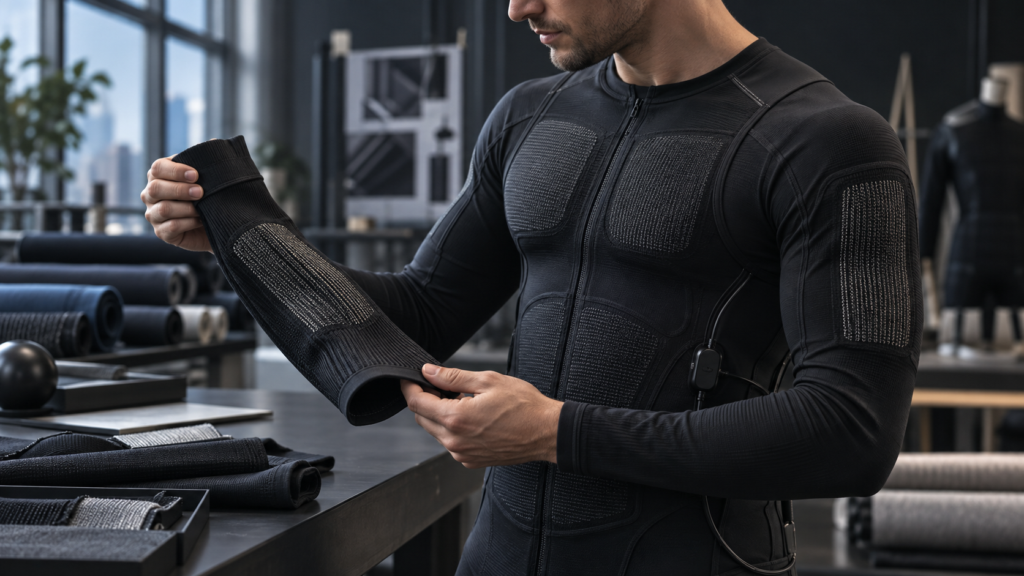
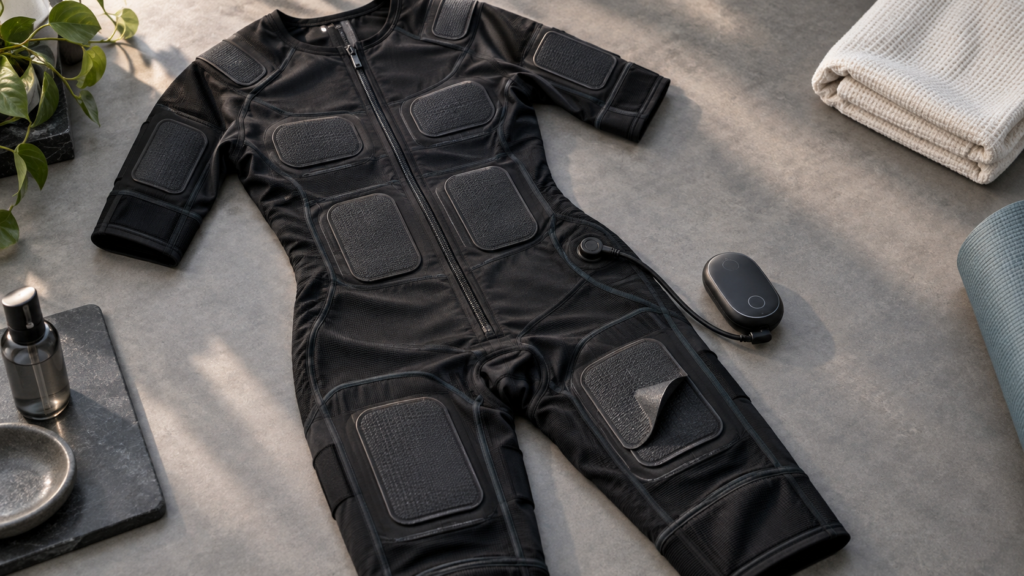
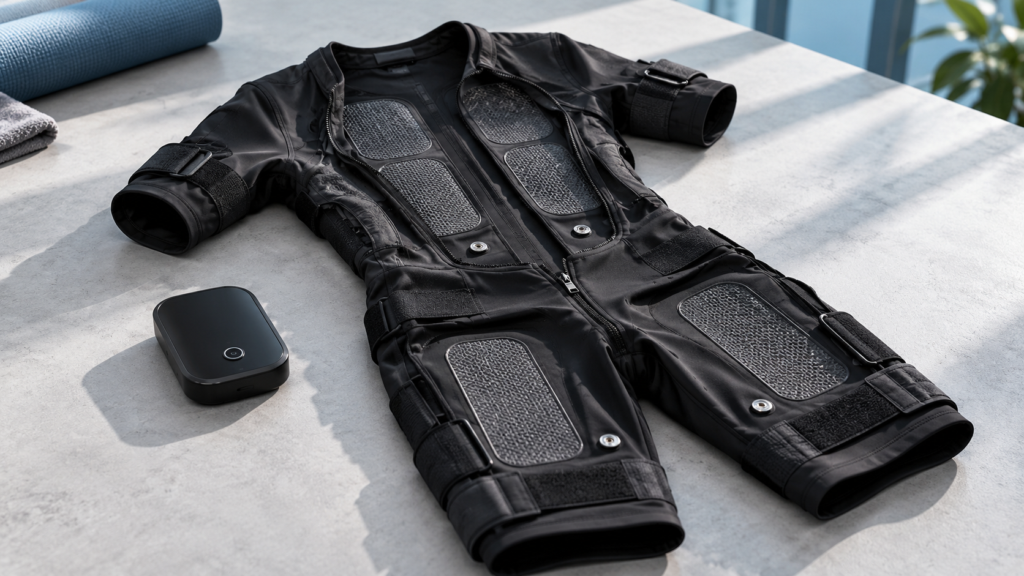
Electrical muscle stimulation uses controlled electrical impulses to cause muscle contractions. With whole-body EMS, electrodes positioned across several areas of the body allow multiple muscle groups to be stimulated during the same training session.
This is different from the idea of simply sitting in a chair while electricity “does the workout for you.”
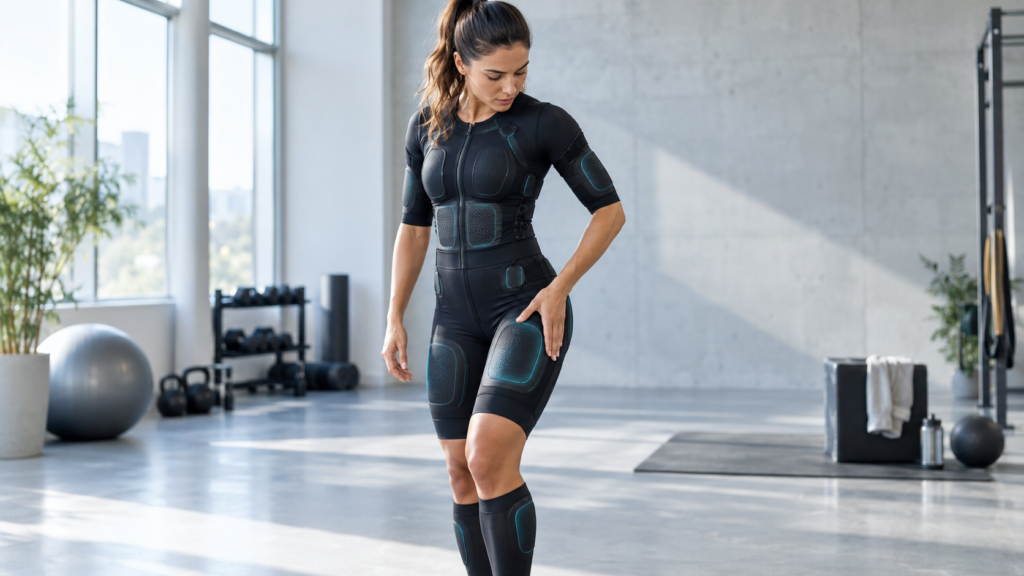
Whole-body EMS can be combined with voluntary movements, allowing someone to perform exercises while electrical stimulation provides an additional muscular stimulus.
That distinction is important when discussing how to stay fit with a desk job. EMS should not be viewed as a way to cancel out eight hours of sitting without changing your habits. It is better understood as a tool that can be incorporated into active training.
What Does the Research Say About Whole-Body EMS?
There is legitimate scientific research behind WB-EMS, but it is important not to overstate what the evidence shows.
A systematic review and meta-analysis published in Medicine examined 26 controlled studies involving 1,183 adults. Compared with control conditions, WB-EMS was associated with positive effects on muscle mass, strength, and power. The included studies covered both active and non-active adults and varied substantially in duration and training protocols.
Another systematic review focused on non-athletic adults and included 16 studies representing 897 participants. Researchers reported significant effects on muscle mass as well as maximum leg and trunk extension strength.
However, WB-EMS studies vary in participant characteristics, stimulation settings, training frequency, exercise selection, and program length. That makes it difficult to take the results of one protocol and assume they will apply to every EMS workout.
The research makes EMS relevant to the conversation around how to stay fit with a desk job, particularly when someone wants another way to challenge multiple muscle groups during training. It does not mean EMS has been proven superior to every form of conventional resistance exercise.
Think of EMS as an Enhancement, Not a Replacement
The most useful way to understand EMS in a desk-worker routine is as another source of muscular stimulation.
Consider a bodyweight squat. Your nervous system already sends signals that cause the muscles involved in the movement to contract. When electrical stimulation is added, external impulses can cause additional contractions while you continue performing the exercise voluntarily.
A similar approach can be incorporated into lunges, hinges, core exercises, and other movements depending on the training program.
For someone researching how to stay fit with a desk job, this can be appealing because whole-body EMS can stimulate several muscle groups during the same workout rather than requiring separate equipment for each area.
Time efficiency is another reason WB-EMS has attracted interest. In one meta-analysis of WB-EMS research, many of the protocols involved sessions of roughly 20 minutes, although session length, frequency, intensity, and exercise design varied across studies.
That does not make 20 minutes a magic number, nor does it mean every 20-minute EMS workout produces the same result. It simply helps explain why EMS may appeal to people who have limited time available for structured exercise.
What Won’t Fix a Day of Sitting?
There is plenty of advice online about how to stay fit with a desk job, but some solutions are oversimplified.
Standing All Day
A standing desk can help you change position and reduce some sitting time, but standing is not strength training.
It also does not provide the same stimulus as walking or other physical activity. Think of a sit-stand desk as one way to introduce more variety into your workday rather than a replacement for exercise.
One Hard Workout Followed by No Movement
Exercising before or after work is valuable. It still does not make movement during the rest of your day irrelevant.
Physical activity guidelines treat sedentary behavior and exercise as related but distinct considerations. This is why a good approach to how to stay fit with a desk job addresses both.
Train regularly, but keep moving throughout the day too.
Stretching Alone
Stretching can feel good after spending hours in one position, and mobility work can certainly be part of a fitness routine.
However, stretching and strength training are not interchangeable. If your goal includes building or maintaining muscular strength, your muscles need an appropriate training stimulus.
Wearing EMS While Doing Nothing
The evidence supporting WB-EMS does not mean an EMS suit should become another excuse to remain inactive.
Research protocols vary, and much of the WB-EMS research involves structured training protocols rather than simply wearing electrodes passively throughout the workday.
If your goal is how to stay fit with a desk job, movement remains part of the equation.
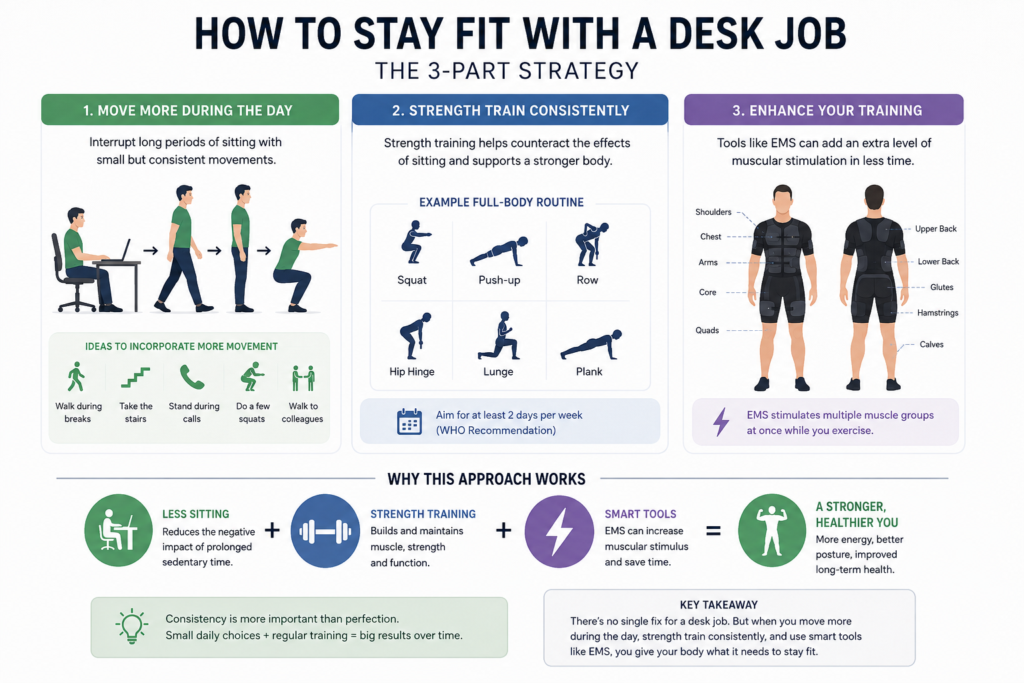
A Simple Three-Part Strategy for Desk Workers
Rather than looking for one hack that reverses sitting, think about your routine in three layers.
1. Move More During the Workday
Look for small opportunities to interrupt long periods of sitting. Walk, stand, take the stairs, change positions, or perform a few simple movements.
You do not need to turn every break into a workout. The goal is simply to keep your desk from becoming the only place your body spends the day.
2. Strength Train Consistently
Dedicate some time each week to exercises that meaningfully challenge your muscles.
The WHO recommendations call for adults to perform muscle-strengthening activities involving all major muscle groups on at least two days per week.
When determining how to stay fit with a desk job, this is something that extra steps around the office cannot fully replace.
3. Enhance Your Training When It Makes Sense
Once you have the fundamentals in place, training tools can help you modify the challenge.
For some people, that could mean dumbbells or resistance bands. For others, it could mean more difficult bodyweight exercises or whole-body EMS.
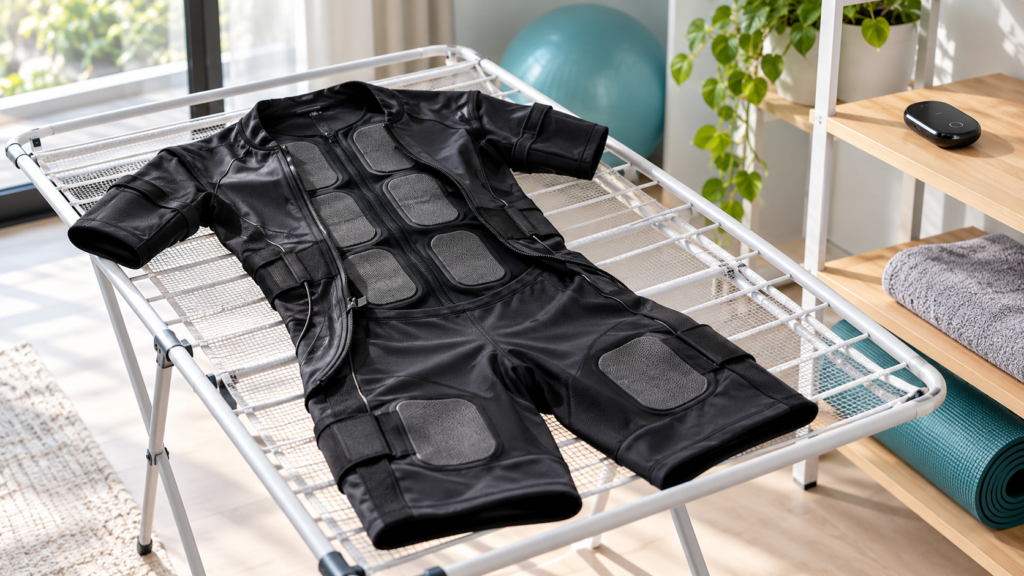
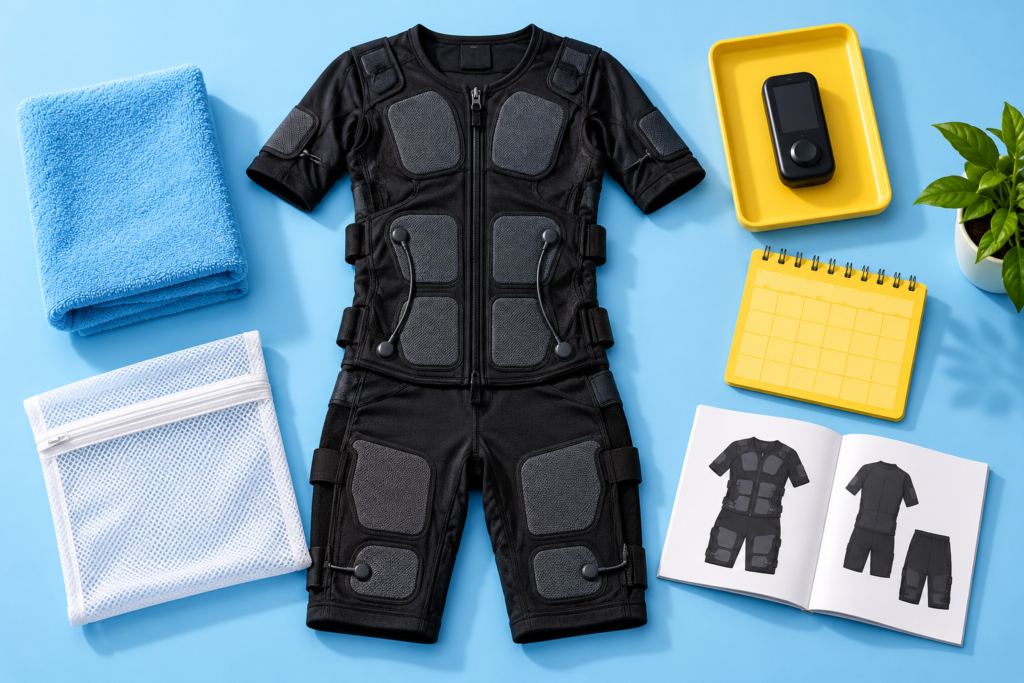
An EMS suit provides an option for someone who wants to combine active exercise with electrical stimulation across multiple muscle groups.
The important distinction is what the technology is there to do: enhance the muscular stimulus of a workout, not eliminate the need for one.
Build a Routine You Can Actually Maintain
The best desk-worker fitness routine is not necessarily the one with the most exercises, equipment, or complicated rules. It is one you can consistently fit around your work.
If you are figuring out how to stay fit with a desk job, start by identifying where long stretches of sitting occur. Find realistic opportunities to interrupt them. Then make sure your week contains deliberate exercise, including strength training.
From there, decide what makes that routine easier to maintain.
For someone with limited time, a home workout may be more realistic than driving to a gym. Someone who finds bodyweight training too easy may need additional resistance. Someone interested in increasing muscular stimulation during a shorter full-body workout may choose to incorporate EMS.
The method can change. The underlying principle does not.
How to Stay Fit With a Desk Job: Comes Down to More Than One Workout
Sitting at a computer for work does not mean you cannot be fit. It simply means movement may need to become more intentional.
The science behind how to stay fit with a desk job points toward a combination of behaviors rather than one solution: spend less time continuously sedentary, replace some sitting with everyday movement, perform regular aerobic activity, and give your muscles a reason to stay strong through resistance-focused exercise.
EMS can complement that approach. Research suggests whole-body EMS can support improvements in muscular strength and muscle mass, making it an interesting option for adding stimulation to an active workout. But it should be viewed in context.
An EMS suit cannot make a sedentary day disappear.
What it can do is provide another way to increase the muscular challenge during the strength-training portion of your routine. Combined with regular movement and consistent exercise, that makes EMS one potential tool within the bigger picture of how to stay fit with a desk job.
Ready for your EMS suit for your desk job? Check out the brand/product reviews or use the product comparison tool to help you decide.