EMS training has attracted growing interest in the fitness world, but most people who encounter it for the first time want to understand how EMS training works and usually leave with the same set of questions: How does it actually work? What is happening in my muscles when the electricity switches on? And is it meaningfully different from conventional exercise?
These are practical questions, not just theoretical ones. Understanding how EMS training works helps you use it more intelligently, set appropriate expectations, and decide whether it belongs in your routine.
Below, we break down how EMS training works in plain language, covering the biology of muscle contraction, the physics of electrical impulses, and what current research says about the body’s response to EMS-assisted exercise.
How Muscles Contract Normally
To understand how EMS training works, it helps to start with how your muscles contract under normal conditions. When you decide to move, whether picking something up, squatting, or pressing overhead, your brain generates an electrical signal that travels down through the spinal cord and along motor neurons to the muscles being called into action.
Each motor neuron controls a group of muscle fibers called a motor unit. When the signal arrives at the muscle, it triggers a chain reaction inside each fiber: calcium is released, which causes two proteins, actin and myosin, to slide against each other, shortening the fiber and producing a contraction.
Your nervous system recruits motor units progressively depending on force requirements, a process governed by what’s called the size principle:
- Light activity calls on fewer motor units
- Heavier effort recruits more
- At maximum voluntary effort, you recruit the greatest number available
Even during maximal voluntary exercise, research suggests not every available muscle fiber activates. Some capacity stays in reserve.
How EMS Bypasses the Voluntary Pathway
This is where EMS training introduces a fundamentally different mechanism. Rather than relying solely on signals generated by your brain and transmitted through motor neurons, EMS applies external electrical impulses directly to the skin over target muscle groups. These impulses penetrate through the skin and tissue to stimulate the motor neurons beneath, triggering contractions that work alongside the voluntary signals your nervous system is already sending.
The practical implication: EMS neuromuscular activation can prompt muscles to contract more fully than voluntary effort alone might achieve at a given exercise intensity. The electrical stimulation adds an activation layer on top of whatever your own nervous system is contributing.
It’s worth being clear about what EMS training does not do in a fitness context: it does not completely override voluntary muscle control. During a typical session, you are actively exercising and engaging your muscles through your own effort while the suit simultaneously delivers supplementary stimulation. The two sources of muscle activation work together.
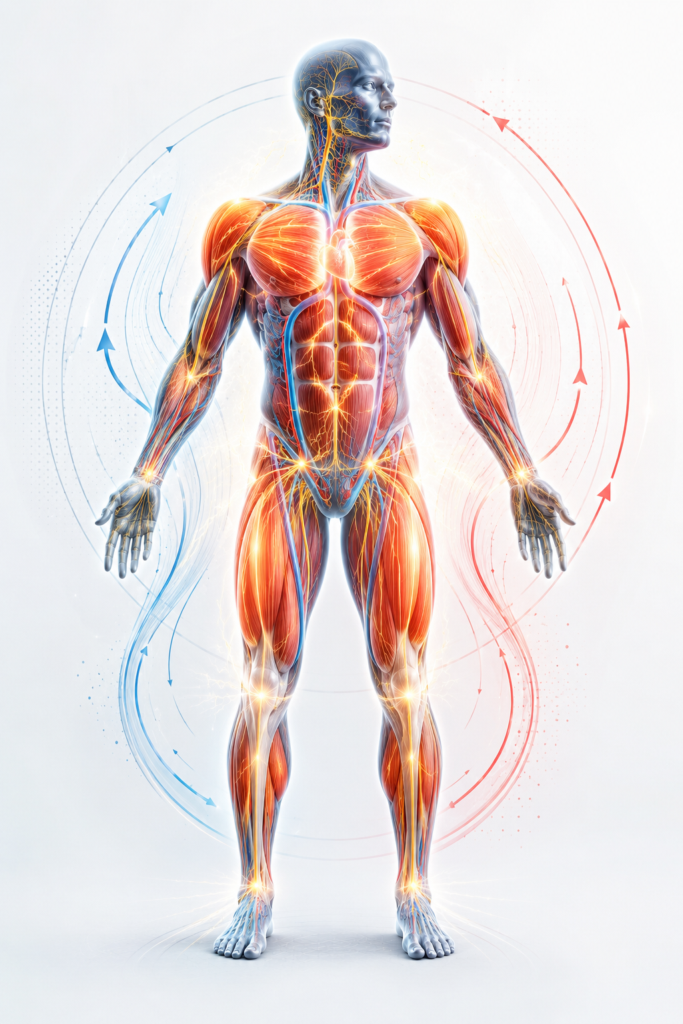
How EMS Training Works: The Three Key Parameters of Electro-Muscle Stimulation Science
EMS devices deliver electrical impulses in precisely controlled patterns, governed by three parameters. Understanding what each does explains why different settings are used for different training goals.
Frequency
Measured in hertz (Hz), frequency refers to how many pulses are delivered per second.
- 1–20 Hz: Slower, sustained contractions. Used in recovery or endurance-oriented applications.
- 50–120 Hz: Faster, more forceful contractions. Used in strength and performance-focused protocols.
Pulse width
The duration of each individual electrical pulse, measured in microseconds.
- Wider pulse widths penetrate more deeply, recruiting more motor units and producing stronger contractions.
- Narrower pulse widths are more superficial in effect.
Intensity
The amplitude of the electrical current, meaning how strong the impulse is. This is the parameter you feel most directly:
- Low intensity: mild tingling
- High intensity: strong, involuntary muscle contraction
In supervised sessions, intensity is carefully calibrated for each muscle group based on your feedback and tolerance.
Motor Unit Recruitment in EMS: Which Muscle Fibers Does It Activate?
Muscle tissue contains two broad fiber categories:
- Type I (slow-twitch): Fatigue-resistant, associated with sustained lower-intensity activity.
- Type II (fast-twitch): Greater force and power output, fatigue more quickly. Primary fibers for explosive strength movements.
During normal voluntary exercise, the nervous system follows the size principle, recruiting Type I fibers first, then Type II as intensity demands increase. Motor unit recruitment during EMS does not strictly follow this order. Depending on the electrical parameters used, EMS can activate both fiber types simultaneously or recruit fast-twitch fibers at lower levels of voluntary effort than conventional training would require.
This characteristic has attracted research interest into whether EMS can access fast-twitch motor units more comprehensively than voluntary training alone, particularly for individuals who struggle to generate maximal voluntary effort due to pain, fatigue, or deconditioning.
What Happens During a Whole-Body EMS Session? Understanding How EMS Training Works in Practice
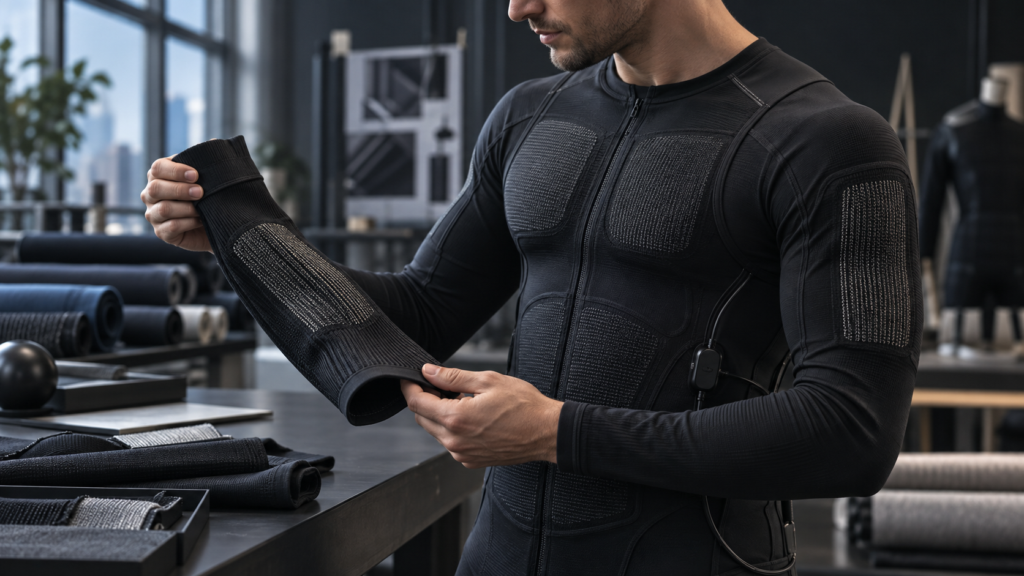
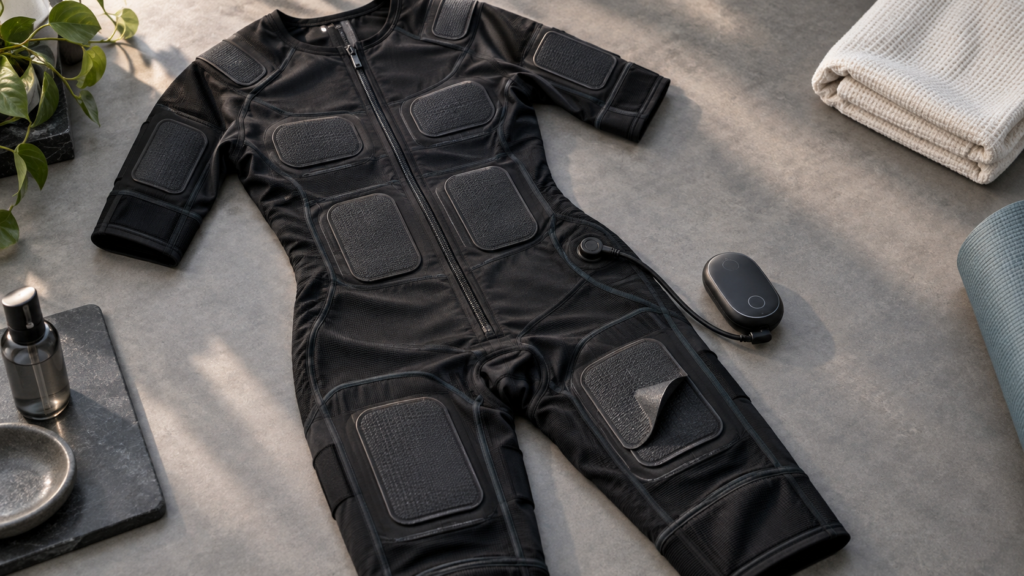
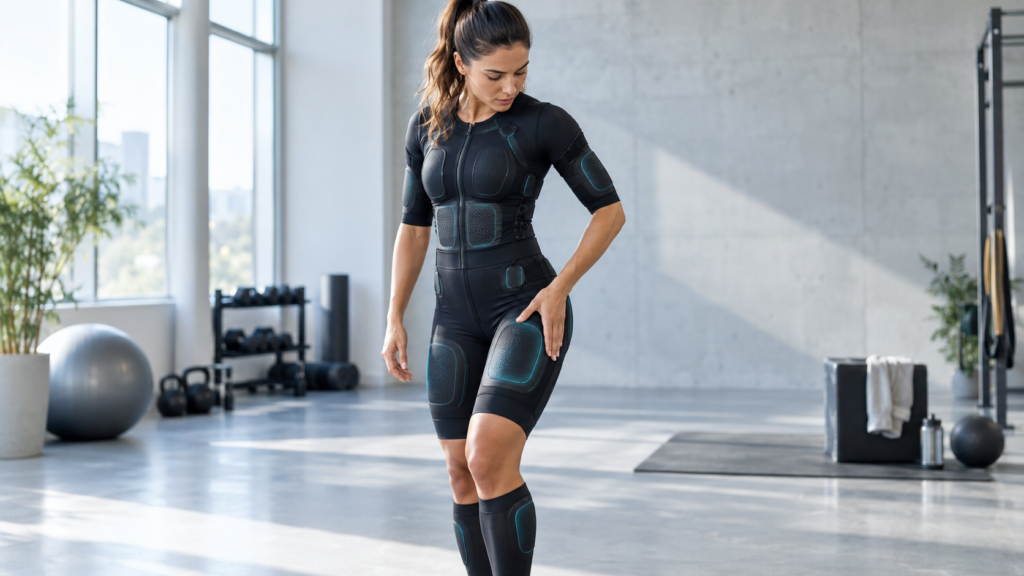
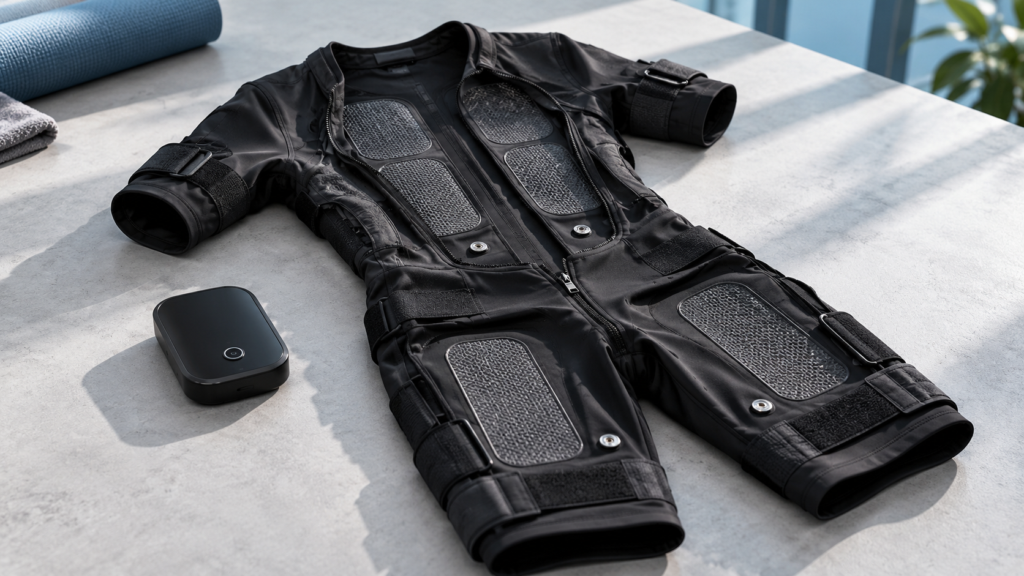
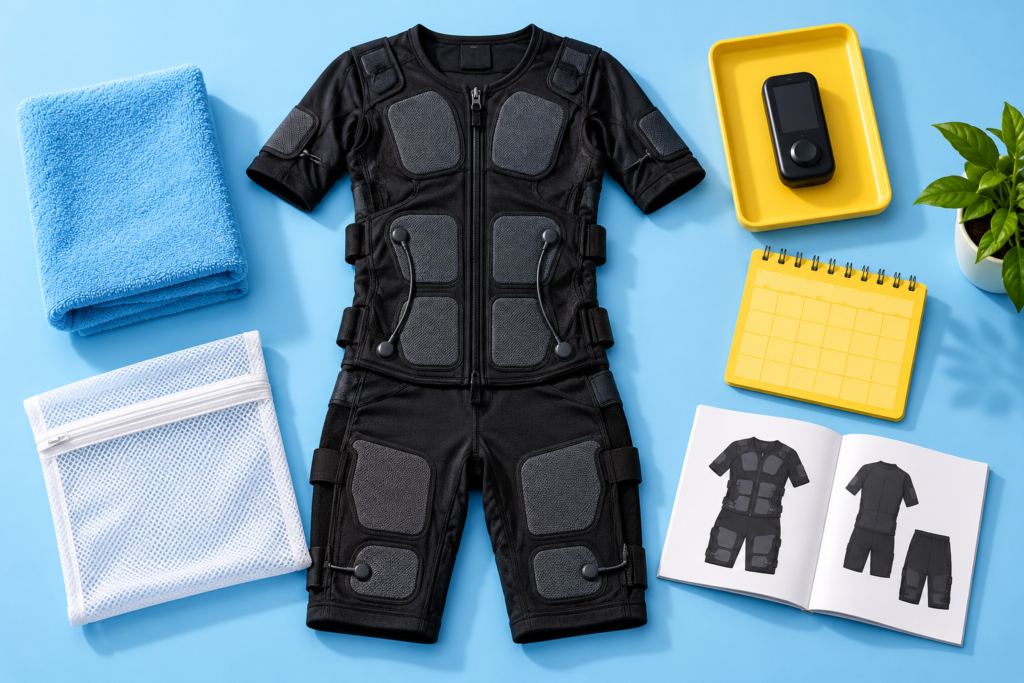
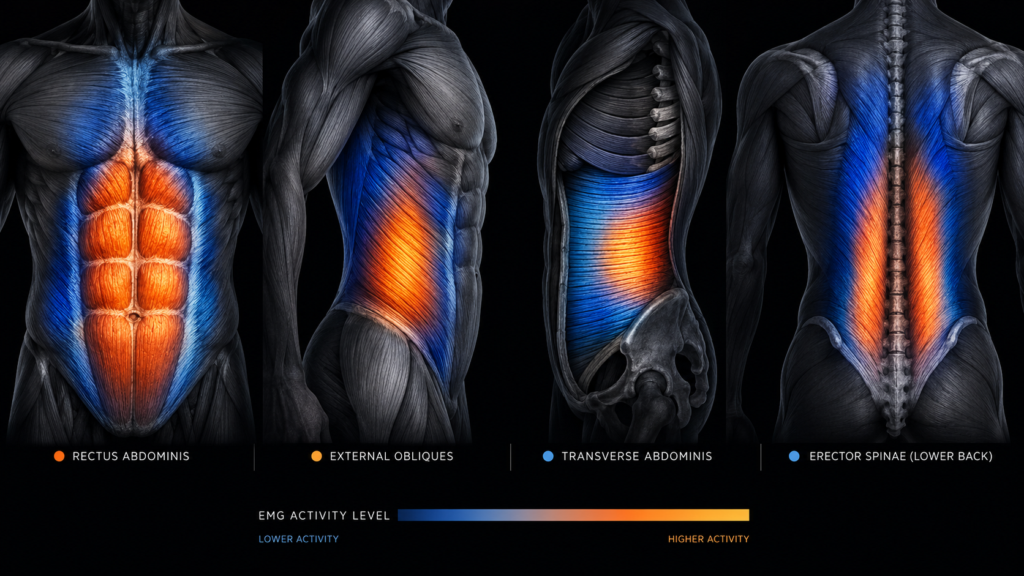
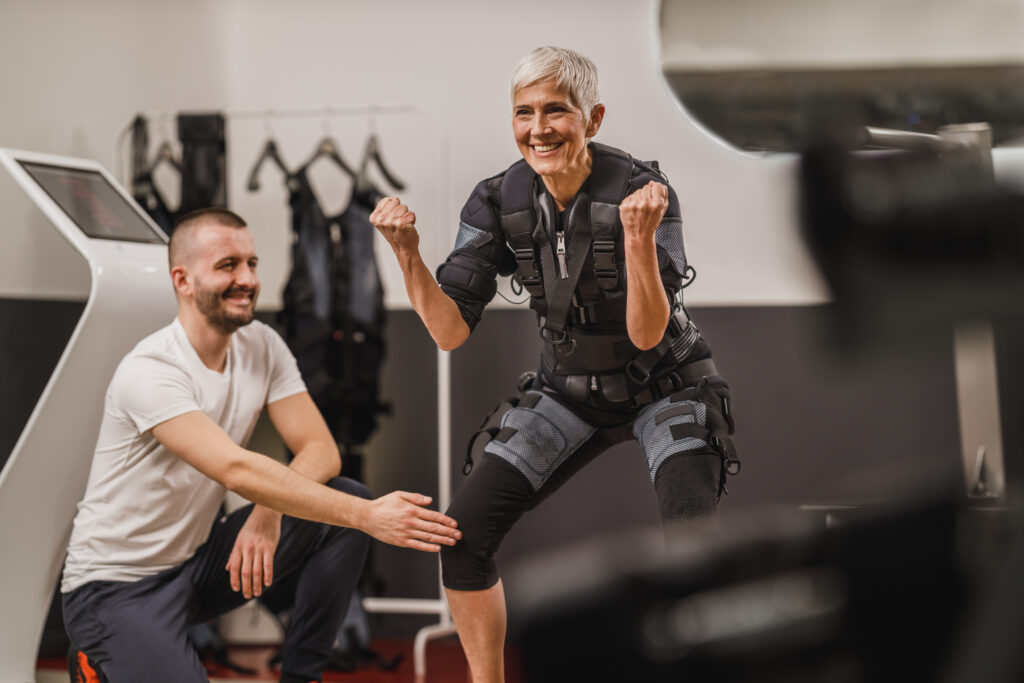
In a whole-body EMS session, the suit stimulates multiple major muscle groups simultaneously, typically the chest, upper and lower back, shoulders, arms, abdominals, glutes, and legs, while you perform functional movements. This distinguishes whole-body EMS training from single-site clinical EMS, which targets one muscle group at a time.
During a 20 to 30-minute session, the device cycles between:
- Active stimulation phases: Current is on, muscles are contracting
- Rest phases: Current is off, muscles relax
This rhythmic pattern delivers muscular work across many groups simultaneously without causing excessive fatigue in any single area.
The sensation during an active phase is commonly described as a powerful, externally driven muscle tightening. Most users report it takes one to three sessions to become comfortable with the experience.
What Current Research Says About EMS Training
The scientific literature on how EMS training works and what it produces has grown substantially over the past 20 years. Studies have examined its effects on muscle strength, muscle cross-sectional area, body composition, and athletic performance across a range of populations.
Key findings include:
- When combined with voluntary exercise, EMS training may produce strength and hypertrophy outcomes comparable to, or complementary to, conventional resistance training, particularly in trained individuals who struggle to generate sufficient overload through voluntary effort alone.
- Studies involving older adults and individuals with sarcopenia have shown potentially meaningful results.
- Outcomes depend heavily on the EMS protocol used, the population studied, the duration of the intervention, and whether EMS was used as a standalone or supplementary method.
It’s equally important to acknowledge what the research does not conclusively establish: that short EMS sessions replace the need for regular physical activity, or that EMS produces superior results for the general population compared to well-designed conventional training. The scientific evidence is promising and growing, but it supports EMS as a complement to broader fitness habits, not a replacement for them.
Conclusion
EMS training works by delivering controlled electrical impulses that stimulate motor neurons and trigger muscle contractions beyond what voluntary effort alone might produce at a given exercise intensity. The science behind it is grounded in established neuromuscular physiology, the same principles that inform the clinical use of electrical stimulation in rehabilitation.
What makes EMS training genuinely interesting is not that it replaces effort, but that it may allow muscles to be activated more comprehensively or efficiently than voluntary training achieves in certain contexts. Used with proper supervision and realistic expectations, it represents a scientifically informed approach to supplementing physical training.
Now that you’ve learned how EMS training works, explore our EMS suit reviews and brand comparisons to find the right fit. You can also use our comparison tool to evaluate your options and make a confident decision.
Frequently Asked Questions
Is EMS training the same as electric shock therapy?
No. EMS training uses carefully controlled, low-level electrical impulses designed to stimulate motor neurons and cause muscle contractions. It is entirely different from therapeutic electric shock used in clinical psychiatric settings, both in purpose and in the nature and intensity of the electrical signals used.
Does EMS training hurt?
EMS training should not be painful when used at appropriate intensities by a qualified trainer. The sensation is typically described as a strong tingling or involuntary muscle tightening. Discomfort can occur if intensity is set too high or electrodes are poorly positioned, which is why proper setup and trained supervision matter.
Can EMS activate muscles that are difficult to engage through voluntary exercise?
This is one of the areas of active interest in EMS physiology research. Because electrical stimulation does not follow the same recruitment patterns as voluntary effort, it may engage certain muscle fibers, including fast-twitch fibers, that are difficult to recruit fully through voluntary training at moderate intensities.
Why is an EMS session only 20 to 30 minutes?
The brief duration is intentional. Because EMS training stimulates a large number of muscle groups simultaneously at potentially high activation levels, sessions are kept short to prevent excessive fatigue, soreness, or adverse effects. Most trainers recommend no more than one or two sessions per week, especially early in training.
Can you explain how EMS training works at a scientific level?
The foundational EMS neuromuscular science is well established. Research on whole-body EMS suits used specifically in fitness contexts is more recent and still evolving. Results are generally promising, but approach strong marketing claims with healthy skepticism and rely on evidence-based guidance from qualified professionals. The 2023 international guideline for whole-body EMS training is a good starting point for understanding the current consensus.