The shoulder is the most mobile joint in the human body and among the most commonly problematic. Its extraordinary range of motion is achieved through complex interactions among the rotator cuff muscles, the scapular stabilizers, the deltoids, and the larger prime movers of the shoulder girdle, and this complexity means that subtle imbalances in muscle activation patterns can have significant consequences for both shoulder health and upper extremity function.
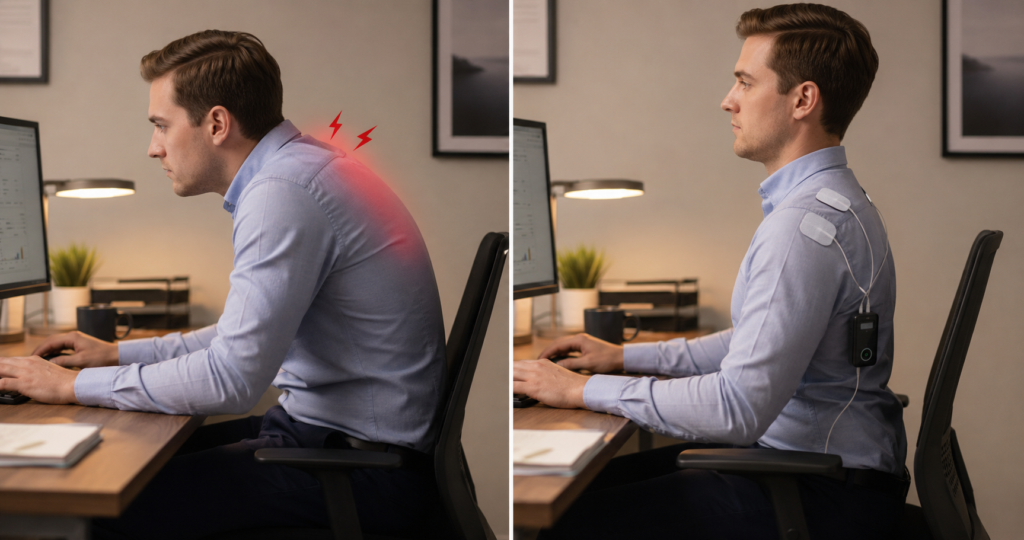
Two populations experience shoulder muscle dysfunction most frequently: desk workers, whose prolonged forward head posture and rounded shoulder position creates characteristic patterns of tight anterior muscles and inhibited posterior muscles, and overhead athletes including swimmers, throwers, and racket sport players, whose sport-specific training dominates certain shoulder muscle groups while neglecting the stabilizing muscles essential for joint health. EMS shoulder activation offers a targeted and precise approach to addressing the muscle inhibition patterns that conventional exercise often fails to reach in both groups.
This guide covers what EMS shoulder activation is, which muscles it targets, how it applies differently to desk workers and athletes, and how to integrate it effectively into a broader shoulder health program.
Why EMS Shoulder Activation Matters: Understanding Common Imbalances
Before understanding what EMS shoulder activation can do, it helps to understand what it is working against. The shoulder imbalances that affect desk workers and athletes share a common thread: internal rotation dominance combined with inhibition of the posterior and stabilizing muscles that keep the shoulder joint healthy under load.
In desk workers, this presents as upper cross syndrome, a predictable pattern involving:
- Shortened, overactive pectorals, upper trapezius, and levator scapulae from prolonged forward posture
- Inhibited and weak deep cervical flexors, lower trapezius, serratus anterior, and rhomboids
- Underactivated posterior rotator cuff, particularly the external rotators infraspinatus and teres minor, compared to the dominant internal rotators
This imbalance pattern affects shoulder mechanics significantly. Impaired scapular control from weak lower trapezius and serratus anterior alters the position of the shoulder socket during arm movement, reducing the space available for rotator cuff tendons and contributing to impingement syndromes. Weakened posterior rotator cuff allows the humeral head to migrate anteriorly and superiorly under load, compressing subacromial structures. EMS shoulder activation addresses this pattern directly by reaching the inhibited posterior muscles that conventional strengthening exercises often fail to adequately target.
In overhead athletes, the same internal rotation dominance is compounded by sport-specific training that develops the internal rotators through throwing, striking, and pulling, while the external rotators receive insufficient direct training. Filipovic et al. (2012) in the Journal of Strength and Conditioning Research found that EMS targeted activation can produce meaningful strength improvements in specific muscle groups in trained athletes, supporting the case for EMS shoulder activation as a tool for addressing sport-specific imbalances.
The Key Muscles Targeted by EMS Shoulder Activation
Effective EMS shoulder activation focuses on the posterior and stabilizing muscles that are most commonly inhibited in both desk workers and athletes. The primary targets include:
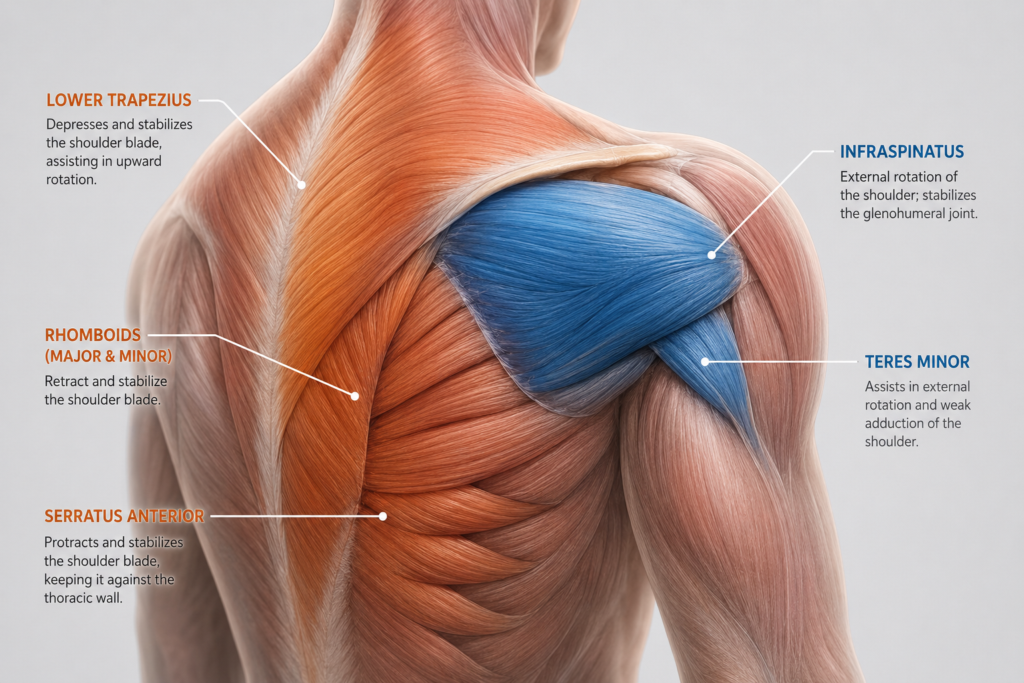
- Infraspinatus and teres minor, the posterior rotator cuff muscles responsible for external rotation and posterior humeral head control
- Lower trapezius, responsible for depression and posterior tilting of the scapula, critical for proper shoulder elevation mechanics
- Serratus anterior, the muscle that holds the scapula against the rib cage and is essential for proper scapular rotation during arm elevation
- Rhomboids and middle trapezius, which support scapular retraction and contribute to overall shoulder girdle stability
These muscles are difficult to fully isolate and activate in conventional exercises, particularly when compensation patterns allow larger and stronger muscles to dominate the movement. EMS shoulder activation provides direct stimulation of the target muscles regardless of those compensation patterns, making it a valuable complement to conventional shoulder training.
Nussbaum et al. in Physiother Can note that neuromuscular electrical stimulation is particularly effective for activating muscles with impaired voluntary recruitment, which describes precisely the inhibited posterior shoulder muscles that EMS shoulder activation is designed to address.
EMS Shoulder Activation for Desk Workers
For desk workers, EMS shoulder activation is most relevant as a tool for counteracting the chronic inhibition that develops from prolonged forward posture. The lower trapezius and posterior rotator cuff are the primary targets, as these are the muscles most consistently inhibited in upper cross syndrome presentations.
Practical applications of EMS shoulder activation for desk workers include:
- Brief daily low-intensity sessions of 10 to 15 minutes targeting the posterior shoulder and lower trapezius, used as a complement to posture correction efforts
- Pre-activation sessions before conventional shoulder strengthening exercises, priming the inhibited muscles to activate more fully during subsequent movements
- Recovery-focused sessions at lower intensity to support circulation and reduce the muscle tension that accumulates through prolonged desk work
For desk workers, consistency matters more than intensity in EMS shoulder activation. The goal is to maintain activation quality in chronically inhibited muscles over time, not to produce acute strength gains in single sessions. Daily brief sessions used alongside postural correction habits and conventional strengthening exercises produce the most meaningful long-term results.
EMS Shoulder Activation for Overhead Athletes
For overhead athletes, EMS shoulder activation serves a different but equally important purpose. The posterior rotator cuff and scapular stabilizers in overhead athletes are not simply weak from disuse but are often specifically undertrained relative to the dominant internal rotator and prime mover muscles that sport-specific training develops.
Filipovic et al. (2016) in the Journal of Sports Science and Medicine demonstrated that whole-body EMS training produced meaningful improvements in strength and power parameters in elite soccer players, supporting the broader case for EMS targeted activation as a tool within elite athletic conditioning programs.
For overhead athletes, EMS shoulder activation is best applied as:
- A pre-activation tool before conventional shoulder exercises, improving the recruitment quality of the posterior rotator cuff and scapular stabilizers during subsequent movements
- A targeted supplement to conventional strength and conditioning work, addressing the specific posterior shoulder imbalances that sport-specific training creates
- A recovery and maintenance tool during high training volume periods when adding conventional shoulder strengthening volume is impractical
Athletes should integrate EMS shoulder activation within their existing strength and conditioning programs under the guidance of a coach or physiotherapist who understands both the sport-specific shoulder demands and the EMS protocols most relevant to the individual’s identified imbalances.
How to Integrate EMS Shoulder Activation Effectively
Whether you are a desk worker or an overhead athlete, EMS shoulder activation works most effectively as part of a comprehensive shoulder health program rather than as a standalone intervention. A few integration principles apply across both populations.
EMS shoulder activation as pre-activation works by applying stimulation to the target posterior shoulder muscles before conventional exercises, priming those muscles to contribute more fully to the subsequent movement. For example, applying EMS shoulder activation to the posterior rotator cuff before performing external rotation resistance band exercises may meaningfully improve the activation quality of those exercises.
EMS shoulder activation as a corrective tool works best when the specific imbalances have been identified, either through professional physiotherapy assessment or through a qualified EMS trainer’s observation of movement patterns. Targeted EMS shoulder activation without a clear understanding of which muscles are inhibited risks stimulating muscles that do not need additional activation while missing those that do.
Micke et al. (2023) in the European Journal of Sport Science found in their systematic review and network meta-analysis that EMS methods produced meaningful effects on selected strength parameters in trained athletes, with the specificity of targeting being a key factor in outcomes. This supports the principle that precise EMS shoulder activation targeting produces better results than generalized stimulation.
EMS shoulder activation is not a substitute for physiotherapy assessment and treatment in cases of existing shoulder injury or significant impingement. In those cases, working with a qualified physiotherapist who can incorporate EMS shoulder activation within a broader rehabilitation program is the appropriate approach.
Conclusion
EMS shoulder activation is a precise and effective tool for addressing the posterior shoulder and scapular stabilizing muscle inhibition that underlies many of the most common shoulder health challenges affecting desk workers and overhead athletes alike. By reaching muscles that conventional exercise often fails to adequately recruit, EMS shoulder activation supports the restoration of the muscle balance that shoulder health and function require.
For best results, EMS shoulder activation works as part of a comprehensive shoulder health program that includes postural correction, conventional strengthening, and where appropriate, physiotherapy assessment. Used this way, EMS shoulder activation becomes a genuinely valuable addition to both preventive shoulder health programs and targeted rehabilitation efforts.
Ready to find the best EMS suit for you? Check out our brand reviews and product reviews to help inform your decision. You can also play with our product comparison tool to find the option that fits your goals and budget.
Frequently Asked Questions
Can EMS help with shoulder muscle weakness?
EMS shoulder activation can directly stimulate weakened or inhibited shoulder muscles, particularly the posterior rotator cuff, lower trapezius, and serratus anterior, in ways that conventional exercise alone may not achieve when compensation patterns allow stronger muscles to dominate. EMS shoulder activation works best as part of a comprehensive shoulder rehabilitation or strengthening program.
Is EMS shoulder activation useful for desk workers with shoulder tension?
Yes. Desk workers commonly develop upper cross syndrome with inhibited posterior shoulder muscles and tight anterior muscles. EMS shoulder activation of the lower trapezius and posterior rotator cuff can support the restoration of shoulder muscle balance, complementing conventional stretching and strengthening exercises for desk-related shoulder dysfunction.
Can EMS shoulder activation prevent shoulder injuries in athletes?
EMS shoulder activation targeting the posterior rotator cuff and scapular stabilizers may support the muscle balance that is protective against shoulder overuse injuries in overhead athletes. This is best used as part of a comprehensive injury prevention program that includes sport-specific strength training and technique assessment.
Which shoulder muscles can EMS target?
EMS shoulder activation can target the posterior rotator cuff including infraspinatus and teres minor, lower trapezius, rhomboids, serratus anterior, and middle deltoid among other shoulder and upper back muscles. Specific electrode placement depends on the target muscles and the EMS system used. Working with a qualified trainer or physiotherapist ensures appropriate targeting.
How often should I use EMS for shoulder activation?
For maintenance and preventive EMS shoulder activation, desk workers and athletes maintaining shoulder muscle balance can benefit from daily brief low-intensity sessions. For rehabilitation of significant shoulder muscle weakness or imbalance, twice-weekly conditioning sessions following professional assessment and programming are more suitable.