
Modern posture problems are largely products of modern environments. The hours most adults spend at desks, looking at screens, driving, and using mobile devices create consistent biomechanical demands that progressively shorten and tighten some muscle groups while weakening and inhibiting others. The result, forward head posture, rounded shoulders, anterior pelvic tilt, and the associated pain and functional limitations these patterns create, is so common that poor posture has come to seem inevitable rather than correctable.
It is not inevitable. But correcting it requires addressing the right problem. EMS posture correction has attracted genuine interest because of its specific ability to target the chronically inhibited muscles that conventional exercise often fails to adequately activate. The posterior cervical muscles, lower trapezius, rhomboids, and gluteal complex, the muscles whose weakness allows poor postural alignment to persist, can be directly stimulated by EMS regardless of the compensation patterns that allow superficial muscles to dominate voluntary exercises.
This article examines the muscle-based causes of poor posture, how EMS posture correction supports the muscle rebalancing that alignment improvement requires, and how EMS fits within a comprehensive approach that addresses not just muscle activation but the movement habits and environmental factors that created postural dysfunction in the first place.
The Muscle Basis of Poor Posture: What EMS Posture Correction Is Working Against
Postural alignment is maintained by the coordinated activity of many muscle groups working in dynamic balance. When that balance is disrupted through habitual positions, repetitive movements, or inactivity, some muscles become chronically shortened and overactive while their antagonists become lengthened and inhibited.
Vladimir Janda’s upper and lower cross syndrome models describe the predictable patterns of this muscular imbalance. Understanding these patterns helps clarify exactly where EMS posture correction fits and what it is designed to do.
Upper cross syndrome, associated with desk work and prolonged screen use, involves:
- Tightness of the pectorals, upper trapezius, levator scapulae, and anterior cervical muscles
- Inhibition of the deep cervical flexors, lower trapezius, serratus anterior, and rhomboids
- The resulting forward head posture, rounded shoulders, and reduced thoracic extension that characterize the archetypal desk worker posture
Lower cross syndrome involves:
- Tightness of the hip flexors and erector spinae
- Inhibition of the abdominal muscles and gluteal complex
- Anterior pelvic tilt, exaggerated lumbar lordosis, lower back pain and movement quality limitations that follow
Both syndromes are maintained by the same mechanism. The tight, overactive muscles provide the movement and stability that the inhibited, weak antagonists cannot provide, reinforcing the compensation pattern. Breaking this cycle requires both releasing the tight muscles and activating the inhibited ones. The latter is where EMS posture correction offers specific and meaningful value.
How EMS Posture Correction Targets Inhibited Postural Muscles
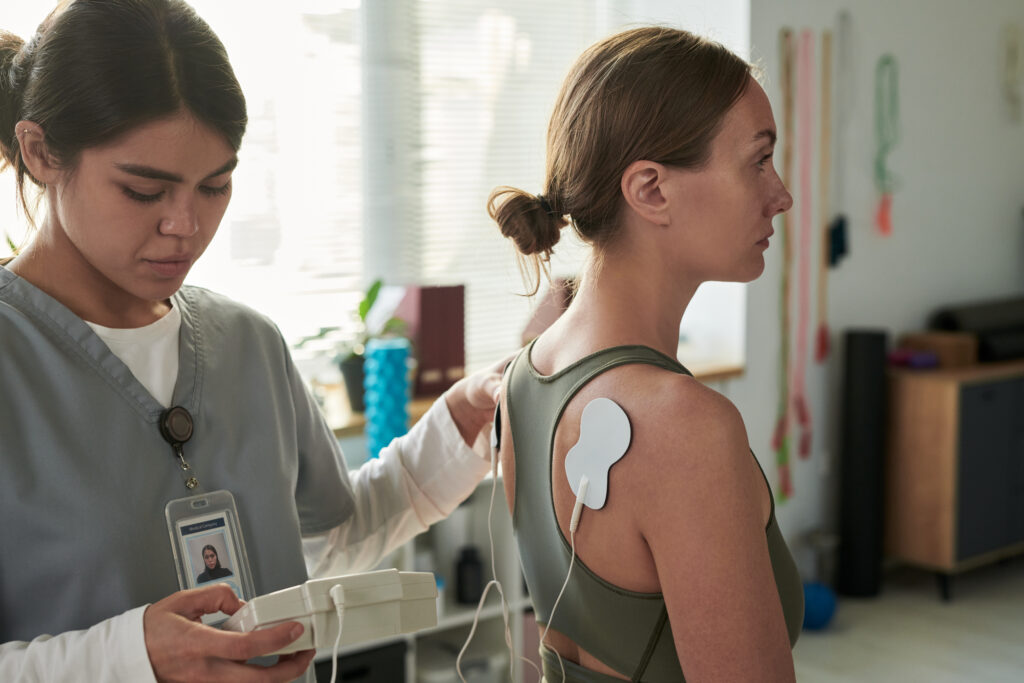
EMS posture correction works by delivering electrical stimulation directly to the chronically inhibited muscles in both upper and lower cross-syndrome patterns, providing the activation stimulus that voluntary exercise struggles to deliver consistently when compensation and inhibition are well established.
Nussbaum et al. in Physiother Can note that neuromuscular electrical stimulation is particularly effective for activating muscles with impaired voluntary recruitment, which describes precisely the inhibited postural muscles that EMS posture correction is designed to reach. When the lower trapezius and deep cervical flexors have become inhibited through years of forward posture, conventional exercises are often still dominated by the overactive compensatory muscles. EMS posture correction bypasses those compensation patterns by stimulating the target muscles directly.
For upper cross syndrome, EMS posture correction targets:
- Lower trapezius and rhomboids to restore scapular stability and reduce rounded shoulder posture
- Deep cervical flexors to counteract the forward head position maintained by overactive cervical extensors
- The serratus anterior supports proper scapular movement during arm elevation
For lower cross syndrome, EMS posture correction targets:
- The gluteal complex to restore hip extension dominance and reduce anterior pelvic tilt
- The deep core musculature supports lumbar stability and reduces exaggerated lumbar lordosis
Research on EMS for postural improvement has found meaningful improvements in postural alignment measures in populations using regular EMS training. Studies examining whole-body EMS training in sedentary adults and older populations have found significant improvements in thoracic kyphosis angles, forward head posture measures, and pelvic alignment following training periods, outcomes consistent with the proposed mechanism of EMS posture correction rebalancing inhibited postural muscles.
EMS Posture Correction for Desk Workers
Desk workers represent the population most commonly affected by the upper cross syndrome pattern that EMS posture correction is well-positioned to address.
The daily reinforcement of forward posture through hours of seated screen time means that even people who exercise regularly often struggle to maintain the posterior muscle activation that upright posture requires. EMS posture correction sessions targeting the lower trapezius, rhomboids, and deep cervical flexors can provide direct activation of these muscles that complements conventional strengthening efforts.
Practical considerations for desk workers using EMS posture correction:
- Brief daily low-intensity sessions of 10 to 15 minutes targeting the posterior shoulder and upper back provide maintenance activation that offsets some of the daily inhibitory effects of prolonged sitting
- EMS posture correction used as a pre-activation tool before conventional posture exercises may improve the recruitment quality of those exercises significantly
- Combining EMS posture correction with ergonomic improvements and regular movement breaks produces better outcomes than EMS alone
Consistency is the critical variable. EMS posture correction is working against the daily reinforcement of poor postural patterns through hours of sitting. Regular, frequent sessions produce more meaningful cumulative results than occasional intensive ones.
EMS Posture Correction as Part of a Comprehensive Program
This is an important point worth stating clearly: EMS posture correction alone cannot fix posture. It addresses the muscular activation component of a problem that also involves movement habits, environmental setup, body awareness, and the daily reinforcement of postural patterns through countless hours of habitual positioning.
The most effective posture correction programs combine multiple approaches:
- Stretching and releasing tight muscles, including the pectorals, hip flexors, and upper trapezius, through targeted flexibility work
- EMS posture correction to activate the inhibited muscles and restore their recruitment quality
- Conventional strengthening of the activated muscles in functional posture-relevant exercises
- Environmental modifications, including ergonomic workspace setup and regular movement breaks
- Body awareness development through mindful attention to posture during daily activities
EMS posture correction’s specific contribution within this framework is the muscle activation component. It facilitates engagement of muscles that are too inhibited to respond adequately to conventional exercise. Once EMS posture correction has helped re-establish more complete activation, conventional exercises can develop the strength and endurance of these muscles in the functional positions and movement patterns that support good posture throughout the day.
Dirks et al. (2014) in Acta Physiologica demonstrated that neuromuscular electrical stimulation prevents muscle disuse atrophy and supports ongoing neuromuscular function in targeted muscles, supporting the rationale for using EMS posture correction to maintain activation in postural muscles that chronic inhibition has effectively put into a state of functional disuse.
How Long Does EMS Posture Correction Take to Work?
This is one of the most common questions about EMS posture correction, and the honest answer is that it depends on how long poor posture has been established and how comprehensively the correction program addresses all contributing factors.
Early improvements in muscle activation quality and body awareness can occur within the first four to eight weeks of consistent EMS posture correction combined with conventional training. People often report feeling their posterior muscles engaging more clearly and noticing improved awareness of their posture during daily activities within this window.
Visible postural alignment improvements measured objectively in research typically require 12 to 16 weeks of consistent combined EMS and conventional training. Full integration of improved postural muscle activation into automatic daily posture, the point at which good posture stops requiring conscious effort, takes longer still and depends heavily on the environmental and habit factors that sit outside of any training program.
The takeaway: EMS posture correction is not a quick fix, but it is a meaningful and evidence-supported component of a correction process that does produce real results with consistent effort over time.
Conclusion
EMS posture correction offers a targeted and valuable contribution to addressing poor postural alignment, specifically in activating the chronically inhibited postural muscles whose weakness allows poor alignment to persist. By providing direct electrical activation that bypasses the compensation patterns blocking voluntary recruitment, EMS posture correction can facilitate the muscle rebalancing that posture improvement requires.
Used as part of a comprehensive posture correction program that also addresses flexibility, movement habits, environmental factors, and functional strengthening, EMS posture correction represents a meaningful tool for people who have struggled to correct poor posture through conventional exercise alone.
Ready to find the best EMS suit for you? Check out our brand reviews and product reviews to help inform your decision. You can also play with our product comparison tool to find the option that fits your goals and budget.
Frequently Asked Questions
Can EMS improve posture? EMS posture correction can contribute to alignment improvement by activating the chronically inhibited postural muscles, including the lower trapezius, rhomboids, deep cervical flexors, and gluteal complex, that conventional exercise often fails to adequately engage. Research has found improvements in postural alignment measures following whole-body EMS training. EMS works best as part of a comprehensive posture correction program.
How does EMS help with rounded shoulders? Rounded shoulders reflect inhibition of the posterior shoulder and upper back muscles alongside tightness of the anterior muscles. EMS posture correction targeting the lower trapezius and rhomboids provides the direct electrical stimulus these inhibited muscles need to become more functionally active, supporting the muscle rebalancing that rounded shoulder correction requires.
Can EMS fix forward head posture? EMS posture correction can support the muscle rebalancing aspect of forward head posture by activating the inhibited deep cervical flexors and lower trapezius. It cannot alone address the full complexity of forward head posture, which also requires stretching tight anterior cervical muscles, improving ergonomics, and developing body awareness. EMS is one valuable component of a comprehensive approach.
How long does EMS take to improve posture? Early improvements in muscle activation quality can occur within four to eight weeks of consistent EMS posture correction combined with conventional training. Visible postural alignment improvements measured objectively in research typically require 12 to 16 weeks of consistent combined training. Full integration into automatic daily posture takes longer and depends on addressing environmental and habit factors alongside EMS work.
Is EMS good for lower back posture? EMS posture correction addressing lower cross syndrome, activating inhibited gluteal muscles and core musculature, can support improvements in pelvic position and lumbar alignment. This targets the muscular component of anterior pelvic tilt and exaggerated lumbar lordosis, which are common sources of lower back postural stress. EMS works alongside hip flexor stretching and functional core training for the most effective lower back posture improvement.