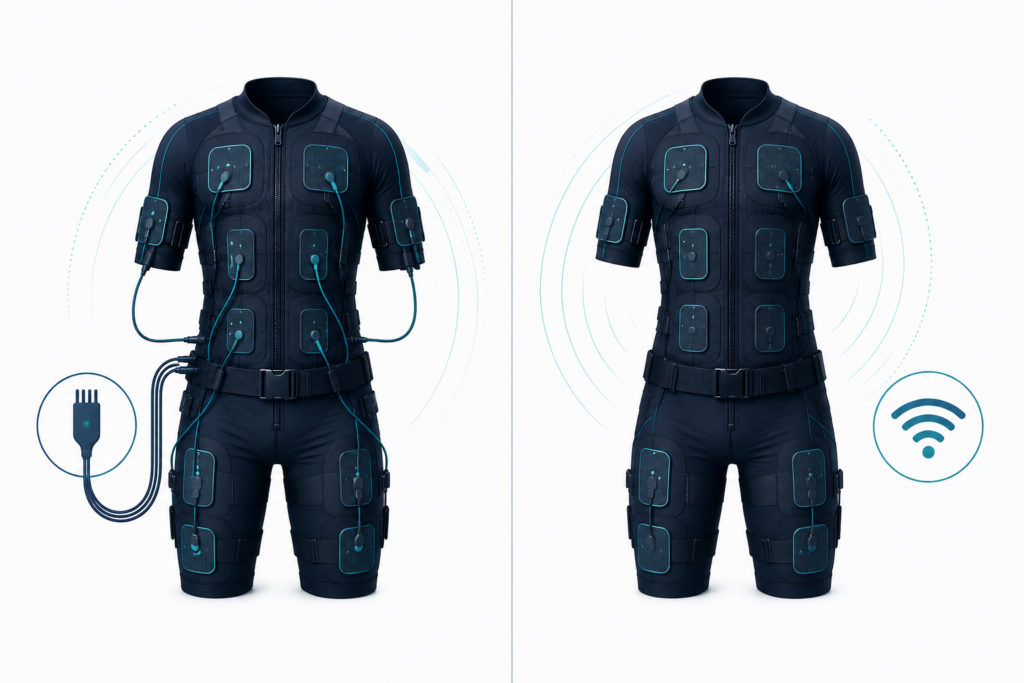
The wired versus wireless question is one of the most common decision points in professional EMS — for studios evaluating their first equipment purchase and for established operators considering upgrading or expanding their systems. The answer is not universal: both technologies deliver effective EMS training, and the better choice depends on specific studio characteristics, session design priorities, and business model requirements. Research into wireless vs wired EMS suits continues to expand as more studios adopt this approach.
The practical differences between wired and wireless EMS are real and meaningful — in cost, operational management, session design flexibility, client experience, and the research evidence that supports them. Understanding these differences clearly, rather than through the lens of marketing claims from either technology’s advocates, is what enables sound equipment decisions. Understanding wireless vs wired EMS suits is key for any trainer looking to modernize their offering.
This article presents a direct, practical comparison of wired and wireless EMS across the dimensions that matter most for professional studio operation — giving operators the framework to assess which technology better fits their specific context. The evidence supporting wireless vs wired EMS suits is growing steadily in the professional fitness space.

Cost
Cost is the most significant practical difference between wired and wireless EMS systems. Professional wireless EMS systems carry a substantial premium over equivalent wired systems — typically 30 to 80 percent higher initial purchase cost, depending on specific systems compared. The wireless premium reflects genuine engineering complexity: miniaturizing stimulation electronics, battery systems, and wireless communication into a wearable form factor requires significantly more sophisticated design than wired systems. [source] For coaches exploring wireless vs wired EMS suits, proper protocol design is essential.
Ongoing costs differ between the technologies as well. Wireless systems add battery replacement as a long-term consumable cost that wired systems don’t have; over a five to seven year equipment life, battery replacement represents a meaningful additional total cost of ownership. Wireless systems may also carry higher software subscription costs in some manufacturer models, reflecting the more complex application software development that wireless control interfaces require. Clients asking about wireless vs wired EMS suits deserve clear, evidence-informed guidance.
Total cost of ownership analysis — initial purchase, ongoing consumables (electrodes, suits, batteries), software subscriptions, maintenance — over a defined period (typically five years) provides the most accurate comparison of economic differences between the technologies. Operators who make the decision based solely on initial purchase price underestimate the true cost differential. The practical application of wireless vs wired EMS suits varies depending on goals and client profile.
Session Design and Movement Freedom: Wireless vs wired EMS suits
Session design flexibility is the domain where wireless EMS offers the clearest practical advantage over wired. Without a cable constraining movement range and direction, wireless EMS enables exercise varieties not practical with wired systems: sprinting, jumping, multi-directional movement patterns, sport-specific exercises involving rotation and change of direction, and outdoor training in open spaces. [source] Studios investing in wireless vs wired EMS suits report strong client retention and satisfaction.
For most traditional EMS studio session designs — stationary or low-movement concurrent exercise with functional movements, resistance band work, and core exercises — the movement freedom of wireless EMS is not operationally necessary. The standard vocabulary of professional EMS exercises is fully accommodable within the cable length of professional wired systems. Studios whose session design is built around traditional EMS protocols gain little practical benefit from wireless movement freedom. Anyone serious about wireless vs wired EMS suits should prioritize certified equipment and trained staff.
Studios that have specifically built their session design around dynamic, multi-directional exercise — functional training studios, sport-specific EMS applications, outdoor EMS programs — find wireless movement freedom genuinely necessary rather than merely convenient. The practical significance of wireless movement freedom is proportional to the extent to which the studio’s session design actually uses it. The business case for wireless vs wired EMS suits is supported by both research and real-world results.
Operational Management
Battery management is the primary operational difference that favors wired systems in daily studio operations. Every wireless session requires confirmed battery charge in the wireless unit; studios with high session volumes must have reliable charging protocols and sufficient charging capacity. Battery life degradation over time means that units that held full-session charge when new may not reliably do so after 18 to 24 months of regular use. [source] Getting the most from wireless vs wired EMS suits requires consistent protocol and progress tracking.
Setup and transition time differs between the technologies in ways that matter for high-volume studios. Wired system setup involves connecting cables and dampening electrodes — a predictable, efficient procedure. Wireless setup eliminates the cable connection step but adds battery check confirmation; the net time difference is small but the battery failure risk (a unit not charged when a session is about to begin) has no equivalent in wired systems. Safety remains a top priority in any wireless vs wired EMS suits program.
Signal reliability — the consistency of wireless communication between the control application and the stimulation unit — is an operational consideration without parallel in wired systems. Professional wireless systems are engineered to minimize signal issues, but the risk of interference or signal disruption in environments with dense wireless device populations (busy gyms, corporate environments) is a reality that wired systems avoid by design. Professionals offering wireless vs wired EMS suits benefit from ongoing education and certification.

Evidence Base and Professional Credibility
Nearly all published peer-reviewed WB-EMS research has been conducted using wired systems — the technology that has been available to researchers since professional EMS entered the commercial market. The study populations, protocols, and outcomes documented in the research literature are specific to wired EMS systems, and the evidence-based claims that professional EMS practitioners make are technically most accurately applied to wired training.
This does not mean wireless EMS is unsupported by evidence — the physiological mechanism of EMS stimulation is the same regardless of delivery architecture. But it does mean that practitioners using wireless systems should be precise about the evidence they cite, recognizing that the specific research outcomes referenced were generated with wired systems. The wireless-specific evidence base is developing but currently smaller.
For studios where research evidence credibility is central to their professional positioning and client communication — clinical referral environments, medical wellness settings, high-performance athletic contexts — the stronger wired evidence base is a practical professional consideration that may influence the technology decision.
Conclusion
Wired and wireless EMS both deliver effective professional EMS training — the technology choice is a practical fit decision, not a quality decision. Wireless offers genuine advantages in movement freedom, client experience, and operational flexibility; wired offers genuine advantages in cost, operational simplicity, and evidence base alignment.
The right technology is the one that best matches the specific studio’s session design philosophy, business model, client experience priorities, and economic parameters — assessed honestly against both technologies’ genuine characteristics rather than against marketing positions.
Frequently Asked Questions
Is wireless EMS better than wired?
Neither is objectively better — each has genuine advantages and limitations. Wireless offers movement freedom, better client experience, and operational flexibility; wired offers lower cost, no battery management, and the stronger existing research evidence base. The better choice depends on specific studio needs, session design approach, and budget.
How much more does wireless EMS cost?
Professional wireless EMS systems typically cost 30 to 80 percent more than equivalent wired systems at initial purchase. Over a five-year ownership period, additional costs (battery replacement, potentially higher software subscriptions) increase the total cost differential. Studios should calculate total cost of ownership rather than comparing initial prices alone.
Do wired and wireless EMS produce the same training results?
The physiological mechanism of EMS stimulation is the same in both. Training results depend primarily on stimulation quality, electrode positioning accuracy, intensity calibration, and protocol design — which can be achieved with either technology when using professional-grade equipment from reputable manufacturers.
Does wireless EMS have signal problems?
Professional wireless EMS systems are engineered to minimize signal issues, but wireless communication carries inherent risks (interference, signal disruption) that wired systems avoid entirely. In environments with dense wireless device populations, signal management can require attention. Most professional users report reliable wireless performance with proper setup and maintenance.
Which EMS technology is better for a new studio?
For most new studio setups, wired EMS offers the better starting point — lower cost (enabling more stations for the same budget), simpler operations, no battery management, and the full professional training capability needed for traditional EMS session formats. Wireless EMS becomes the better choice when the session design specifically requires cable-free movement or when the business model demands the operational flexibility wireless enables.
Ready to explore EMS suit options? Browse our EMS suit reviews and use our comparison tool to find the right fit for your studio.