
Safety is one of the first questions people ask when they learn about EMS training. The idea of wearing a suit that sends electrical impulses into your muscles is new to most people, and that newness raises fair concerns. Is EMS training safe for the average person? What are the real risks? And who should think twice before trying it?
The short answer: Is EMS training safe for healthy adults? Yes, generally, but only when conducted by a certified trainer, with proper health screening, and at appropriate intensity levels. There are real contraindications and risk factors worth understanding before your first session.
Here is what the research and established safety guidelines say.
Is EMS Training Safe: The General Safety Profile
EMS technology has been used in clinical and rehabilitation settings for decades. Its safety record in supervised, properly calibrated environments is well documented in sports science and medical literature. Nussbaum et al. extensively reviewed the clinical evidence on neuromuscular electrical stimulation, finding it effective and safe under appropriate application conditions.
Whole-body EMS suits used in fitness contexts are a newer application of that same technology. Research on EMS training safety in this context has grown substantially, and the general finding is consistent: whole-body EMS training is safe for healthy adults under qualified supervision and within appropriate intensity ranges.
The operative word is appropriate. EMS suit risks increase significantly when sessions are unsupervised, intensities are set too high, or individuals with contraindicated health conditions participate without medical clearance.
Common EMS Side Effects: What Is Normal
Some responses to EMS training are expected and not a cause for concern. Knowing what is normal helps you distinguish routine recovery from a warning sign. Kemmler et al. (2018) documented the most common side effects of whole-body EMS in a peer-reviewed analysis, confirming that most are mild and temporary when sessions are conducted appropriately.
Normal EMS side effects include:
- Delayed-onset muscle soreness (DOMS): The most common side effect. Soreness typically appears 24 to 48 hours after a session and resolves within a few days. Because EMS activates multiple muscle groups simultaneously, this soreness can feel more widespread than after a conventional gym session.
- Post-session fatigue: Feeling more tired than the short session duration might suggest is a normal physiological response to high levels of simultaneous muscle activation.
- Mild skin redness at electrode sites: Occasional and usually short-lived, particularly in early sessions or if electrode contact was not properly established. Proper suit preparation minimizes this.
These EMS side effects are not signs of harm. They are signs that your muscles worked.

Rhabdomyolysis: A Serious EMS Suit Risk to Understand
One of the most significant EMS suit risks documented in the literature is exercise-induced rhabdomyolysis. This occurs when muscle fibers break down rapidly and release a protein called myoglobin into the bloodstream, which can stress the kidneys if present in large amounts.
Rhabdomyolysis can occur with any extremely intense exercise, but EMS-specific cases have been documented, typically in beginners or individuals who underwent sessions at excessive intensities without preparation. A 2024 case report and literature review published in Cureus provides a comprehensive look at EMS-induced rhabdomyolysis cases and the conditions under which they occurred.
Symptoms to watch for after any EMS session:
- Unusually severe muscle pain or swelling
- Dark brown or tea-colored urine
- Significantly reduced urine output
- Extreme fatigue that does not resolve normally
If you experience any of these, seek medical attention promptly.
How to reduce this risk:
- Start at low to moderate intensity
- Increase intensity gradually across multiple sessions
- Keep sessions within the recommended time range
- Allow adequate recovery between sessions (most protocols recommend no more than one to two sessions per week)
- Stay well hydrated before, during, and after training
This is one of the strongest reasons why beginning EMS training under professional supervision matters, especially early on.
EMS Contraindications: Who Should Not Use EMS
EMS contraindications are medical conditions or circumstances where EMS training should not be used without explicit medical clearance, or should not be used at all. This list is not exhaustive. Anyone with a health concern should consult their healthcare provider before asking “is EMS training safe for me specifically?”
EMS training is generally contraindicated for:
- Implanted electronic devices (pacemakers, defibrillators): Electrical impulses may interfere with device function
- Epilepsy: Electrical stimulation may trigger seizures in susceptible individuals
- Pregnancy: EMS suit use is not considered safe during pregnancy
- Active cancer in areas being stimulated: Requires oncological guidance before proceeding
- Recent surgery, open wounds, or skin conditions at electrode contact areas
- Serious cardiac conditions or uncontrolled hypertension: Physician clearance required
- Severe metabolic disorders: Consult your doctor before beginning
- Nerve damage or peripheral neuropathy: Impaired sensation makes it difficult to manage session intensity safely
This is why health intake screening is not optional in any responsible EMS program. Thorough disclosure on the part of the client is the first line of EMS training safety.
Is EMS Training Safe?: The Role of Qualified Supervision
The research is consistent on this point: adverse events are far more likely to occur in unsupervised settings, with improperly calibrated equipment, or without health screening. The 2023 international guideline for whole-body EMS training by Kemmler et al., published in Frontiers in Physiology, outlines the supervision standards, intensity protocols, and screening requirements that define safe practice.
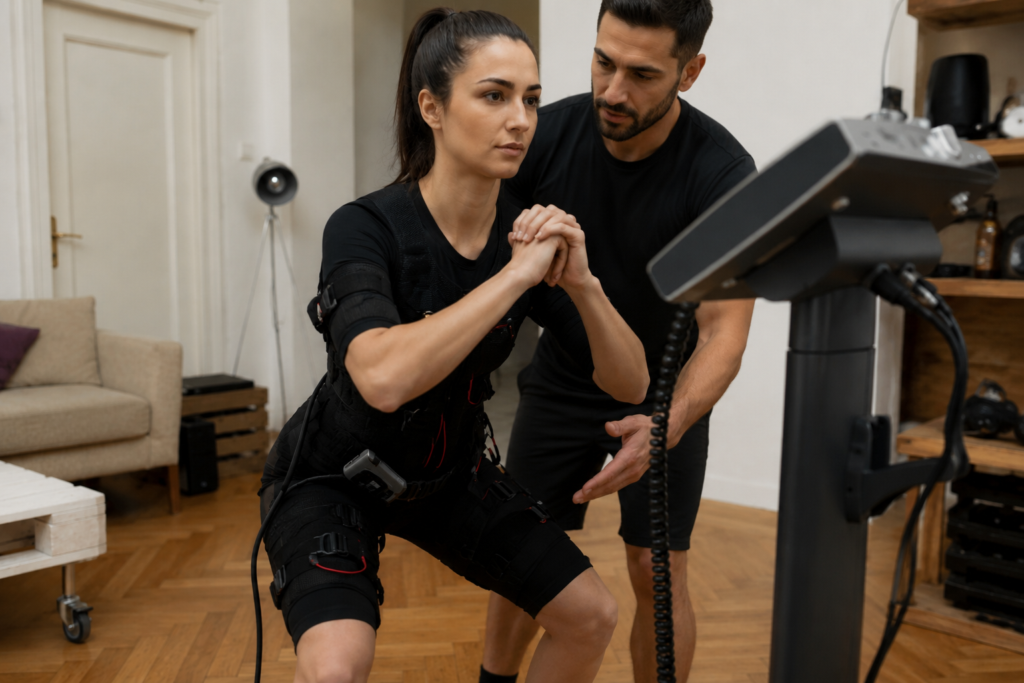
Qualified EMS trainers are trained to deliver effective sessions and to recognize when a client’s response warrants concern. They manage intensity conservatively, especially in early sessions.
When evaluating a studio or trainer, ask:
- What EMS certification do you hold, and who issued it?
- What does your health intake process include?
- What is your protocol if a client reports unusual discomfort or symptoms?
A studio that takes EMS training safety seriously will have clear answers to all three.
Is EMS Training Safe at Home: What Changes About the Risk Profile
Consumer-grade EMS suits for home use are increasingly available and can be used safely by informed adults. However, the EMS suit risks associated with home use are meaningfully higher than in a supervised studio setting, particularly for beginners, people with undisclosed health conditions, or users who progress intensity too quickly. Kemmler et al.’s 2016 guidelines in the German Journal of Sports Medicine laid the early groundwork for what responsible EMS use looks like — guidance that applies just as much to home users as studio clients.
If you are using an EMS suit at home:
- Read all safety documentation thoroughly before your first session
- Understand the contraindications fully
- Start at the lowest available intensity
- Increase gradually, not aggressively
- Consider at least one supervised session with a qualified trainer before going independent
Conclusion
EMS training has a solid safety record when conducted appropriately by qualified professionals, with proper health screening, at progressively increasing intensity levels, and with adequate recovery. The technology itself is not inherently dangerous; the risks arise from misuse, inadequate screening, and inappropriate progression of intensity.
For anyone considering EMS training, the single most important safety step is honesty: honesty about your health history during intake, honesty with your trainer about how the session feels, and honesty with yourself about giving your body adequate time to recover between sessions. Used responsibly, EMS training can be a safe and effective addition to a wellness routine.
Ready to find the right EMS suit for you? See our product and brand reviews, and try out our product comparison tool.
Frequently Asked Questions
Has anyone been seriously injured by EMS training?
Cases of EMS-related adverse events, including rhabdomyolysis, are documented in medical literature. They are typically linked to excessive intensity, missing health screening, or extremely long sessions in unconditioned individuals. Under proper supervision with gradual intensity progression, serious adverse events are uncommon.
Is EMS training safe if I have a heart condition?
It depends on the condition. Individuals with implanted cardiac devices should not use EMS. Those with other cardiac conditions should consult their cardiologist before beginning. A qualified trainer will refer you to your physician if any cardiac concerns come up during screening.
Is EMS training safe during pregnancy?
No. EMS training is contraindicated during pregnancy, and any reputable studio will include this in their screening intake.
How do I know if my EMS trainer is qualified?
Ask about their certification directly, including who issued it. Reputable certifications cover both theoretical knowledge (safety, contraindications, physiology) and practical training. A qualified trainer should explain their credentials without hesitation.
Can EMS training make an existing injury worse?
Potentially, depending on the injury, its severity, and its location. EMS should not be used over areas of active inflammation, open wounds, or recent surgical sites. For musculoskeletal injuries, consult a physiotherapist or sports medicine physician before beginning EMS training.