So you have booked your first EMS session. You know roughly what EMS stands for and understand the basic concept, but you are still not entirely sure what to expect when you walk through the door, how the suit will feel, or what the next 30 minutes will actually involve.
That uncertainty is completely normal. EMS training for beginners is unlike anything most people have experienced in a conventional gym. The combination of wearable technology, electrical stimulation, and guided movement can sound intimidating before you have tried it.
This EMS training for beginners guide walks you through a typical first EMS session from start to finish: what happens before, during, and after, so you arrive informed, comfortable, and ready to make the most of the experience.
What Is EMS Training? A Quick Primer for Beginners
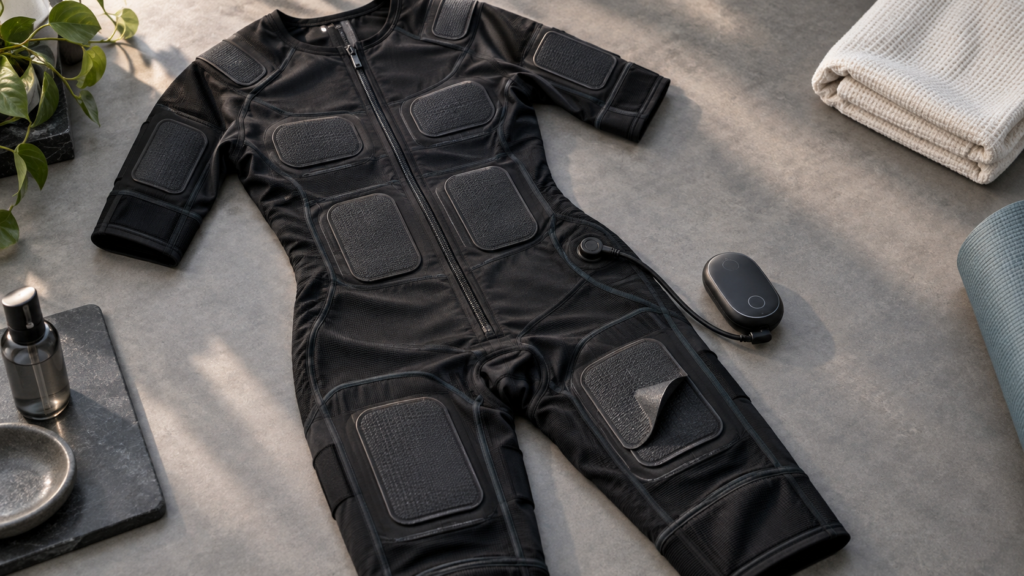
Before diving into what to expect, it helps to understand the basics. EMS stands for Electrical Muscle Stimulation. During a session, a suit fitted with electrodes delivers low-level electrical impulses directly to your major muscle groups, triggering contractions that work alongside your voluntary movement.
The result: your muscles work harder than they would through conventional exercise alone, in a fraction of the time. For anyone exploring EMS training for beginners, the key thing to know is that you are not passively receiving stimulation. You are actively exercising while the suit amplifies the effort.
The Intake and Consultation During EMS Training for Beginners
At a reputable EMS studio, your first EMS session will begin with a brief consultation before the suit even comes out. A certified EMS trainer will ask about:
- Your current fitness level and training history
- Any relevant medical history or health conditions
- Your goals for EMS training
- Any areas of discomfort or concern
This intake is not a formality. It determines whether EMS is appropriate for you and how your trainer will calibrate the session. It’s beneficial to you and your health that you be completely honest here. Conditions including cardiac issues, implanted electronic devices, epilepsy, pregnancy, and recent surgery are contraindications for EMS use. A thorough trainer will take this information seriously.
You will also sign a consent form or waive it, and you should read it thoroughly, front and back. It outlines the nature of EMS training, confirms you have disclosed relevant health information, and acknowledges that EMS is not a medical treatment.
The consultation is also your opportunity to ask questions. If you are unsure how the suit works, what the sensations will feel like, or how intensity is controlled, ask. A good trainer will welcome your questions rather than rush past them.
EMS Training for Beginners: Getting Into the EMS Suit
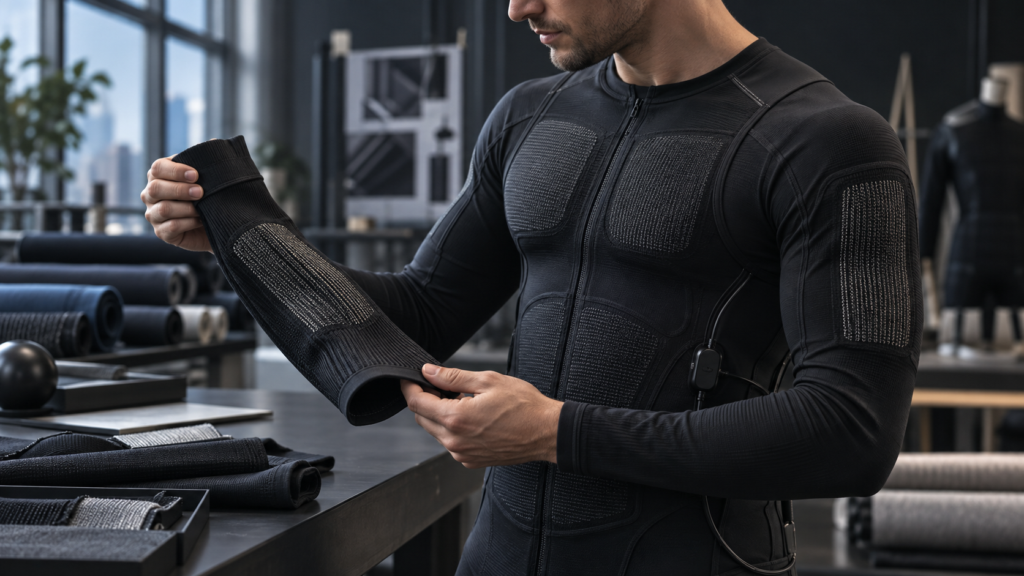
Once the consultation is complete, you will be helped into the EMS suit. Most studios will have you change into a thin, moisture-wicking base layer (typically provided or recommended by the studio) before the suit goes on. The base layer:
- Improves electrode-to-skin conductivity
- Creates a hygienic barrier between the electrodes and bare skin
- Makes the session more comfortable overall
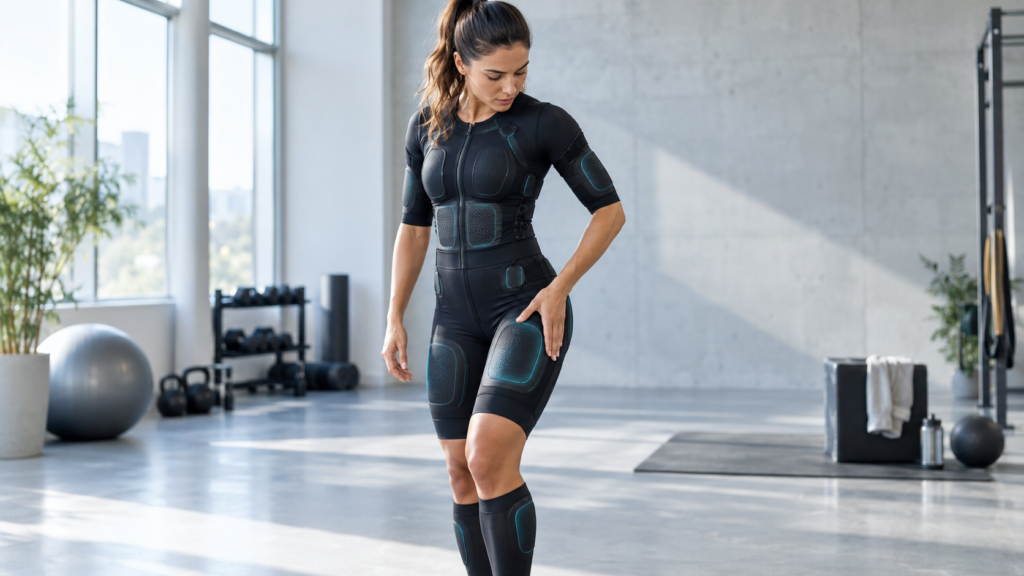
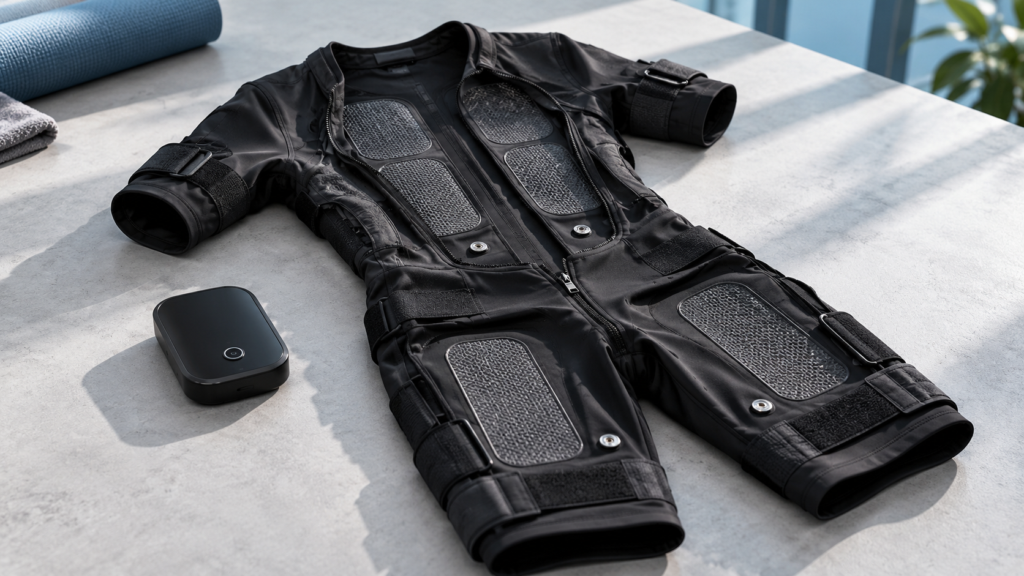
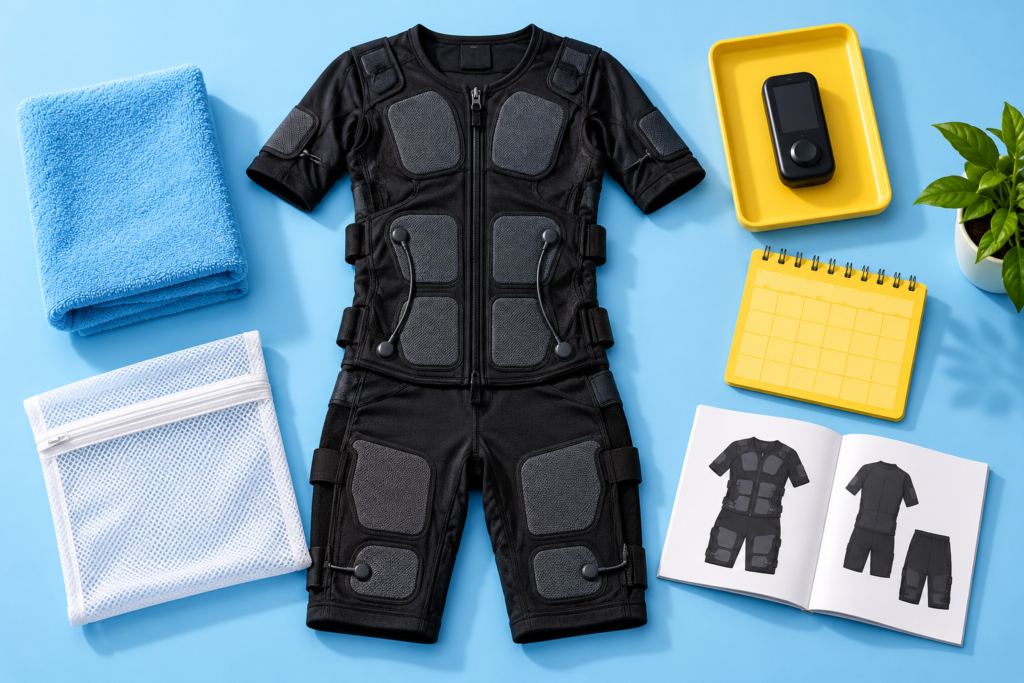
The EMS suit fits over the base layer. Your trainer will check that the electrodes are positioned correctly over each major muscle group: the chest, upper back, lower back, abdominals, glutes, thighs, and sometimes the arms. Proper positioning matters. Misaligned electrodes will not stimulate the intended muscles effectively and can produce uneven sensations.
If the studio uses a wet electrode system, the relevant areas will be dampened with water to improve conductivity. A wireless suit will have its battery unit confirmed as charged. The control device (a tablet or proprietary unit) will be ready for your trainer to operate throughout the session.
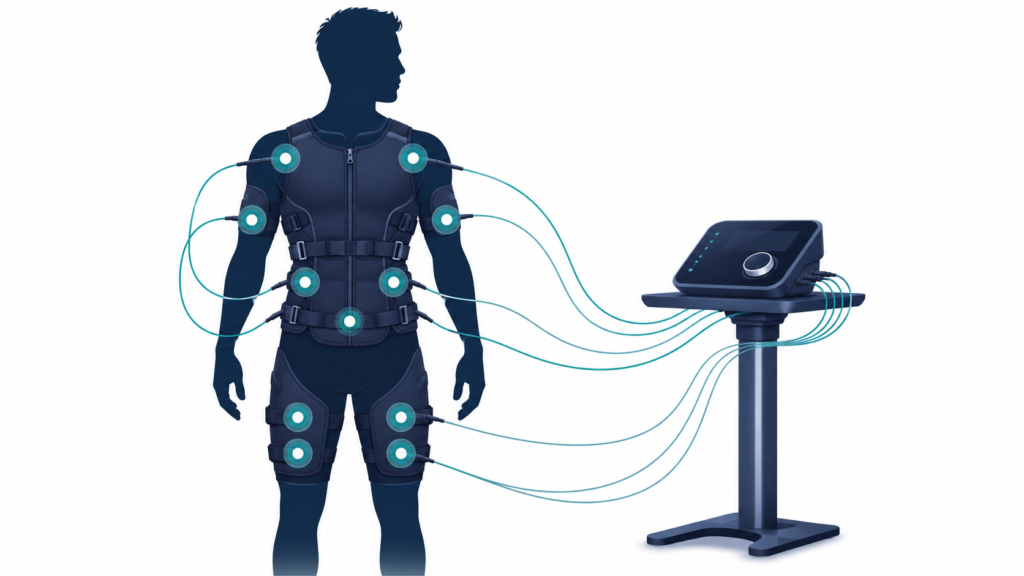
The Calibration Process: Your First Few Minutes During EMS Training for Beginners
Before the main workout begins, your trainer will run a calibration process specific to EMS training for beginners. They will activate the electrical stimulation at very low intensity for each muscle group and ask what you feel. The goal at this stage is not to produce strong contractions. It is to:
- Confirm the electrodes are making good contact
- Verify the signal is reaching the right areas
- Give you time to get comfortable with the sensation before the intensity increases
Therefore, don’t hesitate to be upfront about your experience so they can make any necessary adjustments to improve it. Most people describe the calibration stage as surprising but not unpleasant. The sensation is often compared to a mild tingling or a light involuntary muscle pulse, a twitch you did not choose to make. Your trainer will gradually increase the intensity from this baseline, asking for feedback throughout. You are in control of this process. Good trainers never push intensity to a level that feels painful.
During the EMS Training for Beginners: What the EMS Workout Experience Actually Feels Like
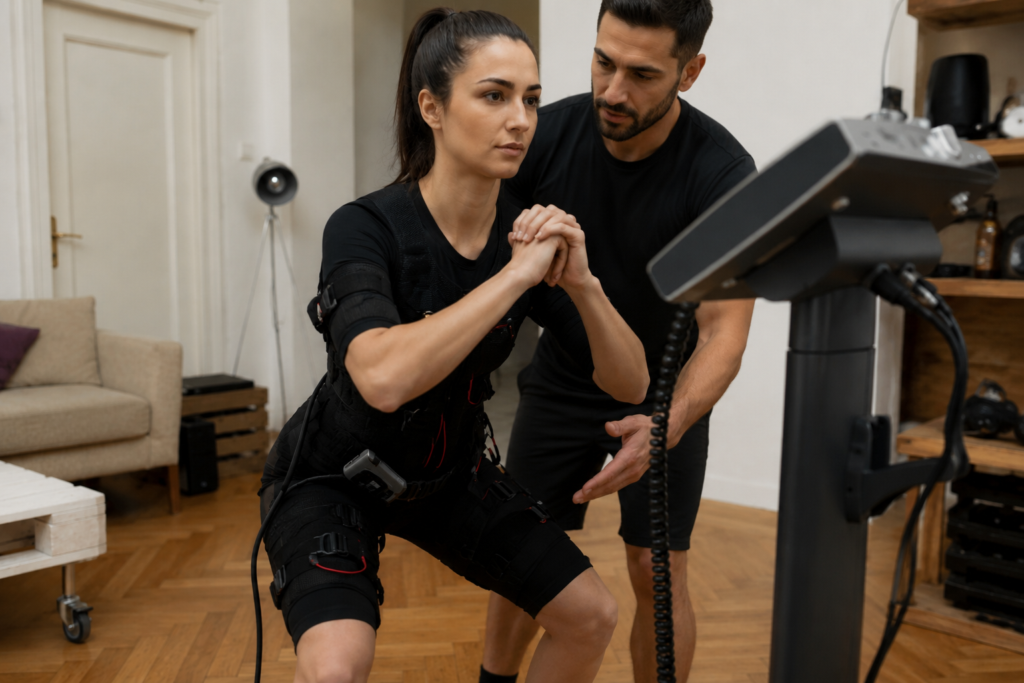
Once calibration is complete, the workout begins. A typical first EMS session is kept at moderate intensity intentionally. Your trainer will guide you through a series of functional movements: squats, deadlift-pattern movements, rows, chest presses, core holds, and lunges are common. These movements are designed to complement the muscle groups being stimulated.
The Stimulation Cycle
The EMS unit cycles between:
- Active phases (4 to 6 seconds): Current is on, muscles contract
- Rest phases (2 to 4 seconds): Current is off, muscles relax
During the active phase, you will feel a strong involuntary contraction layered on top of your voluntary movement. Most people describe it as an intense but controlled sensation, like a muscle being squeezed from the outside. It takes a few cycles to adjust, but most people find their rhythm within the first five to ten minutes.
Communicate Throughout the EMS Training for Beginners
The EMS workout experience is collaborative, but remember that your trainer isn’t feeling what you’re feeling, and everyone’s experience is different. If intensity feels too high in any area, tell your trainer immediately. If any area feels numb, produces a sharp or burning sensation, or causes discomfort beyond normal exercise effort, that is important feedback. Trained EMS instructors make real-time adjustments, and no session should progress through discomfort without addressing it.
Most first EMS sessions last 20 minutes of active stimulation. The brevity is intentional. Even at moderate intensity, EMS simultaneously stimulates a large volume of muscle tissue, and the accumulated work adds up faster than in a conventional gym session of the same length.
After Your First EMS Session: Recovery and What to Expect
After the session ends, your trainer will remove the suit and take a moment to debrief, asking how you felt, whether any areas were uncomfortable, and discussing what to expect in the coming days.
Delayed-Onset Muscle Soreness (DOMS)
The most commonly reported after-effect of a first EMS session is DOMS, typically appearing 24 to 48 hours later. It can be more pronounced than soreness from a conventional workout of the same duration, because EMS activates a broader range of muscle fibers than most people recruit voluntarily. The soreness is usually diffuse, spread across many muscle groups rather than concentrated in one area.
Recovery Guidelines
- Drink water before, during, and after your session, and continue hydrating over the following hours
- Eat adequate protein in the meals following your session to support muscle recovery
- Wait at least 48 to 72 hours before your next EMS session, particularly in the first few weeks
Fatigue after your first session is normal. The level of muscle recruitment in a well-run EMS workout (even at beginner intensity) is substantial, and your body needs time to adapt. This is a sign the training had an effect, not a sign something went wrong.
Common Mistakes in EMS Training for Beginners
A few misconceptions are worth addressing before your first session.
Expecting it to feel like nothing. At effective training intensities, EMS produces real muscle contractions. The sensation is noticeable. If a session produces no discernible sensation, the setup or intensity likely needs adjustment.
Assuming minimal effort is required. EMS training is most effective when you actively participate, contracting voluntarily in sync with the electrical stimulation and performing movements with proper form and engagement. It is not a passive experience.
Expecting immediate results. EMS training produces cumulative adaptations over time, just like any other training method. One session provides a stimulus. Repeated sessions, combined with good nutrition and lifestyle habits, produce results. This is one of the most important things to understand as part of any EMS beginner guide.
EMS Training for Beginners: What to Bring to Your First Session
To make the most of your EMS workout experience, come prepared:
- Comfortable clothing to change into, or confirm with the studio whether a base layer is provided
- Full honesty about your health history during the intake consultation
- Realistic expectations: this will feel different from anything you have done before, and that is the point
- Water: hydrate before, during, and after
- Patience: most people find that by their second or third session, the sensation feels manageable and even motivating

Is EMS Training Right for You as a Beginner?
EMS training for beginners is adaptable to a wide range of fitness levels. Intensity settings are adjustable, sessions are short, and a qualified trainer calibrates everything to match your starting point. That makes it accessible whether you are returning to exercise after a long break or adding it to an existing fitness routine.
That said, knowing what to expect EMS before you walk through the door makes a meaningful difference. People who approach their first EMS session with realistic expectations, open communication with their trainer, and a willingness to give their body recovery time consistently report the best experiences.
Conclusion
Your first EMS session will likely feel unfamiliar, somewhat intense, and genuinely interesting, often all at the same time. That combination is normal. EMS training has a short learning curve, and most people find that by their second or third session, the sensation feels manageable and even motivating.
The most important things to bring to your first session are honesty about your health history and a willingness to communicate during the session. This is something you’ve been looking to add to enhance your workouts for some time, and you should be comfortable with the experience, so don’t hold back with questions, comments, or concerns during the first session. You should also bring realistic expectations about the experience and patience with your body as it adapts. EMS training is a tool, and like any tool, it works best when you use it with knowledge and consistency.
If you’re on the prowl for the right EMS suit, check out our brand and product reviews and our comparison tool.
Frequently Asked Questions About EMS Training for Beginners
Do I need to be fit before starting EMS training?
No. EMS training for beginners can be adapted to a wide range of fitness levels. Intensity is fully adjustable, and a qualified trainer calibrates the session to your current level. If you have been completely sedentary for a long period, discussing this with your doctor before starting any new exercise program is a sensible precaution.
Should I eat before a first EMS session?
Avoid a large meal immediately before your session. A light snack one to two hours beforehand is generally fine. EMS involves real muscular effort, and starting with a full stomach can cause discomfort. Hydrate well before you arrive.
How long does the soreness last after a first EMS session?
DOMS after a first EMS session typically peaks at 24 to 48 hours and resolves within 72 hours for most people. If soreness is severe, unusually localized, or accompanied by dark or discolored urine, seek medical advice promptly.
Can I do a normal gym workout on the same day as an EMS session?
This is generally not recommended, particularly for those new to EMS training for beginners. EMS sessions produce substantial muscle activation, and combining them with a separate gym session the same day significantly increases the risk of overtraining, excessive soreness, or injury.
How many sessions will I need before I see results?
Most trainers suggest committing to a minimum of 6 to 10 sessions, paired with appropriate nutrition and lifestyle habits, before drawing conclusions about results. Consistency over several weeks is the foundation of any meaningful outcome. That applies to EMS training for beginners as much as any other method.