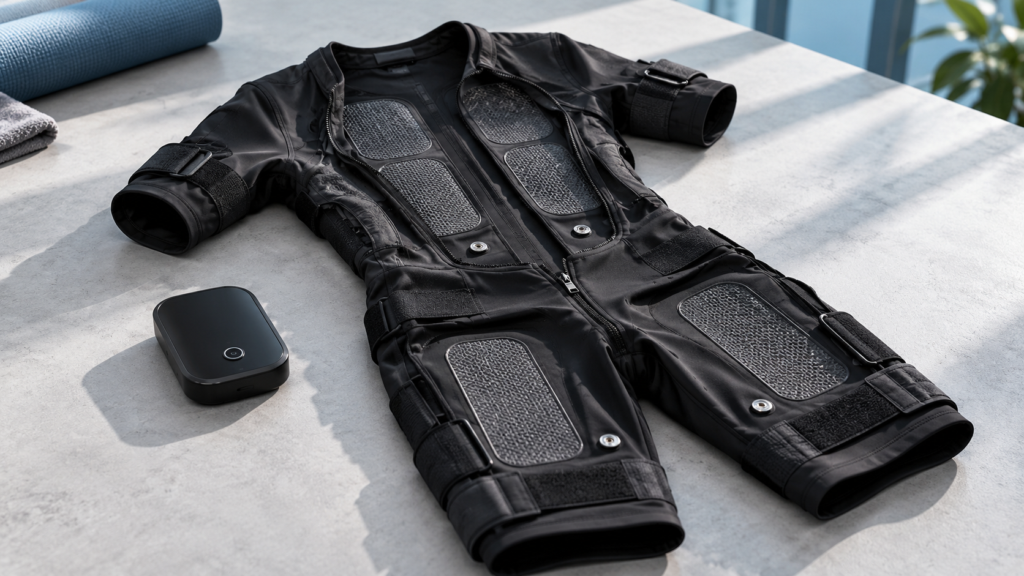
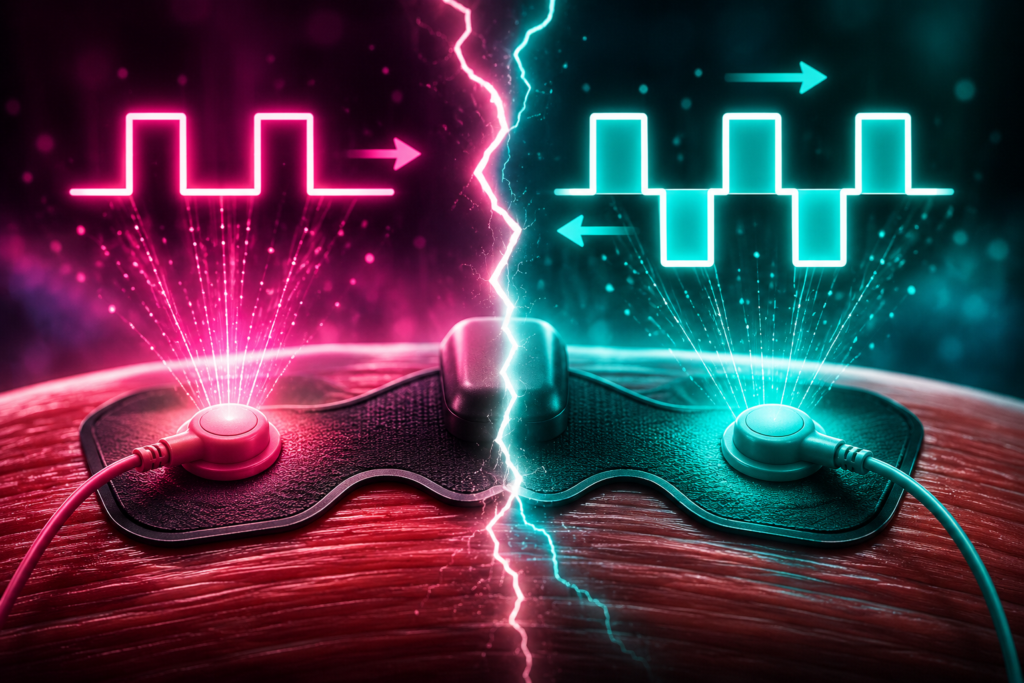
Every EMS device delivers electrical pulses, but those pulses do not all move current in the same pattern. A monophasic pulse travels in one direction. A biphasic pulse has two phases and reverses direction. That distinction affects polarity, charge balance, and how engineers describe a stimulator.
Waveform is important, but it is not a product ranking by itself. Pulse duration, amplitude, frequency, electrode design, output limits, and the intended use must be considered together.
What is an EMS waveform?
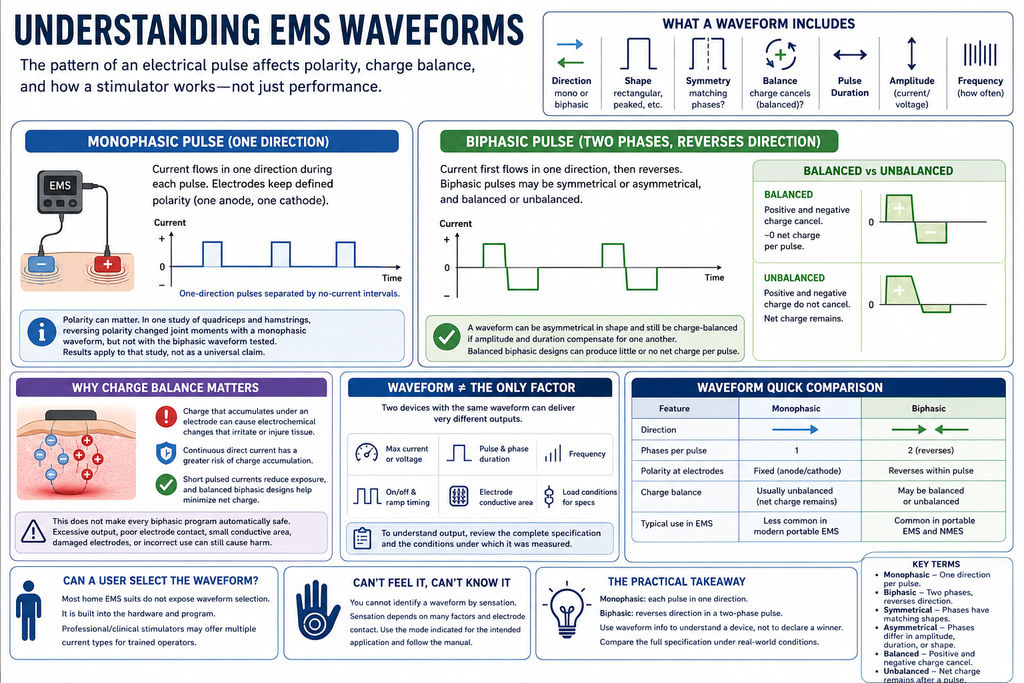
A waveform is a representation of how current or voltage changes over time. It can be described by:
- Direction: monophasic or biphasic.
- Shape: rectangular, peaked, sinusoidal, or another form.
- Symmetry: whether phases have matching shapes and durations.
- Balance: whether positive and negative phase charge cancel.
- Pulse duration, amplitude, and repetition frequency.
Marketing phrases such as “advanced waveform” are not enough to explain any of these properties.
What is a monophasic pulse?
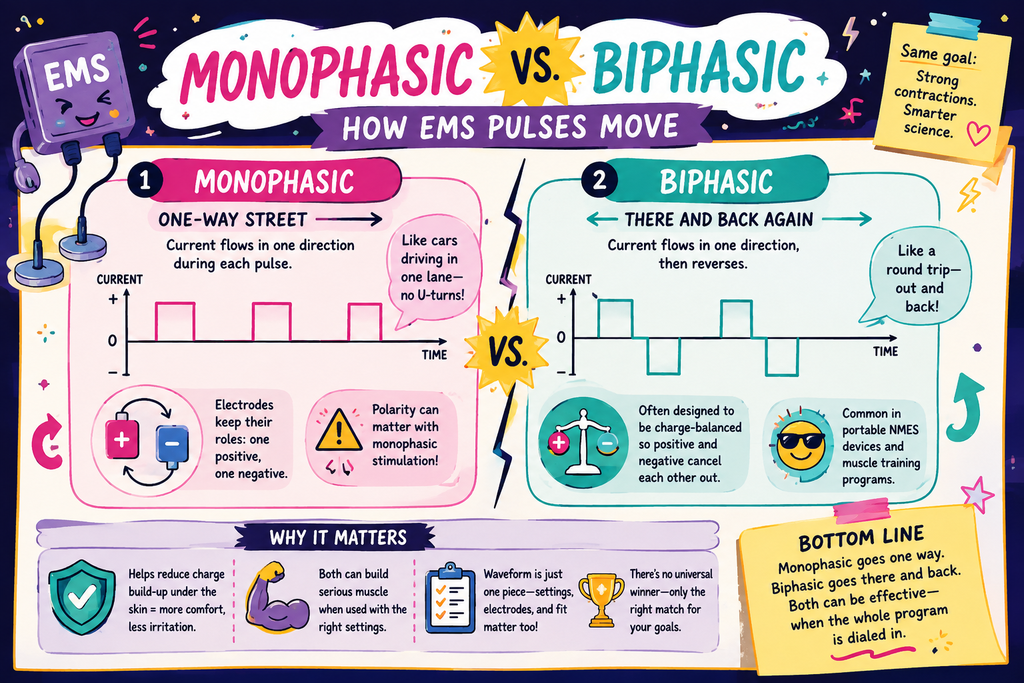
In monophasic pulsed current, current flows in one direction during each pulse. The electrodes retain defined polarity: one is the anode and the other the cathode.
This is different from continuous direct current. A monophasic EMS pulse is brief and separated by periods with no current. A clinical review notes that calling all monophasic pulsed current “pulsed DC” is technically inaccurate because the pulses are far shorter than continuous-current definitions.
Polarity can matter with monophasic stimulation. An older study of quadriceps and hamstring stimulation found that reversing polarity changed joint moments with monophasic waveforms, while polarity did not significantly affect moments with the biphasic waveform studied. The finding applies to that experiment and should not be generalized into a universal performance claim.
What is a biphasic pulse?
A biphasic pulse contains two phases: current first moves in one direction and then reverses. Biphasic pulses may be symmetrical or asymmetrical and balanced or unbalanced.
Balanced means the charge in one phase is offset by an equal and opposite charge in the other, leaving approximately no net charge per pulse. A waveform can be asymmetrical in shape while still being charge-balanced if phase amplitude and duration compensate for one another.
Biphasic pulsed current is common in portable NMES equipment. Research reviews often report short, balanced biphasic pulses in muscle-stimulation protocols, but devices and applications vary.
Why charge balance matters
When electrical charge accumulates under an electrode, electrochemical changes can irritate or injure tissue. Continuous direct current has a greater concern for charge accumulation. Short pulsed currents reduce exposure, and balanced biphasic designs can produce little or no net charge across a complete pulse.
That does not make every biphasic program automatically safe. Excessive output, damaged electrodes, small effective contact area, poor fit, or use contrary to instructions can still cause an unpleasant or unsafe experience.
Symmetrical vs asymmetrical biphasic pulses
In a symmetrical biphasic waveform, the two phases have matching shapes. In an asymmetrical waveform, one phase differs in amplitude, duration, or shape.
“Asymmetrical” does not necessarily mean “unbalanced.” Charge is the area under the current-time curve. A shorter high-amplitude phase can be balanced by a longer low-amplitude phase in the opposite direction.
When reading a specification, ask whether it describes shape, symmetry, balance, or all three. These terms answer different questions.
Does biphasic EMS produce more force?
Individual studies have compared waveforms, but results should be interpreted cautiously. A 1988 study reported greater moments with its biphasic waveform than its monophasic condition. Another investigation discussed in a review found monophasic and biphasic waveforms produced similar torque and both outperformed the polyphasic condition tested.
Those results do not establish that any product labeled biphasic is stronger. Torque comparisons depend on matched pulse charge, amplitude, duration, electrode placement, participant tolerance, and test design.
Waveform vs pulse width and frequency
Waveform describes the pattern of a pulse. EMS pulse width describes how long it lasts, while the existing EMSSuits article on electrical frequency explains how often pulses arrive.
Two devices can both use balanced biphasic rectangular pulses and still deliver very different programs. To understand output, also check:
- Maximum current or voltage.
- Pulse and phase duration.
- Frequency.
- On/off and ramp timing.
- Electrode conductive area.
- Load conditions used for specifications.
Can a user select the waveform?
Most home EMS suits do not expose waveform selection. It is built into the hardware and program. Some professional or clinical stimulators offer multiple current types for trained operators.
Do not choose a waveform based on a blog summary alone. Use the mode indicated for the device’s intended application and follow its manual, contraindications, electrode requirements, and operator training.
Frequently asked questions
Is biphasic the same as alternating current?
Not exactly in every usage. A biphasic pulsed current reverses direction within a discrete pulse. Alternating current can also describe a continuously alternating waveform. Device documentation should identify the current type precisely.
Is monophasic EMS unsafe?
No blanket conclusion is justified. Safety depends on waveform characteristics, charge, output, electrodes, duration, intended use, and correct operation. Approved or cleared devices should be used according to their labeling.
What does charge-balanced mean?
It means positive and negative phase charge are designed to cancel over a complete pulse, leaving little or no net charge.
Can I identify a waveform by sensation?
No. Sensation is influenced by many parameters and electrode contact. A specification or manufacturer document is needed.
The practical takeaway
Monophasic EMS sends each pulse in one direction; biphasic EMS reverses direction during a two-phase pulse. Biphasic waveforms can be symmetrical or asymmetrical and balanced or unbalanced.
Use waveform information to understand a device, not to declare a winner. Reliable comparison requires the entire output specification and the conditions under which it was measured.