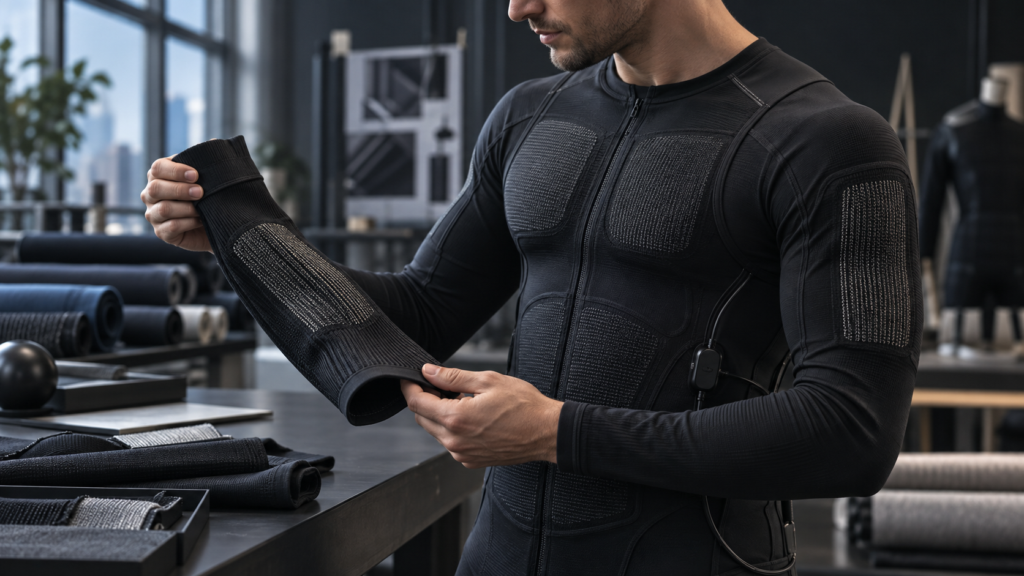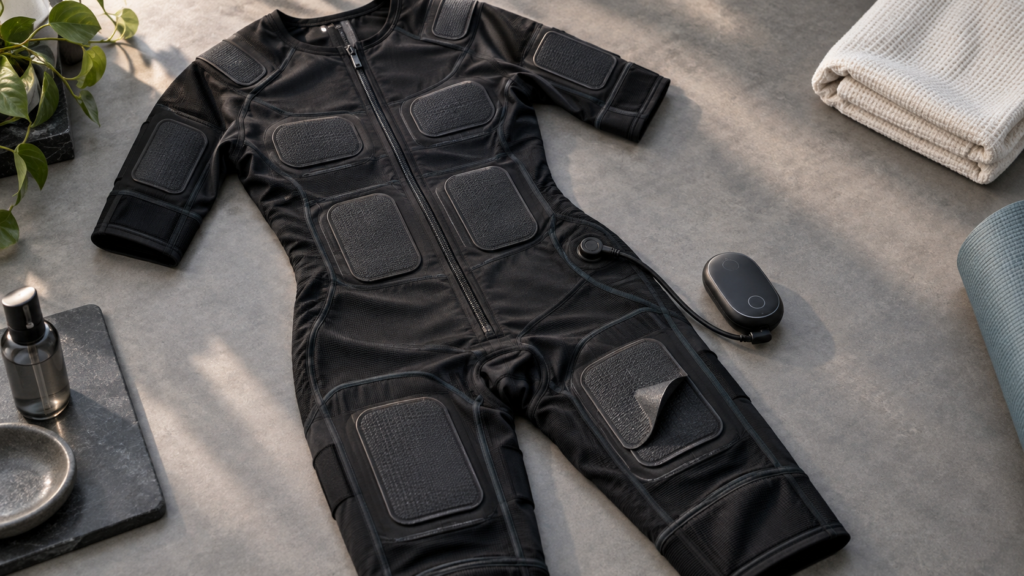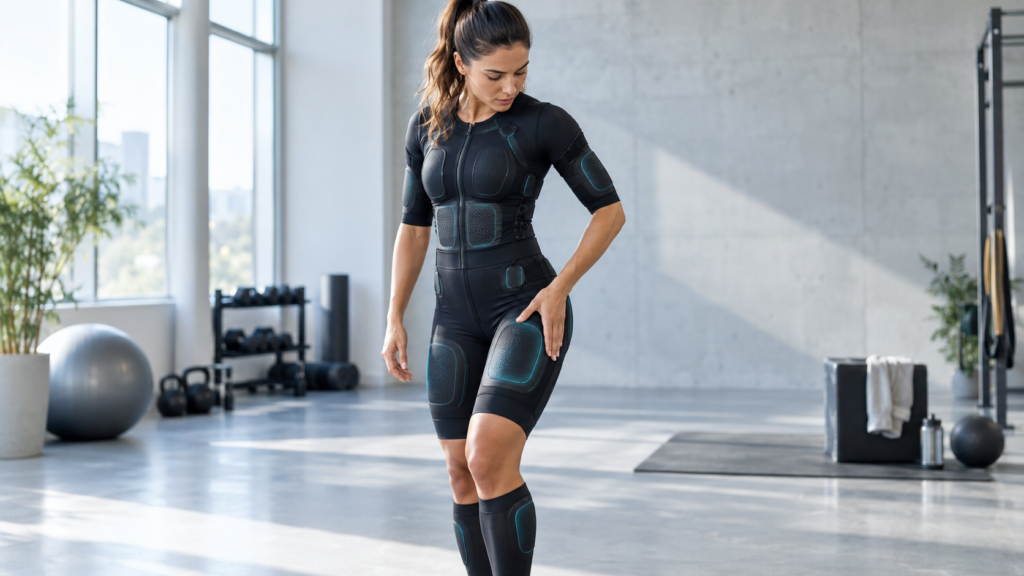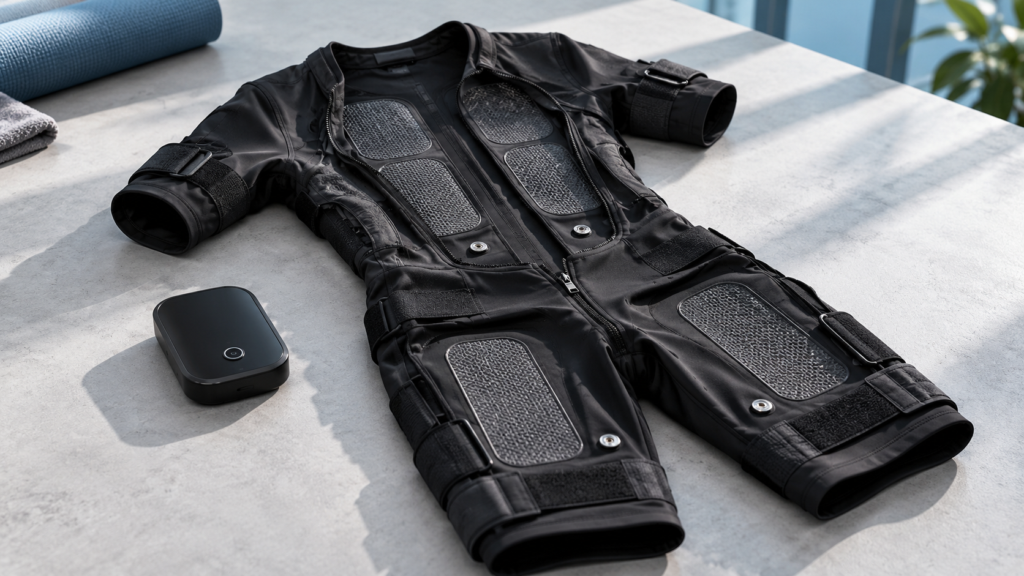
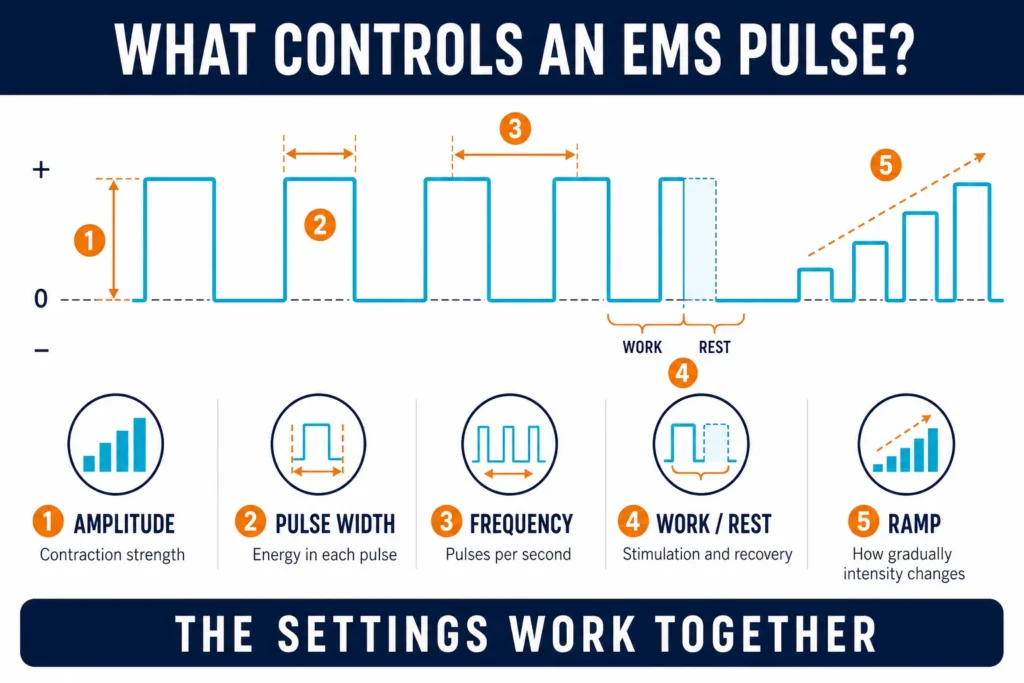
An EMS program can display a frequency, an intensity percentage, and sometimes a value measured in microseconds. That last value is usually the pulse width, also called pulse duration. It describes how long one electrical pulse lasts, not how long the contraction lasts, and not how long the workout lasts.
Pulse width is only one part of the stimulus. Amplitude, frequency, waveform, electrode area, skin contact, and the number of pulses in a train all help determine what a user feels and how much muscle force is produced. That is why a pulse-width number should never be treated as a universal “strength” score or copied from one device to another without checking the manufacturer’s instructions.
What is EMS pulse width?
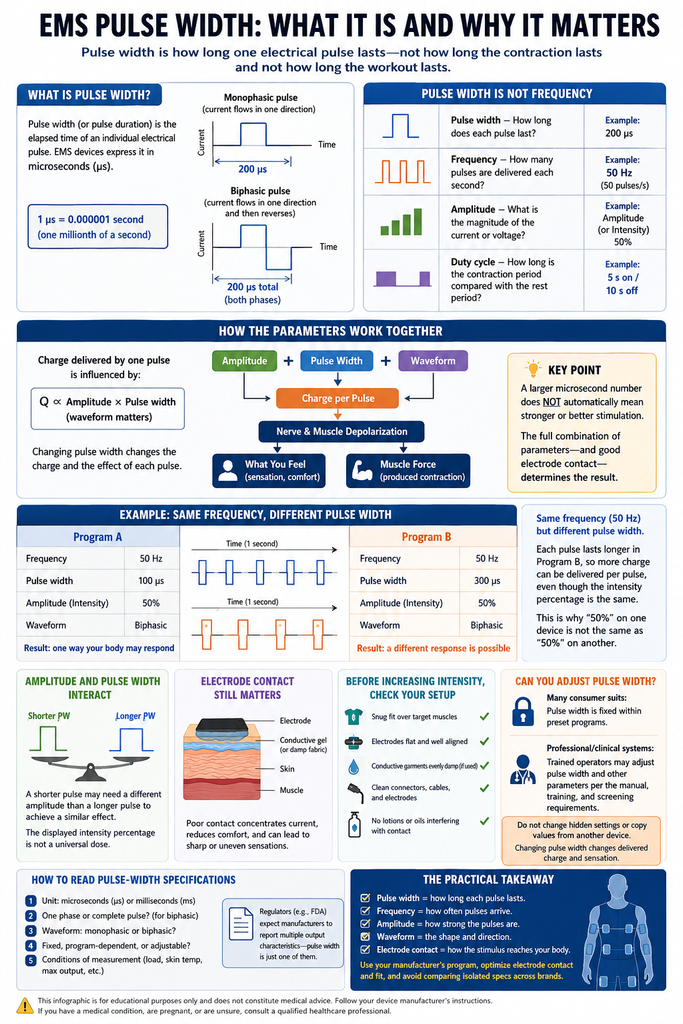
Pulse width is the elapsed time of an individual electrical pulse. EMS and neuromuscular electrical stimulation devices commonly express it in microseconds, abbreviated μs. One microsecond is one millionth of a second.
The more technically precise term is pulse duration. “Pulse width” is widely used in product interfaces and training conversations, however, so both terms appear in manuals and research papers.
For a monophasic pulse, current travels in one direction during the pulse. For a biphasic pulse, current travels in one direction and then reverses. When a source reports the duration of a biphasic pulse, it may include both phases. Device specifications are not always presented in exactly the same way, which is another reason not to compare two numbers without reading how each manufacturer defines them.
Pulse width is not frequency
Pulse width and frequency answer different questions:
- Pulse width asks: How long does each pulse last?
- Frequency asks: How many pulses are delivered each second?
- Amplitude asks: What is the magnitude of the current or voltage?
- Duty cycle asks: How long is the contraction period compared with the rest period?
A program could keep the same frequency while changing pulse width. It could also keep pulse width constant while a user increases amplitude. Each change can alter the stimulus, but it does so through a different mechanism.
For a broader explanation of frequency, see the existing EMSSuits guide to the role of electrical frequency in EMS training.
Why pulse width affects stimulation
An electrical pulse delivers charge over time. Pulse amplitude, duration, and waveform shape together influence the charge delivered by an individual pulse. Increasing pulse duration while holding other parameters constant can make a pulse more effective at depolarizing excitable tissue, but it can also change sensation and tolerance.
This does not mean that a wider pulse is automatically better. Research protocols choose parameters for a particular muscle, task, population, and device. A setting used for a localized clinical NMES application cannot automatically be transferred to a consumer whole-body EMS suit.
Reviews of NMES research often report pulse durations in the hundreds of microseconds, but the ranges vary by application. A critical clinical review describes pulsed-current durations commonly around 100–400 μs in some therapeutic contexts. Another review of NMES training notes that relatively short biphasic pulses are often used, while wider pulses combined with higher frequencies have been studied for their potential to recruit sensory pathways as well as motor axons. Those findings are context-specific rather than a recommendation for users to alter a suit’s factory program.
How pulse width interacts with amplitude
Users often experience amplitude as the adjustable “intensity” control. Pulse width may be fixed inside a program or controlled only by the manufacturer or trainer interface.
Amplitude and pulse width interact. A shorter pulse may require a different amplitude than a longer pulse to produce a comparable response. The same displayed intensity percentage therefore does not prove that two programs deliver an equivalent stimulus.
This matters when comparing brands. A 50% setting on one controller is not necessarily half the physical output of a 100% setting, and it is not necessarily equivalent to 50% on another controller. The percentage may describe a position within that device’s allowed range rather than a standardized dose.
Electrode size and contact still matter
Pulse specifications do not describe the entire user experience. The current is delivered through electrodes, and the electrode-to-skin interface affects current density and comfort.
If an electrode is wrinkled, partly dry, poorly aligned, or separated from the skin, current may concentrate over a smaller effective contact area. The user may notice a sharp or patchy sensation even when the program settings have not changed. Before assuming pulse width is the problem, check:
- Whether the suit fits snugly over the intended muscle zones.
- Whether every electrode has the contact conditions required by its manufacturer.
- Whether conductive garments are evenly dampened when the system uses wet electrodes.
- Whether connectors, cables, and electrode surfaces are clean and undamaged.
- Whether lotions or oils are interfering with contact.
The existing guide to wireless EMS suit maintenance and care covers broader equipment care. Always prioritize the cleaning and setup instructions supplied with the specific suit.
Can users adjust pulse width themselves?
That depends on the device. Many consumer systems offer preset programs and expose only zone intensity. Some professional or clinical stimulators allow trained operators to change pulse duration and other parameters.
Do not use hidden menus, unsupported software, or settings copied from another device to override a manufacturer’s program. Changing pulse width can change delivered charge and sensation. If a professional system makes the parameter adjustable, the operator should follow the device documentation, applicable training requirements, and the client-screening process.
How to read pulse-width specifications
When a manual lists pulse width, look for five details:
- The unit, usually microseconds or milliseconds.
- Whether the figure describes one phase or the complete pulse.
- Whether the waveform is monophasic or biphasic.
- Whether pulse width is fixed, program-dependent, or adjustable.
- The conditions under which the maximum output was measured.
The U.S. Food and Drug Administration’s guidance for powered muscle stimulators treats pulse width as one of several output characteristics manufacturers should report, alongside waveform, frequency, maximum current, and power density. That reinforces the central point: no single parameter describes a stimulator by itself.
Frequently asked questions
Is pulse width the same as pulse duration?
In everyday EMS use, the terms are generally used for the same time-based parameter. Pulse duration is the more technically precise label.
Does a larger microsecond number mean stronger EMS?
Not by itself. The resulting stimulus also depends on amplitude, frequency, waveform, electrode contact, and tissue response. A larger number should not be interpreted as a universal measure of program strength.
What is the best EMS pulse width?
There is no single best value for every device, muscle group, goal, and user. Research protocols vary, and consumer whole-body EMS systems should be operated according to their validated programs and instructions.
Can pulse width explain a sharp sensation?
It may influence sensation, but a sudden sharp or uneven feeling can also result from poor electrode contact, dry contact points, a loose garment, damaged equipment, or excessive amplitude. Stop and correct the setup rather than pushing through a painful sensation.
The practical takeaway
EMS pulse width tells you how long an individual pulse lasts. It is useful for understanding a program, but it cannot be interpreted alone. Frequency determines how often pulses arrive, amplitude describes their magnitude, waveform describes their shape and direction, and the electrode interface determines how the stimulus reaches the body.
For most suit users, the safest approach is simple: use the manufacturer’s program, improve fit and electrode contact before raising intensity, and avoid comparing isolated specifications across brands. Professionals working with adjustable systems should document the full parameter set rather than recording pulse width as if it were the complete dose.