

EMS Technology
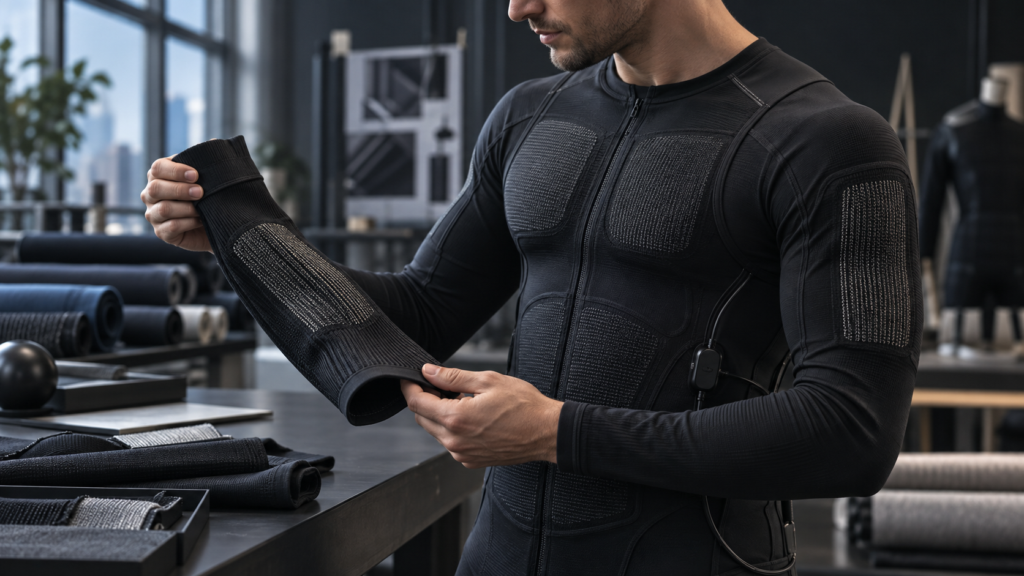
Conductive Fabric Electrodes in EMS Suits: Materials, Contact, and Wear
Learn how conductive textile EMS electrodes work, why moisture and
Includes:
BEST FOR
Instructor-Led EMS Workouts
TECHNOLOGY
Wet Electrode Technology
AVERAGE PRICE
~$3,000
CONNECTIVITY
Wired
Editor's Take
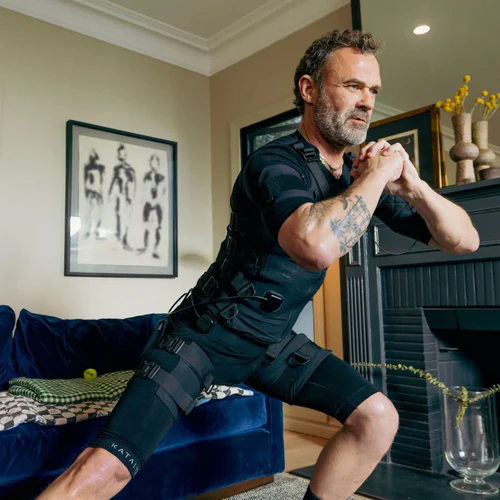
Katalyst is an FDA-cleared WB-EMS system designed for guided at-home training. Its current Gen4 system uses 26 electrodes, allows users to control different muscle groups, and comes with an extensive library of instructor-led workouts that synchronize stimulation with each exercise.
The workouts are easily one of Katalyst’s biggest strengths. Instead of putting on an EMS suit and figuring out what to do yourself, you can choose a class and have the stimulation work alongside the movements you’re being guided through. However, getting the full Katalyst experience requires an ongoing paid membership after you’ve already spent nearly $3,000 on the system.
There are a few other things we’d want to know before making that investment. Katalyst is a wet EMS system, so you’ll need a conductive base layer and water before training. Returns are also subject to a 15% restocking fee, and customer feedback raises some concerns about connectivity, electrode contact, and long-term reliability.
The company also went through an ownership change in 2025, which has created some complications for existing customers. In this review, we’ll go through the Gen4 system, app and workouts, price, shipping, returns, warranty, and what owners are saying so you can decide whether Katalyst is worth the investment.
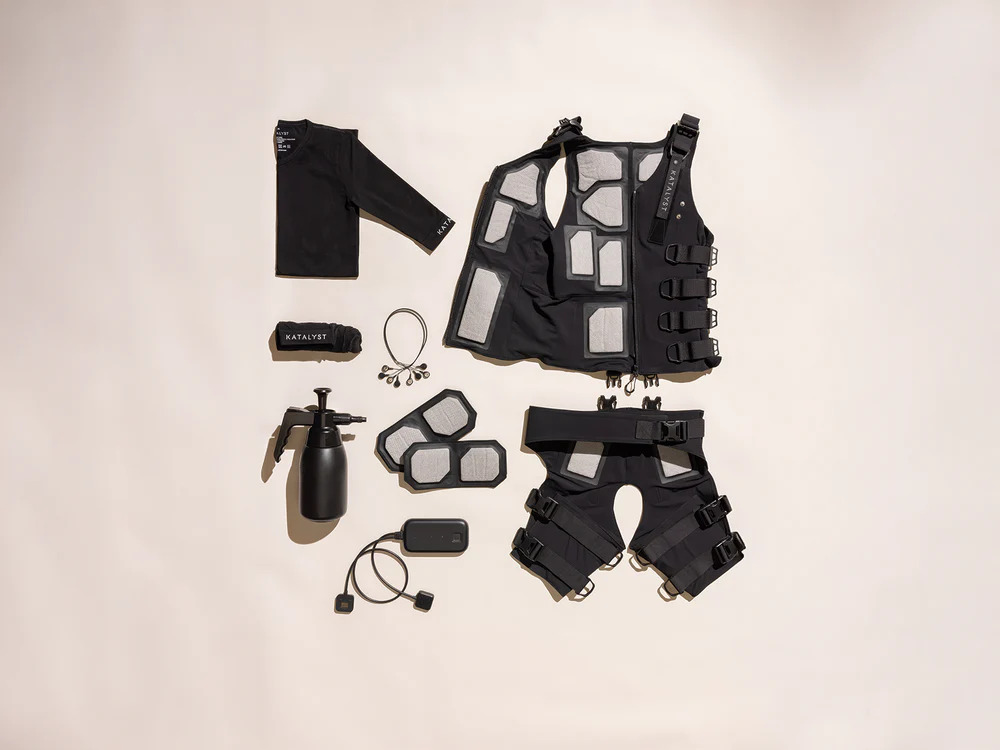
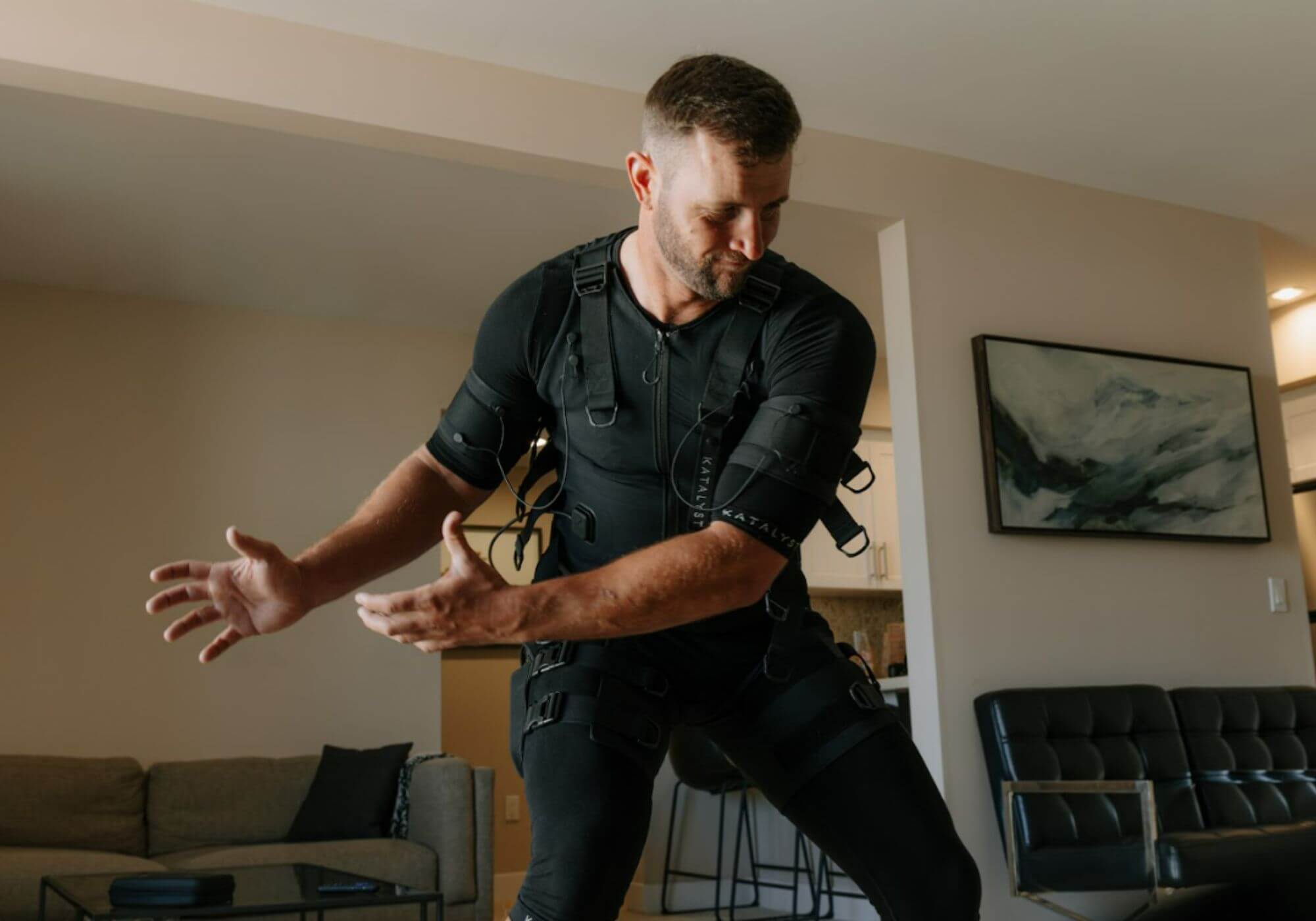
The Katalyst Gen4 is a wireless WB-EMS system designed for at-home workouts. Instead of using a one-piece bodysuit, the system consists of a vest, shorts, and separate arm straps. Its modular design allows Katalyst to select different component sizes based on your measurements.
The Gen4 contains 26 electrodes positioned around major muscle groups throughout the body. You can also turn individual muscle groups on or off, so you aren’t required to stimulate every area during every workout.
Katalyst uses wet EMS technology, which means there’s some preparation involved before you can start training. You’ll need to put on one of the supplied base layers underneath the EMS equipment and spray the electrodes with water. Proper moisture is important because the electrodes need sufficient contact with your body to deliver comfortable, consistent stimulation.
That’s something we’d think about beyond your first few workouts. Preparing a wet system may not seem like a big deal initially, but it’s a step you’ll repeat every time you want to use it. Some customers have also reported having to re-wet or readjust electrodes during workouts when contact isn’t sufficient.
The system is powered by Katalyst’s rechargeable Impulse Pack, which connects to the app and controls the stimulation. Katalyst estimates more than 10 workouts per charge, while fully recharging an empty Impulse Pack takes approximately three hours.
The app is where Katalyst makes its strongest case. Rather than simply giving you stimulation controls and leaving you to plan the workout, Katalyst offers instructor-led classes where the electrical impulses synchronize with the exercises you’re performing.
You can choose from different workouts and skill levels while adjusting stimulation according to your ability. Katalyst generally recommends 20-minute sessions with at least 48 hours of recovery between Strength and Power workouts.
If you like being told exactly what to do during a workout, there’s a lot to appreciate here. You can choose your class, follow the instructor, and let the program coordinate the EMS timing instead of managing every part of the session yourself.
The catch is that access to the complete workout library isn’t permanently included with the $2,999 system.
Katalyst requires a membership with the initial purchase. The monthly option costs $49 and currently includes a three-month free trial. Longer commitments reduce the monthly cost to $41 per month for one year, $39 per month for two years, or $35 per month for three years.
If you cancel, the equipment doesn’t become completely unusable. Katalyst provides access to a limited selection of basic workouts, but you lose the complete guided library and other membership features. That’s important because the synchronized workout experience is one of the biggest reasons we’d consider Katalyst in the first place.
Also pay attention to renewal terms. Prepaid memberships purchased upfront by credit card automatically convert to the $49 monthly plan after the original term unless you change the membership.
The Katalyst Gen4 Training System costs $2,999 before membership. It includes the vest, shorts, arm straps, two base layers, connectors, Impulse Pack, and other equipment needed to train.
There’s also a Partner Suit for $1,399. This includes the EMS garments and two base layers but doesn’t include another Impulse Pack, allowing another person in the household to share the original controller.
If you both want to train simultaneously, the cost goes up considerably. Each person needs an Impulse Pack and compatible device, and Katalyst requires a separate membership for each Impulse Pack to access the complete workout library.
The membership is the expense we’d pay closest attention to. At $49 per month, you’re spending another $588 per year after already paying approximately $3,000 for the system.
If Katalyst’s guided classes are what keep you consistent, you may decide that’s money well spent. But we’d calculate what three or four years of ownership actually costs before buying rather than treating $2,999 as the complete price of the experience.
Because Katalyst uses a modular vest, shorts, and arm-strap system, your measurements are used to determine the appropriate component sizes rather than placing you into a single one-piece suit size.
We’d take those measurements carefully and try the complete system relatively soon after it arrives. Make sure each component fits properly, the electrodes maintain good contact, the Impulse Pack connects reliably, and you’re comfortable with the wet preparation process while you’re still within the return period.
That’s particularly important here because deciding Katalyst isn’t right for you after trying it isn’t completely cost-free.
Katalyst offers a 30-day return period, but there’s a significant catch.
Purchases made after May 18, 2025 are subject to a 15% restocking fee. On a $2,999 system, that’s approximately $450. So, if you try Katalyst and decide it isn’t right for you, you could lose a substantial portion of your purchase price simply by returning it.
The suit and accessories come with a one-year limited warranty, while the Impulse Pack receives three years of coverage.
We like seeing longer protection on the Impulse Pack because it’s one of the most important and expensive components of the system. However, there have been customer concerns about what happens when problems develop outside that coverage. One owner reported trying to purchase a replacement battery after theirs failed and being told they would instead need another Impulse Pack.
There’s also an unusual issue surrounding Katalyst’s 2025 ownership transition. The previous Katalyst company was unable to secure additional working capital, its team was laid off in May 2025, and the company’s assets were eventually acquired by new ownership.
That distinction matters for legacy customers. Katalyst’s current return policy states that the new company can’t process returns or cancellations for purchases made before May 18, 2025.
Some early customers have also said they purchased Katalyst with promised lifetime access to workout content. In May 2026, a customer shared a response attributed to Katalyst support stating that the current company plans to require membership fees from legacy customers because the previous lifetime-access model wasn’t sustainable.
Those promises were made under the previous company, so the situation isn’t as simple as blaming the current ownership. Still, we’d consider it relevant because so much of Katalyst’s value comes from continued access to its software and guided workout platform.
Katalyst gets plenty of praise for the actual workouts, including from owners who aren’t nearly as complimentary about other parts of the experience.
Users frequently praise the instructor-led classes and the way stimulation automatically synchronizes with the exercises. Owners describe the workouts as challenging despite their short duration, and some report improvements in strength, muscle development, and core activation.
One long-term owner who completed more than 100 Katalyst workouts over approximately 2.5 years said the workouts were effective and produced noticeable results. Another owner with experience using multiple EMS systems said they continued paying for Katalyst specifically because they preferred its synchronized Strength and Power workouts.
That’s what makes Katalyst interesting. Even some customers who criticize the price or reliability still really like the workouts.
Unfortunately, reliability is also one of the more consistent concerns in customer feedback.
That same long-term owner estimated that their system worked smoothly only around 70% to 80% of the time. They reported connectivity problems, poor electrode contact, repeated adjustments, and having to re-wet electrodes. According to their experience, what should have been a 20-minute workout could sometimes become a 30- to 40-minute process once setup and troubleshooting were included.
Other customers have reported electrode connection problems and pads that stopped working properly, while some recent owners have complained about slow communication when trying to resolve technical issues.
There are also complaints tied specifically to the ownership transition. One customer reported ordering a system in 2024, receiving it in 2026, and discovering that it wouldn’t turn on and didn’t fit correctly. According to the customer, the current company wouldn’t replace or refund it because the original purchase had been made under the previous ownership.
We wouldn’t treat legacy-order problems as representative of every Katalyst purchase made today because those transactions occurred under a different company. But if we’re trying to help you understand the complete ownership picture, we wouldn’t leave them out either.
Katalyst’s strongest feature remains its guided workout experience. The synchronized classes are genuinely well-liked, and for someone who needs that structure to stay consistent, they could make the system appealing.
The harder part for us is everything surrounding those workouts. You’re spending $2,999 on a wet EMS system and then potentially another $588 every year to maintain full access to one of its best features. There’s also the 15% return fee, reported reliability issues, and some uncertainty created by the ownership transition.
If guided EMS classes are your top priority and you don’t mind paying continuously for them, Katalyst has one of the stronger workout libraries available. We’d just make sure you’re comfortable with the long-term cost and the realities of wet EMS ownership before letting the appeal of a 20-minute guided workout make the decision for you.
Individually controlled electrode zones target key muscle groups for balanced full-body activation.
Allows users to fine-tune stimulation strength for beginners through advanced fitness levels.
Provides joint-friendly workouts that reduce strain compared to heavy weightlifting.
Channels:
Available Sizes:
Frequency (Hz):
Charging Time:
Warranty:
Presets:

Join EMS users comparing suits, sharing protocols, and posting honest results. Free to join, no sales pitch.
Protocol sharing
Suit comparisons
Safety-first advice
Learn how conductive textile EMS electrodes work, why moisture and
Fix patchy or sharp EMS stimulation by checking fit, moisture,
Learn how EMS electrode area and placement affect current density,
Inspect EMS cables, plugs, snaps, strain reliefs, and controller contacts
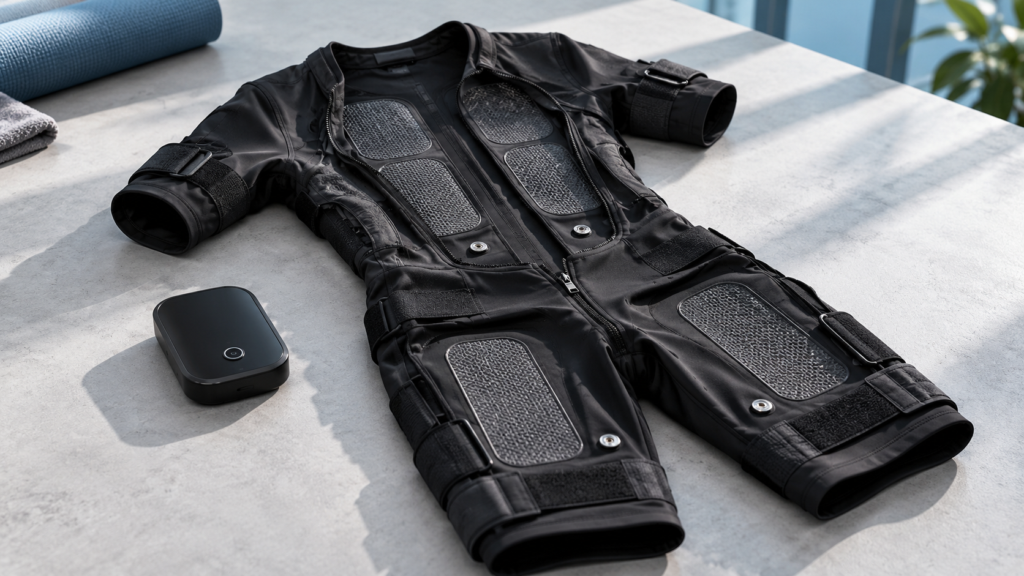
Learn what affects EMS suit lifespan and how to recognize
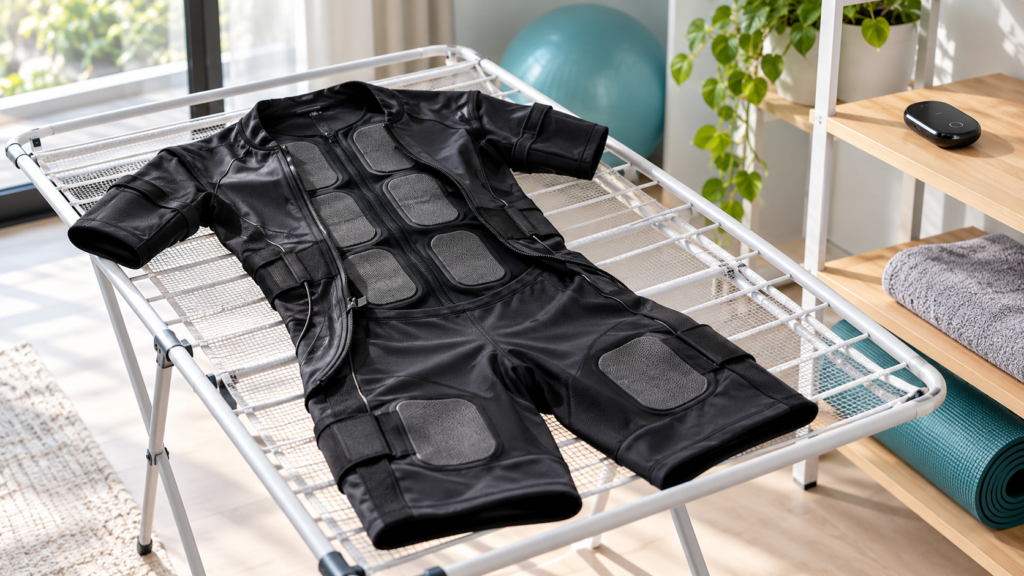
Remove EMS suit odor by using the approved wash and