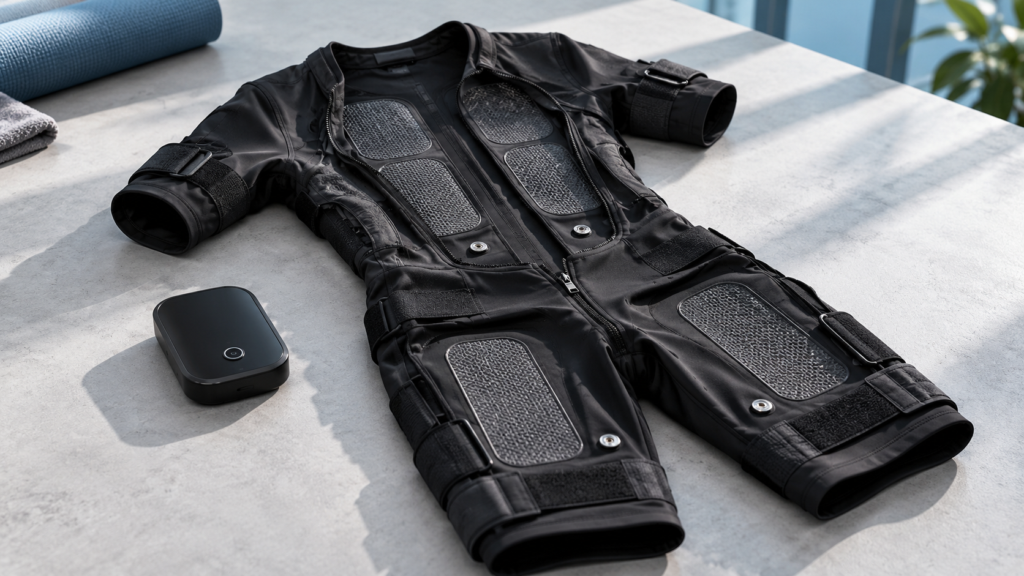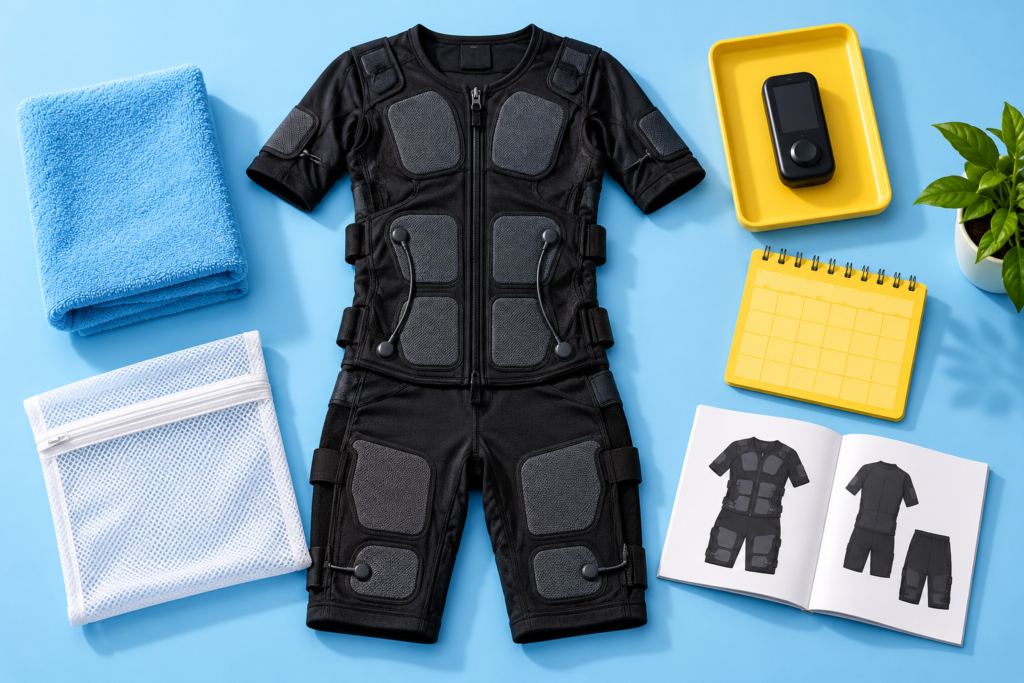
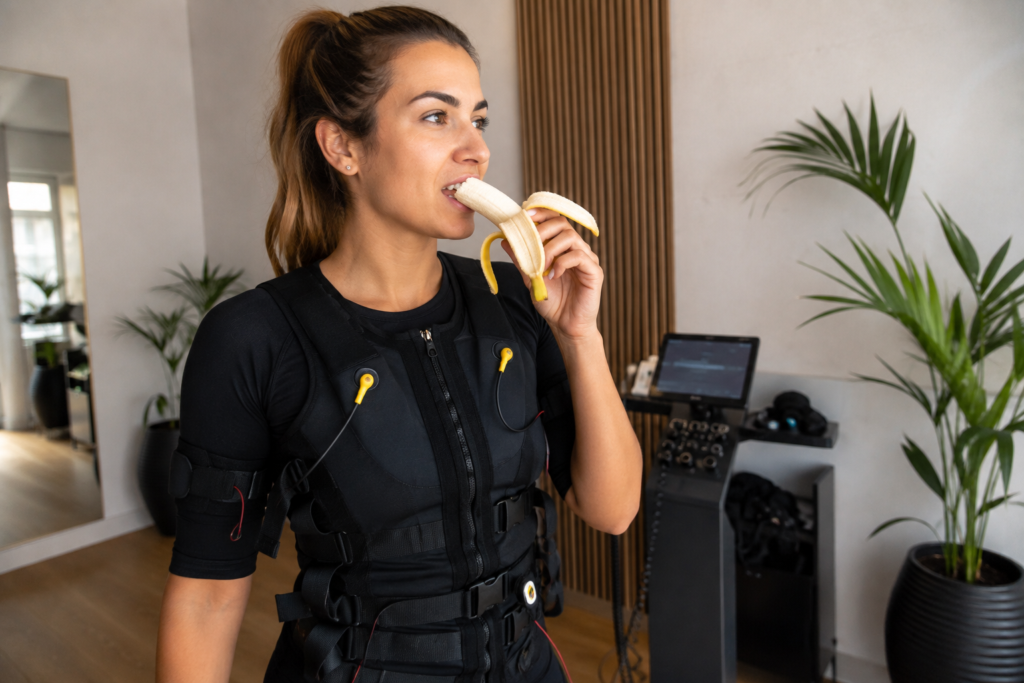
If you are getting ready for an EMS workout, food may not be the first thing you think about. You put on the suit, adjust the settings, and get through what is usually a fairly short training session. But your muscles are still contracting and using energy, which brings up a reasonable question: should you eat before or after an EMS workout?
The simple answer is that you can do both.
Eating before an EMS workout can provide fuel for the activity, while eating afterward can help provide the nutrients your body uses during recovery. However, that doesn’t mean you need a special EMS diet, a huge pre-workout meal, or a protein shake waiting for you the second the suit comes off.
Research specifically examining nutrition around EMS workouts is still limited. What we do have is research showing that electrical muscle stimulation has metabolic effects, along with a much larger amount of evidence about nutrition before and after exercise in general.
So, when deciding whether to eat before or after an EMS workout, it makes more sense to start with established exercise nutrition principles rather than inventing a separate set of rules for EMS.
Here is what that research can actually tell us.
Does an EMS Workout Require Fuel?
An EMS workout may produce muscle contractions differently from a conventional workout, but those contractions still require energy.
Research has found measurable metabolic responses to electrical muscle stimulation. For example, one study involving people with type 2 diabetes used an EMS suit that stimulated muscles in the trunk, arms, and legs. Participants completed 20-minute EMS sessions twice a week for 10 weeks. Researchers observed changes in exercise capacity and glucose metabolism during the study.
This doesn’t mean everyone needs to eat immediately before EMS training. It simply shows that electrical stimulation isn’t metabolically meaningless just because the workout may look different from traditional exercise.
Your nutritional needs still depend on things like how long and intensely you train, what else you’re doing during the session, your overall activity level, and when you last ate.
In other words, deciding whether to eat before or after an EMS workout is more about normal exercise nutrition than creating a completely different set of rules for EMS.
Should You Eat Before an EMS Workout?
You certainly can, and for many people it makes sense.
Carbohydrates are one of the body’s major sources of energy during exercise. According to Mayo Clinic’s guidance on eating and exercise, consuming carbohydrates before exercise can support workout performance, particularly when the activity requires more energy.
But timing matters.
Eating a giant meal and immediately squeezing into an EMS suit probably isn’t going to make for the most comfortable session.
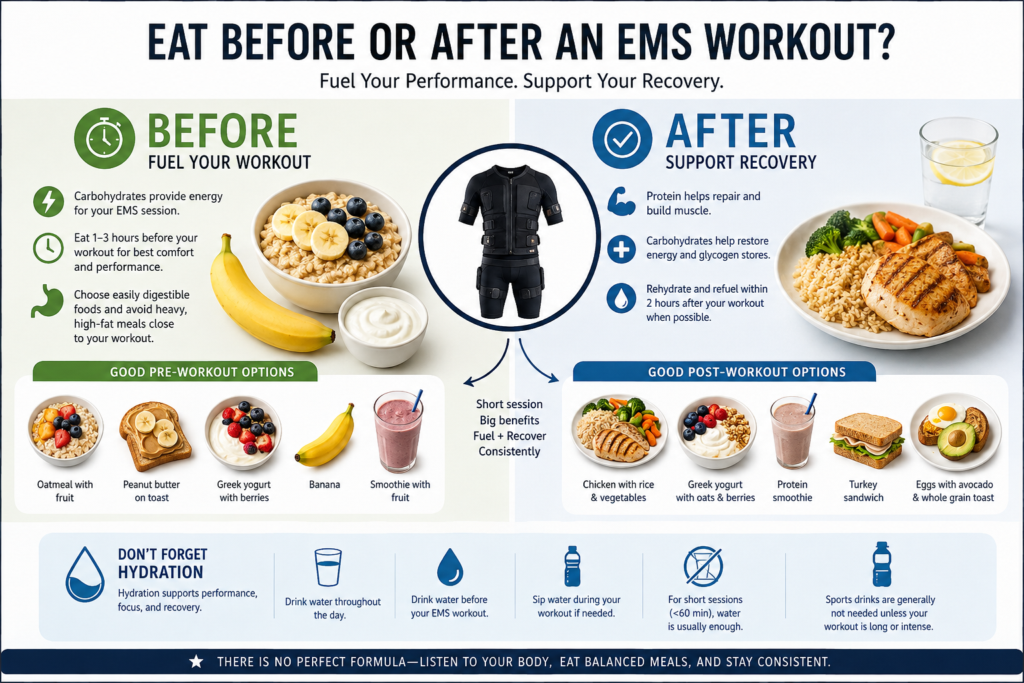
Mayo Clinic recommends allowing around three to four hours between a large meal and exercise. For a smaller meal or snack, about one to three hours is generally suggested.
Those aren’t EMS-specific rules. They’re general exercise guidelines, but they’re useful here.
If you ate lunch two hours ago and you’re about to do a short EMS session, you probably don’t need to eat again simply because you’re using EMS. On the other hand, if you haven’t eaten since breakfast and you’re training late in the afternoon, having something beforehand may make more sense.
That’s why there isn’t one universal answer to whether you should eat before or after an EMS workout. The timing of your previous meal and how you personally feel while exercising matter too.
The goal is to arrive fueled without feeling overly full.
What Should You Eat Before an EMS Workout?
There isn’t a special food that makes EMS work better.
A normal pre-workout meal can include carbohydrates along with some protein. Mayo Clinic Press recommends a meal containing carbohydrates and protein before physical activity, while also suggesting that high-fat and high-fiber foods may be less comfortable close to exercise because they take longer to digest.
If you have a few hours before your EMS workout, a regular meal could look like:
- Chicken, rice, and vegetables
- Oatmeal with yogurt and fruit
- Eggs with toast and fruit
- A turkey sandwich with fruit
- Greek yogurt with oats and berries
You don’t need to make this complicated.
If your EMS workout is coming up sooner, a smaller snack may be easier to tolerate. That could be a banana, yogurt, toast, crackers, fruit, or a small smoothie.
The closer you get to your workout, the less appealing a large, heavy meal will probably become.
The International Society of Sports Nutrition’s position stand on nutrient timing also supports the use of carbohydrate and protein around exercise. At the same time, the organization emphasizes overall daily nutrition rather than suggesting that one perfectly timed meal determines the success of a workout.
That’s a useful distinction when deciding whether to eat before or after an EMS workout.
Meal timing matters, but your entire diet matters more than one snack.
Can You Do an EMS Workout on an Empty Stomach?
Yes, your muscles don’t require a freshly eaten meal in order to contract.
That doesn’t mean everyone should train on an empty stomach, though.
Some people feel perfectly comfortable exercising before breakfast. Others feel hungry, lightheaded, weak, or simply perform worse.
Mayo Clinic notes that exercising without eating can leave some people feeling slow or lightheaded, particularly when more energy is required for the activity. It recommends paying attention to how your own body responds rather than assuming one eating schedule works for everyone. You can read its full exercise nutrition guidance here.
It is also important not to turn fasted training into something it isn’t.
Doing EMS on an empty stomach doesn’t automatically mean you’re going to lose more body fat or get better results. Whether someone gains or loses weight depends on much more than whether breakfast happened before or after one training session.
If you feel good doing EMS before breakfast, eating beforehand may not be necessary. If you consistently feel weak or uncomfortable when you train without food, there’s little reason to force it just because you’ve heard that fasted workouts are better.
For someone who prefers fasted training, the answer to whether to eat before or after an EMS workout may simply lean toward eating afterward.
Should You Eat After an EMS Workout?
This is the other half of the question.
Eating after an EMS workout gives your body an opportunity to get protein, carbohydrates, fluids, and other nutrients it needs anyway.
Protein is particularly relevant to muscle recovery because it provides amino acids used in muscle protein synthesis.
According to the International Society of Sports Nutrition’s position stand on protein and exercise, exercise and protein intake both stimulate muscle protein synthesis, and consuming protein before or after resistance exercise can support this process.
Carbohydrates have a different role. Among other things, they can help restore muscle glycogen used during exercise.
That doesn’t mean you need to rush to the locker room and drink a protein shake within five minutes.
The idea of an extremely short post-workout “anabolic window” is more rigid than the evidence supports. The ISSN nutrient timing position stand notes that high-quality protein consumed in the post-exercise period stimulates muscle protein synthesis, but it also places considerable emphasis on meeting total daily protein needs and distributing protein intake across the day.
Mayo Clinic gives a very practical recommendation: when possible, have a meal containing both carbohydrates and protein within about two hours after exercise.
So if you’re wondering whether to eat before or after an EMS workout, there isn’t much reason to stress over the exact minute.
What Should You Eat After an EMS Workout?
Your post-EMS meal can look like a normal balanced meal.
For example:
- Chicken with rice and vegetables
- Fish with potatoes and vegetables
- Eggs, toast, and fruit
- Greek yogurt with oats and berries
- A turkey or chicken sandwich
- A smoothie containing fruit and a protein source
You don’t need to eat all of these foods, obviously. The point is that there isn’t a secret EMS recovery food.
Protein supplements aren’t mandatory either.
The ISSN position stand on protein and exercise states that physically active people can meet their protein requirements through whole foods. Protein supplements can simply be a convenient option for people who have difficulty meeting their needs through their normal diet.
So if you’re going home and eating dinner after your EMS workout, you probably don’t need to drink a protein shake on the drive home just because you finished training.
If dinner isn’t happening for several hours, a snack containing protein and carbohydrates may be more practical.
This is another reason the decision to eat before or after an EMS workout doesn’t need to revolve around supplements. Normal food can cover the same basic nutritional needs.
How Much Protein Do You Need After EMS?
This is where it’s easy to get unnecessarily precise.
There isn’t an established amount of protein that every person needs specifically because they completed an EMS workout.
The broader sports nutrition research gives us a better starting point.
The International Society of Sports Nutrition states that about 1.4 to 2.0 grams of protein per kilogram of body weight per day is sufficient for most people who exercise regularly. It also gives a general recommendation of approximately 20 to 40 grams of high-quality protein per serving for stimulating muscle protein synthesis, although individual needs can vary.
That does not mean everyone who uses an EMS suit needs 40 grams of protein immediately afterward.
Daily intake is important.
If someone eats adequate protein throughout the day, their nutrition doesn’t suddenly become inadequate because they didn’t drink a shake immediately after training.
This is another reason the question of whether to eat before or after an EMS workout shouldn’t become overly complicated.
Don’t Forget About Carbohydrates
Protein tends to get most of the attention when people talk about workout nutrition, but carbohydrates matter too.
Your muscles store carbohydrate in the form of glycogen, which can be used as fuel during physical activity.
How much carbohydrate you need depends greatly on the amount and type of training you’re doing.
Someone completing a short EMS workout doesn’t have the same fueling requirements as someone running a marathon or completing several hours of high-volume training.
The ISSN’s nutrient timing review specifically notes that glycogen depletion is greatest during high-volume exercise and that aggressive carbohydrate replacement becomes particularly important when rapid glycogen restoration is required between demanding exercise sessions.
That’s a very different situation from assuming every EMS workout requires a large carbohydrate recovery meal.
For the average person, including normal carbohydrate sources in meals around training can be enough.
Rice, potatoes, oats, bread, pasta, fruit, beans, and other carbohydrate-containing foods can all serve that purpose.
What About Hydration Before an EMS Workout?
Food is only one part of the equation.
Starting an EMS workout already dehydrated isn’t ideal.
The American College of Sports Medicine’s position stand on exercise and fluid replacement recommends beginning physical activity adequately hydrated. It also makes an important point that gets lost in a lot of hydration advice: fluid needs can vary substantially between people.
Sweat rate matters.
So do the environment, workout duration, intensity, body size, and how much fluid someone has already consumed.
This is why there isn’t much value in inventing an exact amount of water that everyone must drink before an EMS session.
You don’t need to chug a giant bottle of water right before putting on the suit.
Instead, normal hydration throughout the day and drinking around your workout as needed is a more practical approach.
Do You Need a Sports Drink During an EMS Workout?
For a typical short EMS session, probably not.
Water is generally enough for shorter workouts unless there are other circumstances that substantially increase fluid or electrolyte losses.
The American College of Sports Medicine has noted that during exercise lasting less than an hour, there is little evidence of a physiological or performance difference between drinking plain water and consuming a carbohydrate-electrolyte beverage. Longer and more intense exercise can be different, especially when substantial sweating is involved.
Mayo Clinic similarly recommends water for general fluid replacement and suggests sports drinks become more useful during exercise lasting longer than about 60 minutes. Its exercise hydration recommendations are available here.
That means you don’t need a sports drink just because EMS involves electrical stimulation.
Dietary electrolytes are important for normal nerve and muscle function, but the fact that an EMS suit uses electrical current doesn’t automatically create some special need to drink extra electrolytes during every session.
That’s a separate nutrition question from how the device itself produces electrical stimulation.
Does EMS Require a Special Diet?
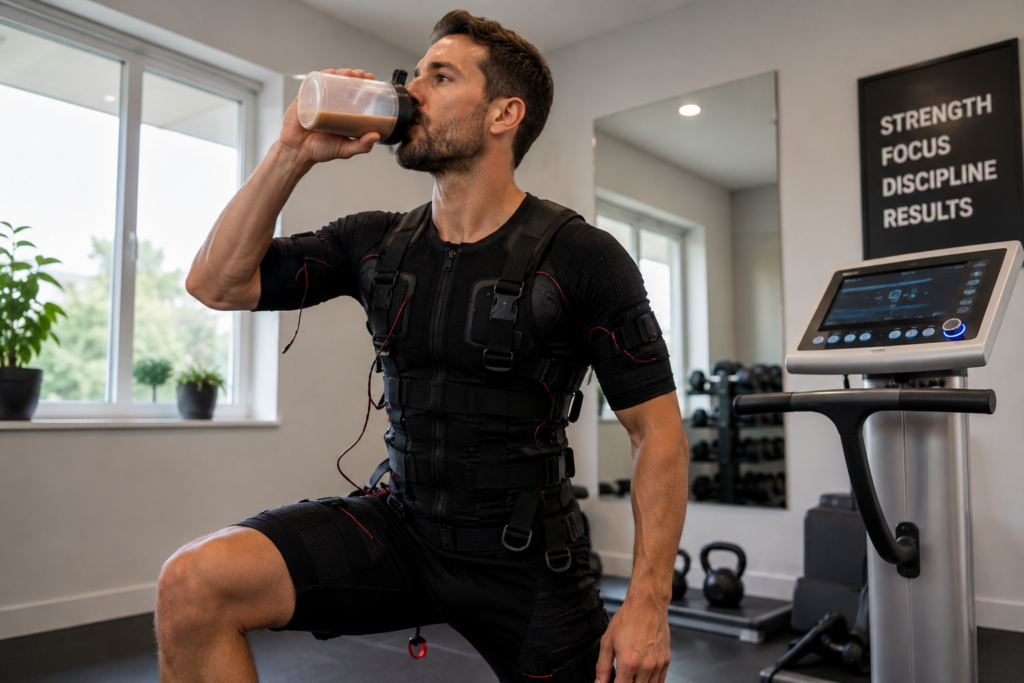
Based on the available research, there isn’t an established “EMS diet.”
We have evidence that EMS can produce muscular and metabolic responses. For example, the study using an EMS suit in people with type 2 diabetes found changes in glucose metabolism and exercise capacity following a 10-week training program.
What that research doesn’t tell us is that EMS users need a unique macronutrient ratio, special meal plan, unusual supplements, or some completely different approach to nutrition.
There simply isn’t good evidence for making that leap.
For most healthy people doing EMS training, established exercise-nutrition principles give us a much better foundation:
- Eat enough to support your activity.
- Get adequate protein throughout the day.
- Include carbohydrates based on your activity and energy needs.
- Eat foods you can comfortably digest before training.
- Stay hydrated.
- Don’t turn one pre- or post-workout meal into something more important than the rest of your diet.
Knowing these basics makes it much easier to decide whether to eat before or after an EMS workout based on your own schedule instead of following a rigid EMS meal plan.
Eating Before vs. After an EMS Workout
Here’s a simple way to think about it:
| Timing | What to consider | Examples |
| 3–4 hours before | A normal meal can provide fuel without leaving you overly full | Chicken and rice, oatmeal and yogurt, eggs and toast |
| 1–3 hours before | Keep the meal or snack somewhat smaller | Yogurt and fruit, small sandwich, toast and eggs |
| Shortly before | Something light may help if you’re hungry | Banana, toast, fruit |
| During a typical short session | Focus mainly on hydration as needed | Water |
| Within a couple of hours afterward | Include protein, carbohydrates, and fluids | Regular balanced meal or snack |
These are general exercise nutrition principles rather than special rules created for EMS. The timing recommendations are consistent with Mayo Clinic’s guidance on eating around exercise.
So, Should You Eat Before or After an EMS Workout?
For most people, the answer doesn’t need to be either/or.
Eating before an EMS workout can provide energy and prevent hunger, especially if it has been several hours since your last meal. Eating afterward gives you an opportunity to consume protein, carbohydrates, fluids, and other nutrients that support normal recovery.
You don’t necessarily need a dedicated meal at both times.
If you ate a balanced meal a couple of hours before your EMS workout and you’re having another normal meal afterward, you’re already covering both sides of the equation.
Likewise, you don’t need to force yourself to eat immediately before training if you feel better without food in your stomach.
Current research doesn’t establish a special nutritional requirement unique to EMS training. The better approach is to apply the same basic principles that work around other forms of exercise: eat enough overall, get adequate protein and carbohydrates, stay hydrated, and time your meals in a way that allows you to train comfortably.
So, when deciding whether to eat before or after an EMS workout, don’t overthink it. Both can have a place. What matters more is what you’re eating across the entire day and whether that diet actually supports your training and recovery.
Ready for your EMS suit? Check out our product/brand reviews or utilize our product comparison tool page to find the best suit that fits your needs.