
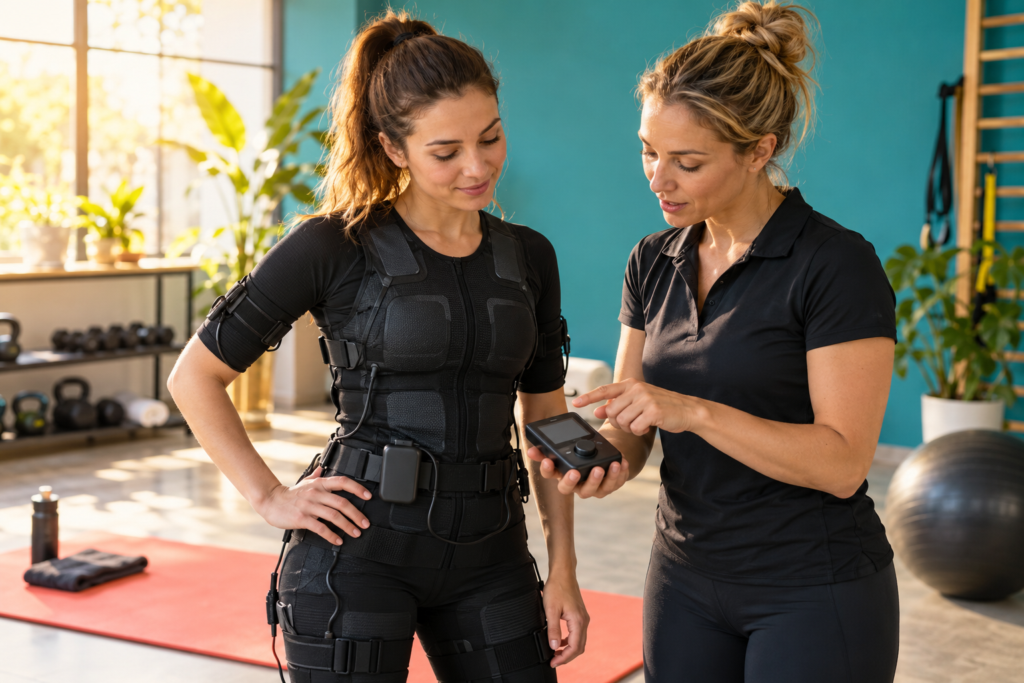
Between Thanksgiving and New Year’s, you may disengage from your EMS workout routine to enjoy scrumptious pumpkin pie and honey-glazed ham. Maybe even black-eyed peas and collard greens for wealth and prosperity on NYE. But then the resolutions come in, and on New Year’s morning, you return to the gym with renewed determination and your EMS suit. The problem? You believe you can just pick up exactly where you left off. That’s a mistake we highly recommend avoiding, as it can cause more harm than good.
This isn’t to say you can’t use your EMS suit right away, but resuming at the same intensity as last time isn’t safe.
This guide explains why returning after a break needs a gentler start, what research and international guidelines recommend, and a simple plan to get back on track.

Why EMS training after a break needs a softer first session
Whole-body EMS activates large amounts of muscle at once. That is why short sessions can feel so effective. It is also why the load can climb fast if intensity jumps too soon.
A mini review in Frontiers in Physiology (Teschler and Mooren, 2019) discusses how intense whole-body EMS can produce marked increases in creatine kinase (CK), a marker of muscle damage, especially in people who are not conditioned to the stimulus. CK can keep rising for days, with peaks often reported around 72 to 96 hours after a hard session. Our safety research overview covers the same theme in plain language.
Your muscles also adapt when you train regularly. Scientists call this the repeated bout effect. After an early bout causes more damage, later bouts of a similar load often cause less. The 2023 international guideline for safe and effective whole-body EMS (Kemmler et al.) notes that this protective pattern shows up with EMS-related CK increases too.
Here is the catch for EMS training after a break. That protection fades when you stop for a while. A long layoff can leave you closer to beginner status than your memory of last month’s settings suggests. If you want the bigger picture on what happens when training stops, see our note on muscle loss from inactivity.
What the guidelines recommend for a return
The 2023 guideline was written for safe whole-body EMS application in general. Its principles are a useful frame for EMS training after a break, even when your break was holiday travel rather than a brand-new start.
- Start moderate. Initial sessions should sit around “4” (somewhat strong) on the Borg CR10 effort scale, not high intensity.
- Shorten the first session. The guideline advises a reduced first session, with a few minutes of familiarization plus about 12 minutes of intermittent work, and a maximum of about 20 minutes for a typical resistance-style session.
- Limit frequency early. During the first 8 to 10 weeks of whole-body EMS, it recommends no more than one 20-minute session per week.
- Protect recovery later. After that conditioning phase, it recommends at least four days between high-intensity sessions.
- Skip exhaustion. Maximum-effort or continuous tetanic contractions should be avoided, no matter how experienced you feel.
An older systematic review in the Journal of Strength and Conditioning Research (Filipovic et al., 2011) looked at EMS training regimens across many trials. Effective programs in that analysis often averaged about three sessions per week, and pushing frequency higher was not automatically better. For EMS training after a break, treat that as a reminder to respect recovery, not as a reason to jump straight back to your old weekly volume.
For a practical schedule walkthrough, pair this with our guide on how often EMS training should happen and our first-session length breakdown. The same start-low logic shows up in our intensity tips and Is EMS training safe? overview.
How long was your break?
There is no official chart for EMS training after a break, so use common sense and err on the side of caution.
| Time off | Practical restart approach |
| About 1 to 2 weeks | You likely have not lost much conditioning. Drop intensity a notch for the first session back, then check how you feel over the next few days before returning to your usual level. |
| About 3 to 6 weeks | Treat the first one or two sessions as re-familiarization. Use moderate intensity, a shorter session, and allow about a full week before the next one. Increase gradually. |
| About 2 months or more | Consider yourself close to beginner status again. Follow the conditioning approach in the guideline. Moderate intensity, shorter sessions, and no more than one session per week for several weeks before progressing. |
This table is a practical filter, not a medical protocol. If your break followed illness, injury, or surgery, talk with a clinician before you restart. Athletes coming back from an off-season stretch can also lean on our off-season EMS guide.
A sample four-week plan for EMS training after a break
This sample is built for EMS training after a break of a month or more. Adjust it to your trainer’s advice, your device instructions, and how you recover.
| Week | Session plan | Intensity cue | Recovery note |
| Week 1 | One short session at moderate intensity | Around “somewhat strong,” not a personal best | Note soreness over the next 72 to 96 hours |
| Week 2 | One session, slightly longer if Week 1 went well | Same level, or a small step up only if you recovered cleanly | Keep at least several quiet days between sessions |
| Week 3 | One fuller session, up to about 20 minutes | Moderately hard effort, still controlled | If soreness lingers, hold intensity steady |
| Week 4 | One session, if you feel good | Leave at least four days between harder sessions | Stop adding volume if form or energy slips |
On non-EMS days, walking, mobility work, and light activity help you stay active without stacking EMS load. A quick pre-session equipment check and solid hydration habits make the return smoother. Our session prep checklist is another useful warm-up for the habit itself.
EMS training after a break works best when the plan is boring in a good way. Short. Repeatable. Easy to stick with.
Warning signs to take seriously
Some muscle soreness after a return session is normal during EMS training after a break. Stop training and contact a doctor promptly if you notice severe muscle pain, unusual weakness, significant swelling, or dark tea- or cola-colored urine. Those can be signs of serious muscle breakdown.
Do not treat “push through it” as a badge of honor during EMS training after a break. Recovery is part of the work. If you are sorting out normal soreness versus a red flag, our EMS and DOMS overview can help you frame the difference.
Who should check with a doctor first
EMS training after a break is not a free pass to skip screening. EMS is not suitable for everyone. Talk to a physician before restarting if you are pregnant, have a pacemaker or other implanted electronic device, have epilepsy, a heart condition, or any other medical concern, or if your break was due to illness, injury, or surgery.
Review our full EMS suit contraindications guide before you suit up again. When in doubt, get clearance first. Our FAQ also covers common safety questions in short form.

Frequently asked questions
Can I go straight back to my old intensity after the holidays?
It is better not to. EMS training after a break goes smoother when you start a level or two lower and work back up over a few sessions, especially if you have been off for more than a couple of weeks.
How many EMS sessions per week should I do when I come back?
One per week is a safe starting point while you recondition. Guidelines recommend at least four days between high-intensity sessions once you are conditioned. That pacing is the backbone of EMS training after a break.
Why am I sorer than I used to be?
The protective adaptation your muscles built up, the repeated bout effect, fades during time off. The same session can feel harder and cause more soreness. That is expected early in EMS training after a break.
Is it safe to use EMS while I am still sore?
Wait until significant soreness has resolved before your next session. Recovery is part of training, and it matters even more during EMS training after a break.
Do home EMS users follow the same return rules?
Yes. The same principles apply whether you train in a studio or at home. Start low, keep early sessions shorter, leave recovery days, and follow your device instructions. If you are comparing systems while you rebuild the habit, browse our brand reviews or line up options in the product comparison tool.
Start low, then earn the harder sessions
Coming back is about patience. A few weeks of moderate work will get you back to your usual routine far more safely than one hard session that leaves you sidelined.
Keep your first return session intentionally easy, protect your recovery days, and let consistency do the heavy lifting. EMS training after a break should feel like a restart, not a rebound. If you need help choosing gear for that next chapter, start with our brand reviews.
This article is for general information only and is not medical advice. Consult your doctor before restarting EMS or any new training plan, especially if you have a medical condition or are returning from illness, injury, or surgery. Follow your device instructions and stop if you feel sharp pain, dizziness, or unusual discomfort.
This article is for general information only and is not medical advice.