
Quick Answer
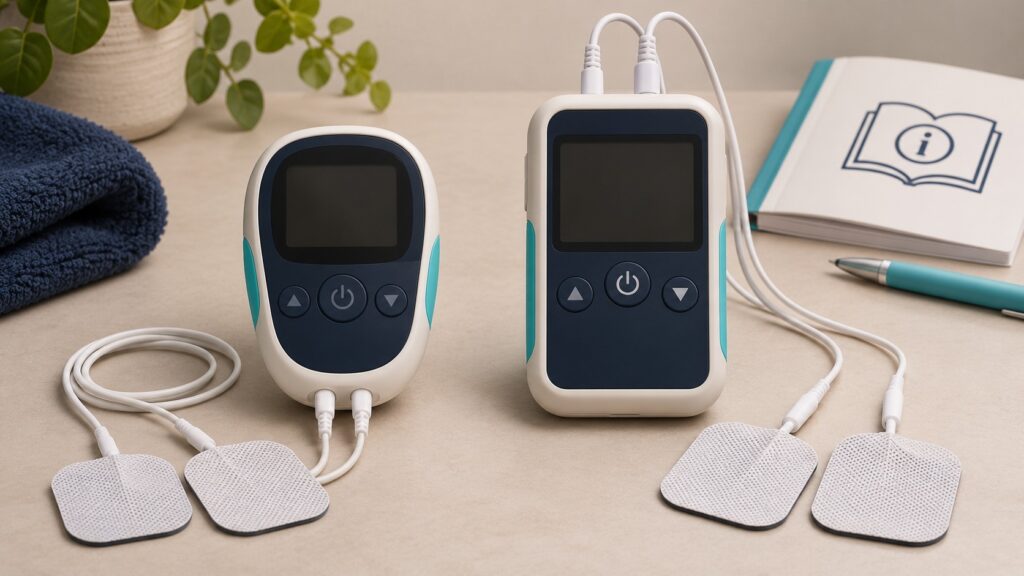
TENS is intended primarily for pain relief, while EMS deliberately produces muscle contractions for conditioning, activation, or specified rehabilitation uses. They can share hardware and overlapping settings. Some TENS methods also produce muscle twitches, so neither sensation nor frequency alone reliably identifies the mode. Check the device’s manual, intended use, and program instructions before using a combination unit.
Key Takeaways
- Conventional TENS usually provides strong, comfortable sensory stimulation; some TENS methods also produce motor twitches.
- EMS is designed to create controlled muscle contractions, but the appropriate training and rehabilitation uses vary by device.
- Frequency, waveform, cycling, and sensations can overlap. Confirm mode using the manual rather than guessing.
- A localized TENS/EMS combination unit does not automatically provide a whole-body suit’s coverage or independent zone control.
- Follow contraindications, approved electrode configurations, beginner guidance, and recovery instructions.
TENS and EMS units often look almost identical: a small controller, a few wires, and adhesive pads or electrodes. Some home devices even combine both modes in one box. But they are designed to do different jobs, and the settings that make sense for one can be the wrong choice for the other. This guide explains the technical differences between TENS and EMS, how the stimulation parameters compare, and how to confirm which mode you are actually using.
TENS vs EMS at a Glance
| Factor | TENS | EMS / NMES |
|---|---|---|
| Full name | Transcutaneous electrical nerve stimulation | Electrical muscle stimulation; often called neuromuscular electrical stimulation in clinical literature |
| Main purpose | Pain relief | Muscle activation or conditioning; clinical rehabilitation uses depend on the device and plan |
| Intended response | Strong, comfortable sensation in conventional sensory-level use; some methods produce motor twitches | Deliberate, controlled muscle contraction |
| Main target in conventional use | Sensory nerve pathways involved in pain modulation | Motor nerves supplying the muscles |
| U.S. classification | TENS for pain relief: 21 CFR 882.5890 | Powered muscle stimulator: 21 CFR 890.5850 |
The regulatory categories can be checked in the TENS regulation and powered muscle stimulator regulation. They describe device categories, not proof that any particular product is cleared for every use.
What TENS Is Designed to Do
A TENS unit delivers electrical pulses through electrodes placed on the skin according to its instructions. The goal is pain relief, rather than a muscle-training workout.
A 2014 research review describes how TENS can influence pain-processing pathways. It discusses both high-frequency and low-frequency approaches, with intensity an important part of the intervention.
- High-frequency TENS is commonly used at a strong but non-painful sensory intensity.
- Low-frequency methods may use intensities that produce muscle twitches.
That second point matters when comparing TENS vs EMS. Seeing a twitch does not automatically mean the program is an EMS workout. Your manual and the intended program purpose are more reliable than a sensation-based guess.
The evidence base for TENS is large. A 2022 meta-analysis included 381 randomized trials and found moderate-certainty evidence of lower pain during or immediately after TENS compared with placebo. Reported adverse events were generally mild where described, although adverse-event evidence was limited by reporting quality.
Those findings concern pain relief around treatment. They do not establish that a TENS unit fixes the underlying cause of pain, builds muscle, or provides lasting relief for every condition.
What EMS Is Designed to Do
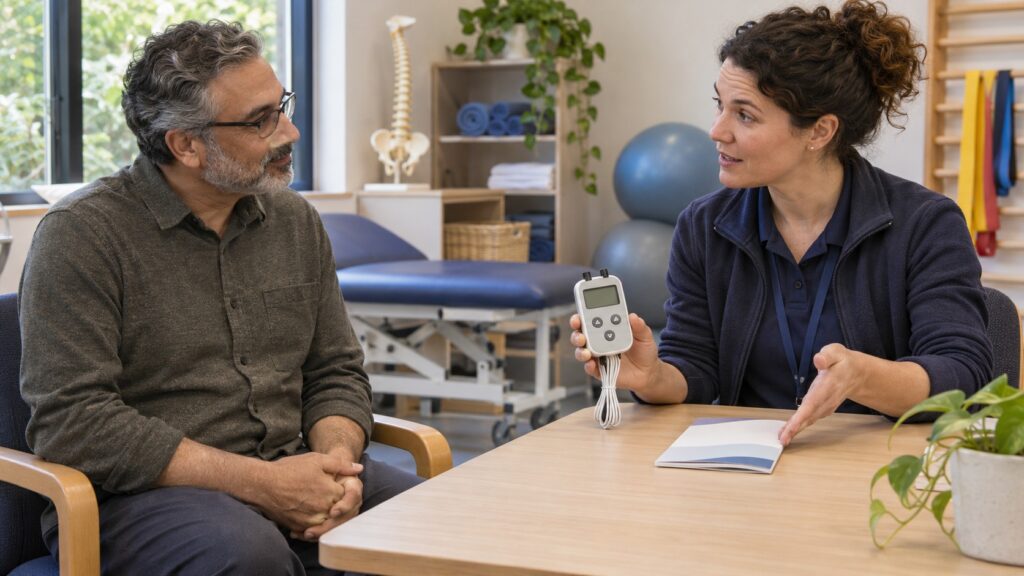
EMS, often called NMES in clinical research, deliberately stimulates motor nerves to make muscles contract. In a muscle-training program, the intended response is a controlled contraction rather than tingling alone.
A methodology review discusses how stimulation parameters, electrode setup, and the amount of muscle force produced influence NMES application. These are reasons to use an appropriate program, not to turn intensity up as high as possible on your first attempt.
Whole-body EMS suits apply stimulation across multiple muscle groups. A 2017 supervised research protocol used 85 Hz, a 350-microsecond pulse width, and four seconds of stimulation followed by four seconds of rest, alongside low-intensity movement.
That is an example of a studied protocol in a particular population and setting. It is not a universal home-training prescription, and copying its numbers does not reproduce its equipment, screening, supervision, or progression.

How the Settings Actually Differ
Frequency
Frequency is measured in hertz, meaning pulses per second. Frequency ranges overlap between TENS and EMS. A number on the screen cannot identify the mode on its own.
For more detail on how frequency affects stimulation, see our guide to electrical frequency.
Pulse Width
Pulse width, or pulse duration, describes how long a pulse lasts. Along with amplitude and waveform, it influences charge delivery and nerve recruitment. Pulse width and phase duration are not always labeled consistently across devices, so read the manufacturer’s definitions.
Training-focused NMES protocols may use pulse durations intended to produce useful contractions at tolerable settings. That does not make a wider pulse better for every purpose. Read EMS pulse width explained for more context.
Intensity Target
In conventional TENS, the usual target is a strong, comfortable sensation without a sustained muscle contraction. EMS training deliberately seeks muscle activation.
But the distinction has exceptions. Low-frequency TENS can produce twitches, while an EMS program turned down too low may produce little more than tingling. If the response is unexpected, pause and check the instructions. Do not increase output simply to prove which mode you selected.
On and Off Cycling
Conventional TENS may run continuously during a session. Muscle-training EMS programs often alternate contraction and rest, with ramp periods that gradually build or reduce stimulation. Some TENS programs also use bursts or modulation, so cycling alone is not definitive.
See our guides to EMS duty cycle and ramp time for the difference between work-rest timing and the transitions into a contraction.
Waveform
Both TENS and EMS devices may use biphasic waveforms, which have phases in opposite directions. A properly balanced waveform can limit net charge accumulation, but the term “biphasic” by itself does not tell you the intended treatment or guarantee charge balance.
Our article on monophasic vs biphasic EMS explains the terminology. Check the full program description rather than treating a waveform name as a quality rating.
How to Confirm the Mode on a Combo Unit
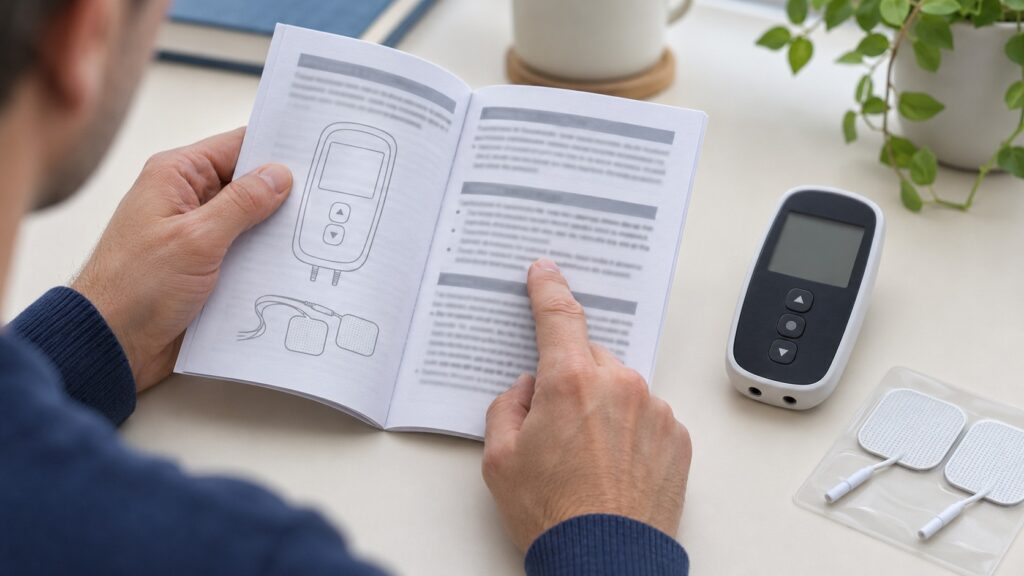
Many consumer devices are labeled “TENS/EMS.” Use this checklist before applying stimulation:
- Read the program name and manual. Confirm whether the program is intended for pain relief, muscle conditioning, or another specified use.
- Check the approved electrode placement for that program. Do not assume a placement diagram applies to every mode.
- Review the listed parameters and expected response. Tingling, twitches, and contraction-rest cycles can provide context, but none is a definitive test by itself.
- Start according to the beginner instructions. Stop if stimulation is painful or the response differs from what the manual describes.
- Confirm the device’s intended use and regulatory information. The FDA’s consumer guidance explains why the labeling and advertised use matter.
If the manual does not clearly separate the programs, ask the manufacturer or a qualified healthcare professional before using them.
Can a TENS Unit Replace an EMS Suit?
A TENS-only device is not a substitute for muscle-conditioning equipment. A combination unit may include a genuine EMS mode, but its coverage and control depend on the model.
A small unit commonly works through a limited number of pads. A whole-body suit integrates electrodes and channels across multiple regions, often for guided movement-based sessions. The difference is the intended application, coverage, and training setup, not an automatic ranking of which device is more effective.
For a broader explanation of research settings and equipment, see NMES vs EMS suits.
Electrode size and placement also influence current distribution and comfort. Our guide to electrode size and current density explains why pad geometry and contact matter.
Safety Considerations for Both
- Check contraindications first. Implanted electronic devices, pregnancy, and some cardiovascular or neurological conditions may rule out use. Review the contraindications guide and the exact device manual.
- Do not improvise placement over the front of the neck, broken skin, or a current path across the chest. Use the specified configuration and obtain clinical guidance where appropriate.
- Progress conservatively with EMS. The 2023 international WB-EMS guideline emphasizes screening, qualified supervision, careful beginner progression, and recovery.
- Inspect pads, cables, connectors, and suit contact areas. Adhesive pads that are drying out or lifting can give uneven contact. Dry-contact textile systems have their own preparation instructions and should not automatically be moistened.
- Stop for pain, burning, or unexpected symptoms. Severe muscle pain, marked swelling, unusual weakness, or dark urine after EMS requires prompt medical assessment.
Frequently Asked Questions
What is the main difference between TENS and EMS?
TENS is intended primarily for pain relief. EMS deliberately produces muscle contractions for conditioning, activation, or specified rehabilitation uses. Conventional TENS is sensory-level, but some TENS methods also produce twitches.
Can I use an EMS device for pain?
Do not assume a muscle-training program is a pain-relief program. Some clinical plans use NMES for conditions involving pain or impaired function, but the device, purpose, and professional guidance matter. For pain relief, ask whether TENS or another approach suits your situation.
Are TENS and EMS frequencies different?
Their frequency ranges can overlap. Check the intended program, pulse characteristics, intensity guidance, and timing instead of identifying a mode from hertz alone.
Is a TENS/EMS combo unit worth it?
It may be useful if you need both supported functions for localized use. Check the actual programs, electrode requirements, and intended uses before purchasing. It does not automatically provide whole-body suit coverage.
Is it safe to use TENS and EMS on the same day?
There is no blanket answer for every device and person. Follow the instructions and treatment plan, and do not stack stimulation on the same area without appropriate guidance.
Choose by Purpose, Not Appearance
TENS and EMS can share hardware, settings, and some sensations. Their intended purposes remain the useful starting point: pain relief for TENS and deliberate muscle activation for EMS.
Check the manual, the intended use, and the program instructions before turning the device on. A familiar-looking controller is not enough information to decide how it should be used.
Sources
- Vance CGT, et al. Using TENS for pain control: the state of the evidence. Pain Manag. 2014. Read the review.
- Johnson MI, et al. Efficacy and safety of TENS for acute and chronic pain in adults: the meta-TENS study. BMJ Open. 2022. Read the meta-analysis.
- Maffiuletti NA. Physiological and methodological considerations for the use of NMES. Eur J Appl Physiol. 2010. Read the review.
- Kemmler W, et al. The randomized controlled FranSO study. Clin Interv Aging. 2017. Read the study.
- Kemmler W, et al. Updated international WB-EMS guideline. Front Physiol. 2023. Read the guideline.
- U.S. Food and Drug Administration. Electronic Muscle Stimulators. Read the guidance.
This article is for general education and is not medical advice. Follow the device instructions and seek appropriate healthcare guidance before starting electrical stimulation.