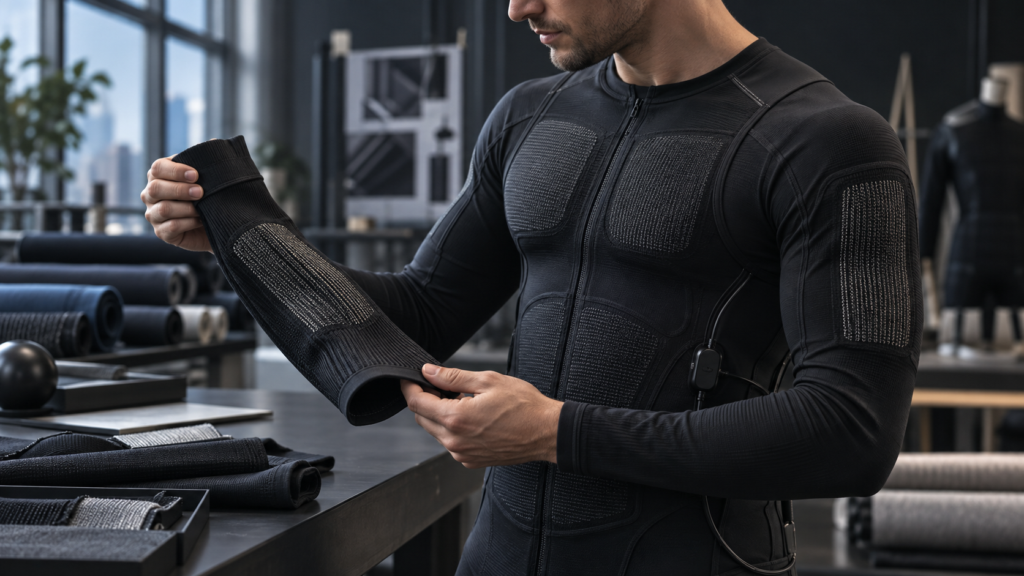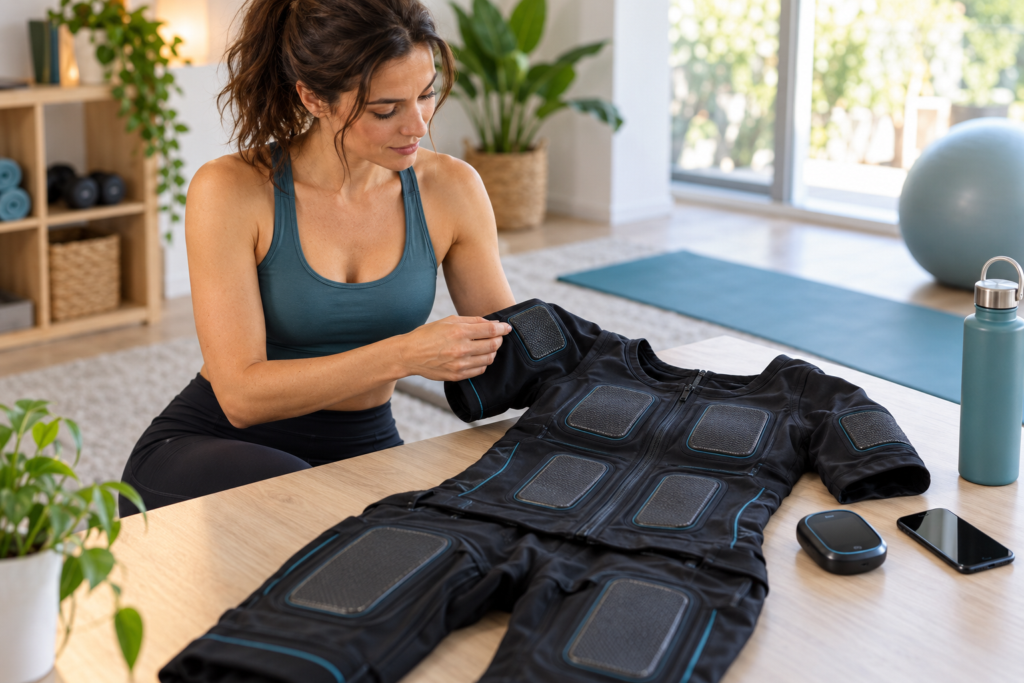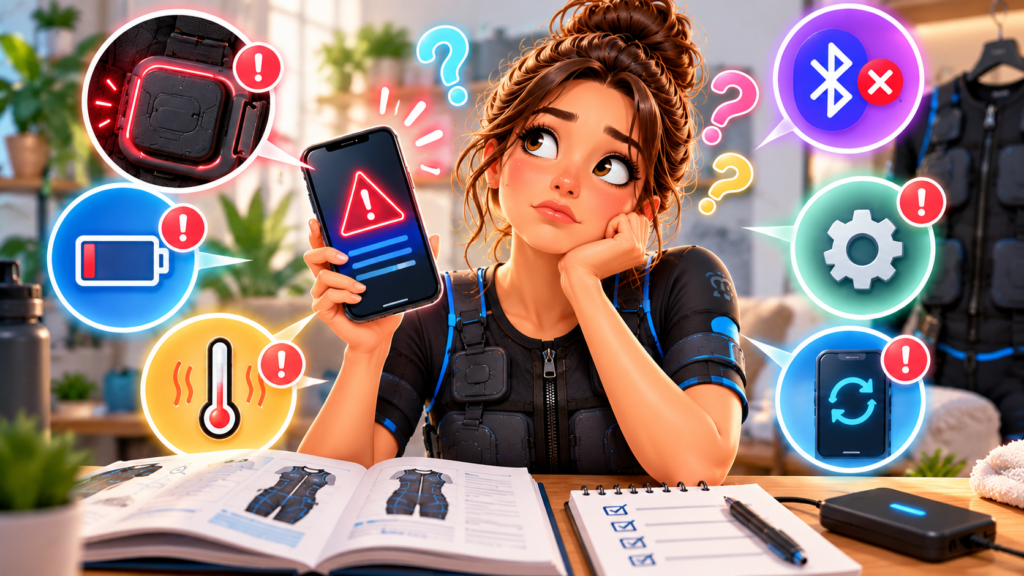
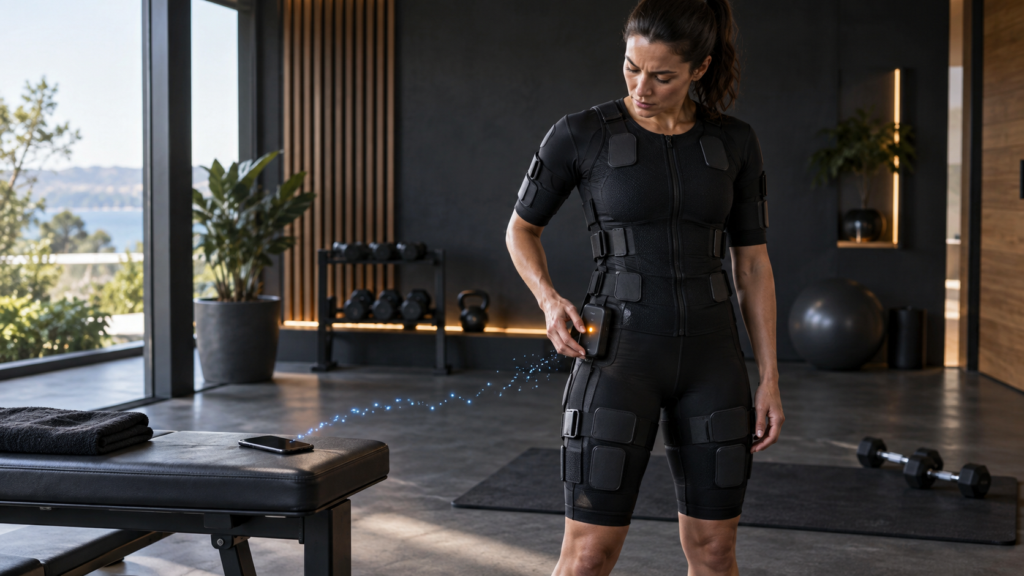
An EMS suit that pairs normally but disconnects during exercise has a different problem from a system that never connects. The failure may follow movement, battery demand, wireless interference, an app entering the background, or a controller that is not fully seated on the garment.
Treat every unexpected disconnect as a reason to stop the exercise. Do not continue a loaded movement while looking at the phone or attempting to reconnect.
First: return to a stable position
Put down weights or release resistance safely. End the set, return zone levels to zero if the app remains responsive, and use the controller’s stop function according to its manual.
Do not assume stimulation has ended solely because the phone says “disconnected.” Some systems generate the program locally and may behave differently after losing the phone link. The manufacturer’s documented fail-safe behavior is the only reliable answer.
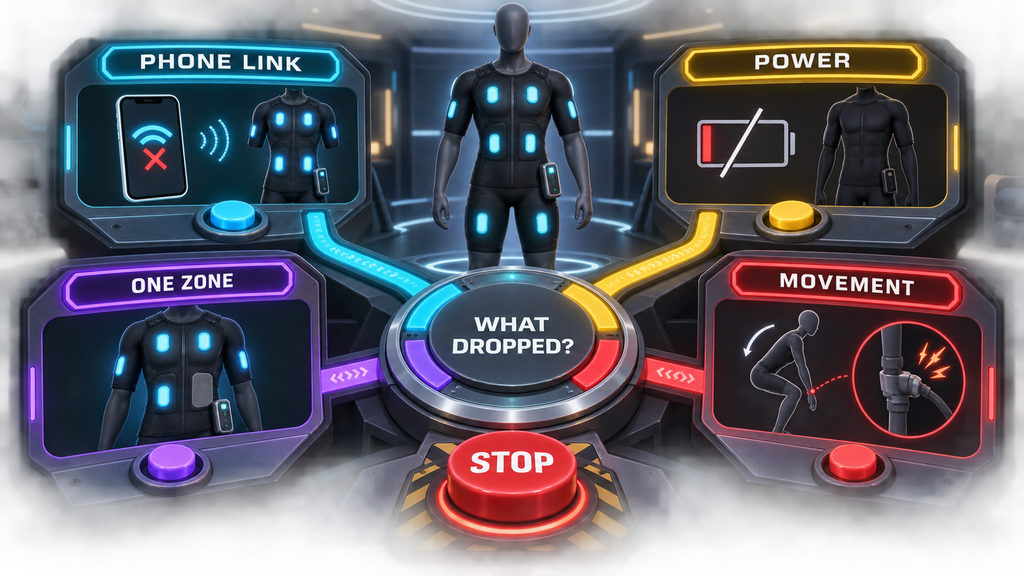
Identify the type of dropout
Record what happened:
- Did the app lose the controller while stimulation continued?
- Did stimulation and the app stop together?
- Did the controller power off?
- Did only one garment zone fail?
- Did the problem occur during the same movement each time?
- Was there an error message or status-light pattern?
These observations separate a wireless-link issue from a garment contact, power, or conductor problem.
Check controller seating
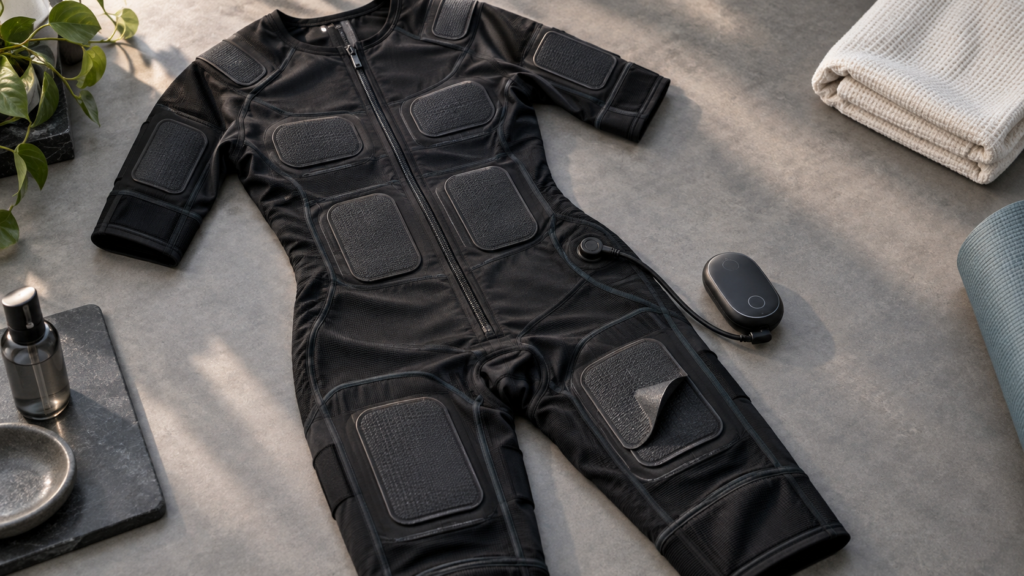
Movement can expose an attachment that was almost, but not fully, engaged. With output off, remove and reinstall the control unit exactly as shown in the manual.
Inspect the attachment for:
- Moisture where the manufacturer requires a dry connector.
- Dirt, detergent residue, or lint.
- A bent or recessed contact.
- A cracked housing or loose latch.
- Garment tension pulling on the controller.
Do not clean electrical contacts with a metal tool or unapproved solvent.
Check whether movement triggers the failure
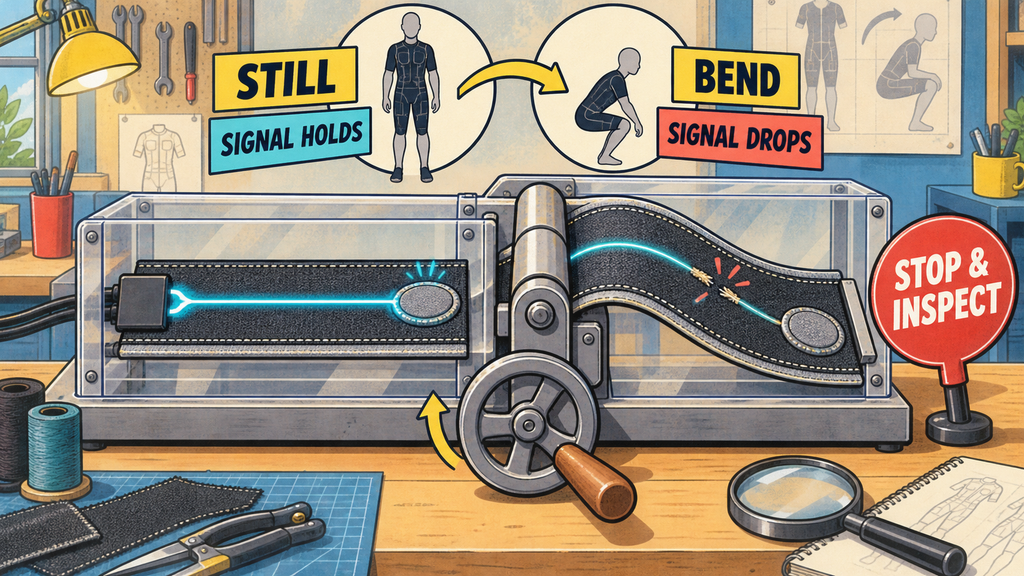
If the system disconnects during a squat, hinge, or torso rotation but works while standing still, a garment conductor or connector may be changing with stretch. That pattern can indicate physical wear even when the suit looks normal at rest.
Do not reproduce the fault repeatedly under full stimulation. Stop using the affected hardware and report the movement-dependent pattern to support.
Check battery state and behavior
A controller may show enough charge to power on yet shut down under use if the battery, connection, or power-management system is faulty. Fully charge it using the approved equipment and observe the official indicator.
Stop immediately if the battery or enclosure becomes swollen, unusually hot, wet, cracked, or odorous. Do not charge damaged lithium-ion equipment.
The planned EMSSuits guide to an EMS controller that will not charge covers power checks in detail.
Check the phone and app
Operating systems can suspend background apps, restrict Bluetooth access, or enable battery-saving settings that interfere with a training connection. Check the official support instructions for:
- Required Bluetooth permission.
- Whether the app must remain in the foreground.
- Supported phone and operating-system versions.
- Battery-optimization exceptions.
- App and firmware compatibility.
Avoid changing unrelated phone security settings. Grant only the permissions the official app documents.
Reduce wireless uncertainty
Keep the phone within the manufacturer’s stated range and on the side or position recommended for the controller. Remove it from a metal locker or a location blocked by the body.
Temporarily move away from crowded wireless equipment if support recommends that test. Do not assume every dropout is radio interference; a reproducible movement-related failure is more consistent with a physical connection.
Restart only after a low-level equipment check
Use the official shutdown and restart sequence. Once reconnected:
- Select the correct profile and program.
- Confirm every zone begins at zero or the documented safe starting state.
- Test at a low level in a stable stance.
- Confirm pause and stop controls work.
- End the session if the link drops again.
Do not resume where the previous intensity left off unless the system explicitly and safely manages that state.
When to contact support
Stop troubleshooting and seek service when:
- The controller repeatedly shuts down with charge remaining.
- Disconnection follows garment movement.
- A connector is loose or damaged.
- The unit overheats or shows battery damage.
- Firmware updating failed.
- The app and controller disagree about whether stimulation is active.
- Reconnection causes an unexpected intensity jump.
Provide the model, serial identifier if requested, app version, phone OS, exact error, controller light pattern, and steps that reproduce the failure. Never send passwords or recovery codes.
Frequently asked questions
Can I keep exercising if the phone disconnects but EMS continues?
End the set safely. A lost control link can limit your ability to adjust or stop the program, and device behavior varies.
Does Bluetooth interference cause every dropout?
No. Battery, app state, controller seating, garment wiring, and movement-related faults are also possible.
Should I reinstall the app?
Only after the official restart sequence and after checking whether reinstalling removes profiles or logs. Support may request diagnostic information first.
Is one dead zone a wireless disconnect?
Usually it points more directly to zone settings, electrode contact, or a garment circuit. See the guide to patchy EMS electrode contact.
The practical takeaway
When an EMS suit disconnects mid-workout, stop movement and establish whether the phone link, controller power, garment connection, or one electrode zone failed. Inspect with output off, restart using the official sequence, and test only at a low level.
A repeatable dropout is not normal. Do not train around it or rely on repeated reconnection. Give support the exact conditions so the device can be serviced before another full session.