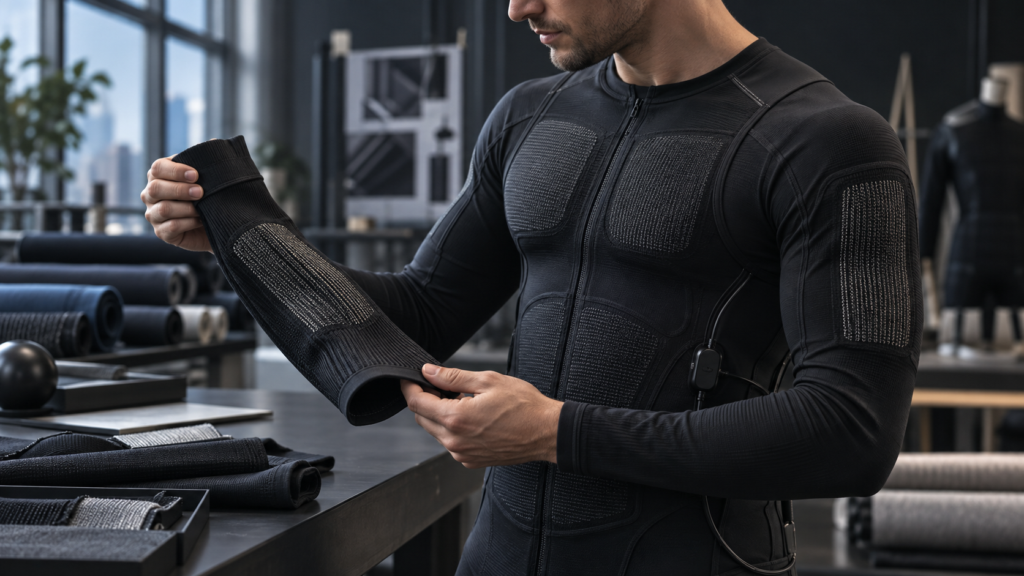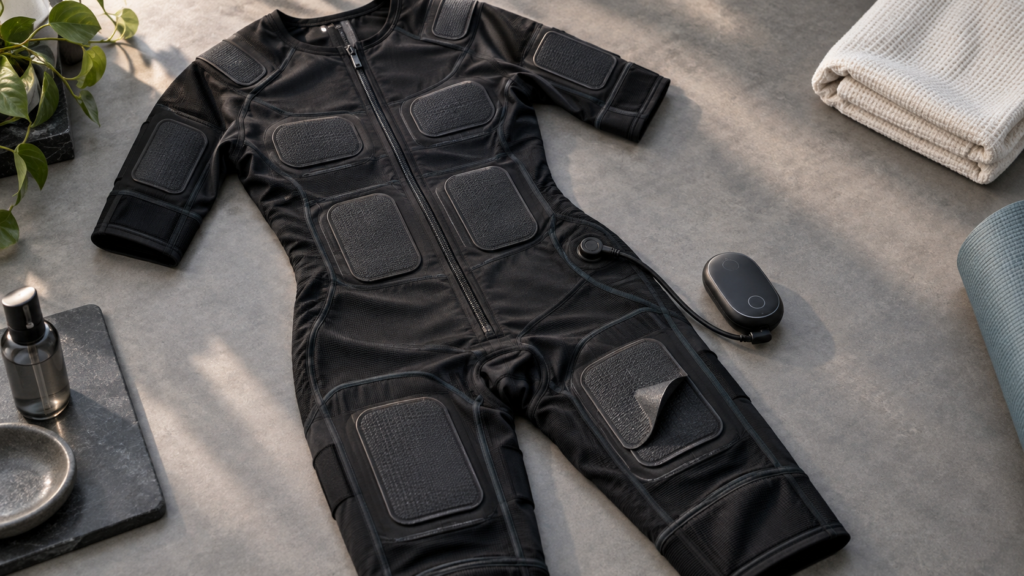
Strap into an EMS suit for the first time and something feels off, in a good way. Instead of the familiar burn of a heavy set, you get a deep, synchronized buzz that seems to grab the whole muscle at once. You’re not imagining that difference. It’s real, it’s physical, and it comes down to how your body switches muscle on in the first place.
To explain why EMS feels the way it does, we have to start smaller than the muscle itself. We have to start with the motor unit.
What a Motor Unit Actually Is
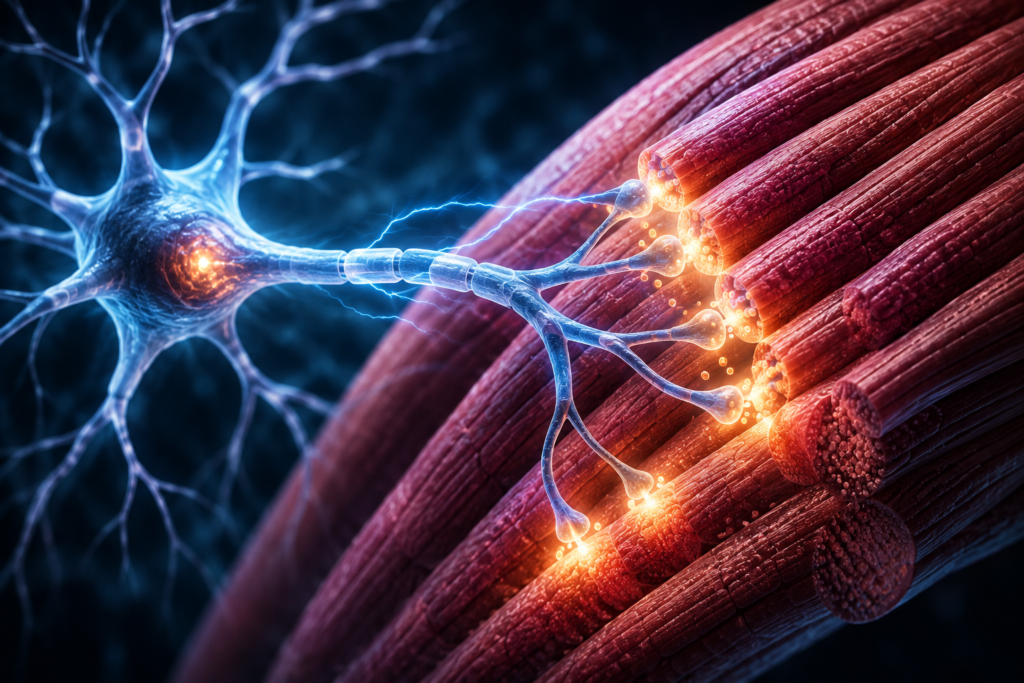
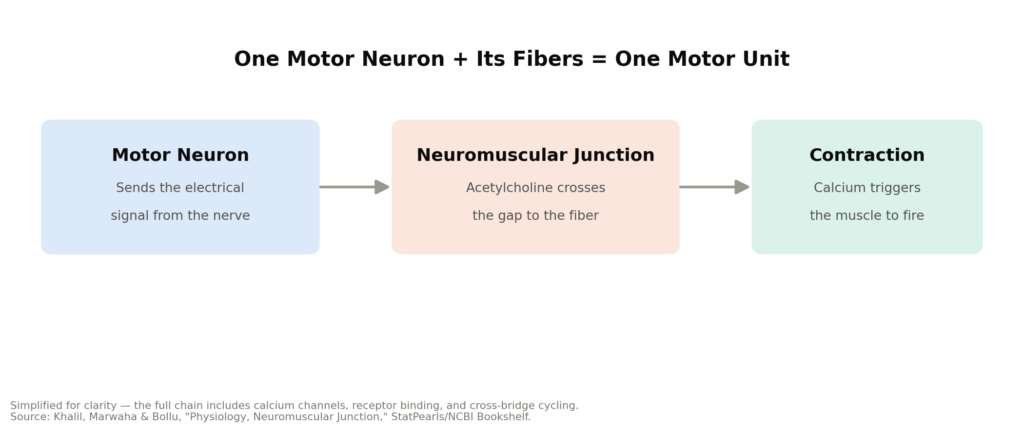
A motor unit is one motor neuron and every muscle fiber it’s wired to. When that neuron fires, every fiber in its unit fires with it, every single time. No partial signals, no half-measures.
Here’s the mechanism, stripped down. A signal travels down the neuron and reaches its very end, where it triggers the release of a chemical messenger called acetylcholine (a name you can safely forget the second after reading it, what matters is what it does). That messenger crosses a microscopic gap and locks onto the muscle fiber, opening the door for the electrical change that tells the fiber to contract. Calcium floods in, the fiber’s internal machinery grabs hold, and force gets produced. All of that happens in a fraction of a second, and it’s the same basic chain reaction picking up a coffee cup or a loaded barbell.
Not every motor unit is built the same, though. Some are small, efficient, and built to run all day without tiring, the kind you use standing in line at the grocery store. Others are large, powerful, and burn out fast, the kind you call on for a heavy final rep. Your muscles are a mix of both, and which ones get used, and in what order, turns out to matter enormously.
How Your Nervous System Normally Calls Them Up
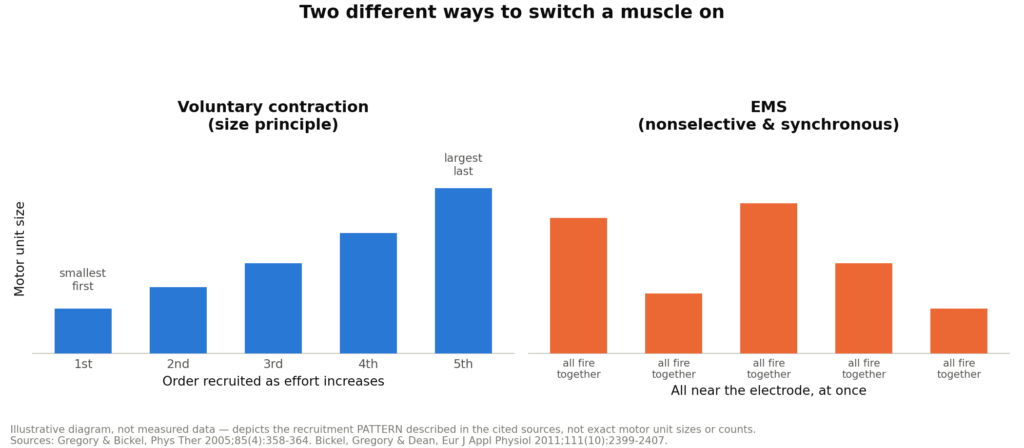
Your body is a smart hiring manager. For a light task, it brings in the small, efficient crew first. Only as the job gets harder does it start calling in bigger, more powerful units to help out. This is called the size principle, and it’s one of the more elegant patterns in human physiology: smallest motor units first, largest only when the task actually demands it.
The rule isn’t perfectly rigid. In fast, complicated, real-world movement, your nervous system adjusts the order somewhat based on what the specific task needs. But as a general pattern, smallest-to-largest holds up well, and it’s exactly the pattern that makes voluntary training feel the way it does: a gradual ramp, not an all-or-nothing switch.
Which brings us back to that buzz.
Why EMS Feels Different (Because It Works Differently)
EMS skips the hiring manager entirely.
When an electrical current activates a muscle from the outside, it doesn’t respect the size principle. Research on electromyostimulation describes the recruitment pattern in blunt terms: nonselective, spatially fixed, and temporally synchronous. Translated, that means EMS fires whatever motor units happen to be near the electrodes, big and small together, all at once, rather than working up through a size-based order. Studies looking more closely at this pattern have also found that EMS tends to favor fibers closer to the skin’s surface over deeper ones, and that inconsistent current distribution from electrode placement is a big part of why.
That’s just a different mechanism, with real consequences. Because EMS keeps activating the same motor units over and over instead of rotating through a size-based hierarchy, it tends to fatigue muscle faster than the same amount of voluntary effort would. A controlled study measuring this directly found strength dropping by roughly a tenth immediately after stimulation, consistently across different stimulation styles, and traced that fatigue to the muscle itself rather than to the nervous system struggling to keep up. That’s useful to know: the tired feeling after an EMS session is a real, physical kind of fatigue, not a sign that something’s wrong.
It also explains something else people notice: real, if temporary, muscle soreness after a session, similar to what shows up after trying a new exercise for the first time. Research on EMS training describes this as expected muscle micro-damage, the kind your body adapts to and stops reacting to as strongly with repeated exposure. Normal, not a warning sign.
Does EMS Training Actually Work?
Here’s the honest answer, because the honest answer is more useful than a hyped one.
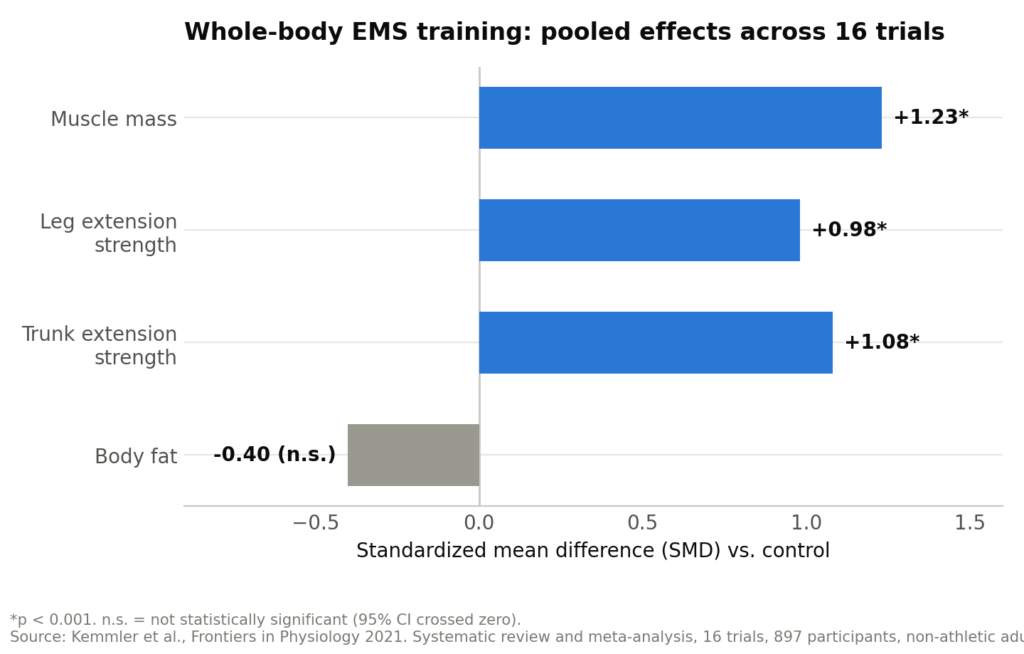
A systematic review pooling 16 controlled trials and nearly 900 people found large, statistically significant improvements in muscle mass and leg and trunk strength from whole-body EMS training. That’s a real, well-supported result. The same review did not find a significant effect on body fat specifically. So: EMS training builds and strengthens muscle. It does not, on its own, melt fat.
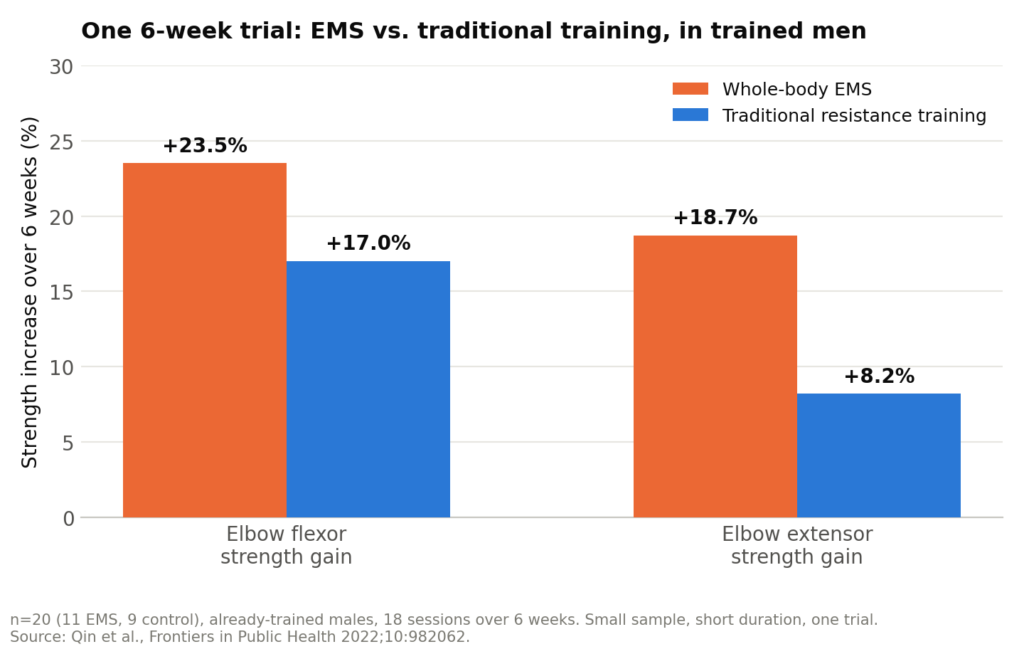
One smaller study found EMS producing slightly greater arm-strength gains than an equivalent amount of traditional resistance training, in men who were already well-trained, over six weeks. Worth knowing, worth keeping in perspective: one small trial, one muscle group, one short window.
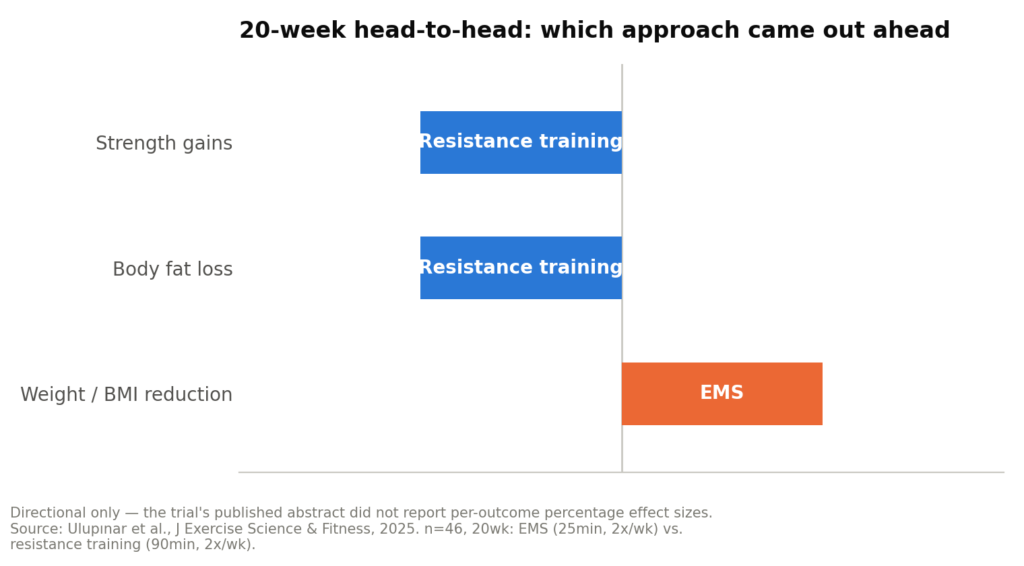
The most useful comparison is also the most humbling one. A 20-week trial put EMS training head-to-head against traditional full-body resistance training, and traditional training won on strength gains and fat loss. EMS came out ahead on one specific measure: weight and BMI reduction. The researchers’ own conclusion was that EMS works well as an option for people who can’t do high-load resistance training, not as something that beats lifting at its own game.
What This Means for How You Train
Understanding motor units changes how you read what you feel during and after a session. That deep, synchronized buzz is the physical signature of a real recruitment pattern, not a placebo and not a sign anything’s wrong. The soreness afterward is expected muscle micro-damage, the same category of response as trying a new lift for the first time, and it fades as your body adapts to repeated exposure.
The evidence points to a specific, honest role for EMS training, not an unlimited one. It builds and strengthens muscle in a real, measurable way. It hasn’t shown a clear fat-loss effect on its own. Set against traditional resistance training directly, over a long enough window, lifting still wins on raw strength and fat loss. Where EMS holds up is different: it’s fast, it doesn’t demand the recovery cost of a heavy lifting session, and it activates muscle even when a full workout isn’t realistic that day.
None of that makes EMS a shortcut, and it doesn’t make it interchangeable with a barbell. It makes it a specific tool with a specific, documented mechanism, worth understanding on its own terms instead of through whatever a product label happens to claim. Once you know why the buzz feels different, you know exactly what you’re getting, and what you’re not.
Ready to jump into EMS fitness? Check out our product and brand reviews to compare coverage, intensity control, and battery life across the top EMS suits on the market, or use our comparison tool to line up specs side by side and find your best fit.
Motor units explained: the data behind the post
EMS recruits muscle differently than your nervous system does on its own. Click a tab below to see what controlled trials have actually measured, for and against EMS training.

One motor neuron plus every fiber it’s wired to is one motor unit. Source: Khalil, Marwaha & Bollu, “Physiology, Neuromuscular Junction,” StatPearls/NCBI Bookshelf.