
A marathon runner and a sprinter train for opposite outcomes. One holds a steady pace for hours. The other empties the tank in ten seconds. Much of that difference comes down to the muscle fibers each one is working with, and how those fibers are built.
Muscle is not one uniform material. It is made of fibers that contract at different speeds and burn energy in different ways. The blend you carry in any given muscle shapes what that muscle is good at. It explains why your calves can hold you up all day while your hamstrings give out on a sprint, and why no single style of training works for every goal.
What a muscle fiber actually is
Skeletal muscle is built from cells called fibers. Each fiber gets sorted by two things, how fast it contracts and how it produces energy. Those traits track together closely enough that researchers group fibers into a small set of types. Every muscle you have is some mix of them.
Two families, three types
There are three main types, running along a spectrum from steady to explosive. Type I is the slow-twitch fiber. Type IIa and Type IIx are the two fast-twitch fibers. Tap through them below to see how they differ.
Interactive · Compare the fibers
The three fiber types, side by side
Type I
The old tortoise-and-hare comparison holds up. Slow-twitch is the tortoise, steady and durable. Fast-twitch is the hare, quick to fire and quick to fade.
Why different muscles have different blends
Here is where fiber type stops being trivia and starts explaining your body. A muscle’s fiber blend matches the job it does.
Take the two big muscles in your calf. The soleus, the deeper one, is heavily slow-twitch. Studies put it around 80 percent Type I on average, with some people ranging even higher. That fits its work, since the soleus spends the day keeping you from tipping forward when you stand. It needs endurance, not explosiveness. The gastrocnemius, the muscle you see when someone flexes a calf, sits closer to an even split. Its job is push-off and jumping, so it carries more fast-twitch fiber than the soleus beneath it.
The pattern repeats across the body. Postural muscles that hold you steady tend to skew slow-twitch. The vastus lateralis in your thigh runs closer to a third slow-twitch, leaving most of it fast-twitch for powerful knee extension. Most muscles land in the mixed middle, near an even split, because most muscles do a little of both.
Data · Fiber composition by muscle
Slow-twitch share, by muscle
How your body chooses which fibers to use
Your body does not fire every fiber at once. It recruits them in order, and the order follows effort. This is Henneman’s size principle. When a movement asks for little force, the body calls on the small slow-twitch motor units first. As the demand climbs, it brings in progressively larger fast-twitch units. Pick up a coffee cup and you are using slow-twitch fiber. Load a heavy barbell and your body reaches deeper into the fast-twitch pool to move it.
That is why one muscle can handle both an easy stroll and an all-out sprint. Same muscle, different fibers recruited depending on what you ask of it. Drag the slider to raise the effort and watch which fibers switch on.
Interactive · Henneman’s size principle
Raise the effort, recruit the fibers
At rest. No fibers firing yet. Move the slider to add effort.
Can you change your mix
Mostly, your fiber ratio is set by genetics. On average people run close to a 50/50 split across the muscles they move with, though the exact number varies person to person, and the only way to measure yours precisely would be a muscle biopsy. Training will not hand you a whole new set of fibers, but it does shift things. Endurance work pushes your fibers toward more fatigue-resistant behavior. Heavy and explosive work develops the force and speed side. Fibers can shift their character along that spectrum, especially between the two fast-twitch types, even if you never fully convert one main type into another. Most people never test their ratio and just read it off experience. If long runs come easy, you likely lean slow-twitch. If you would rather sprint and lift, you likely lean fast.
Where electrical stimulation fits in
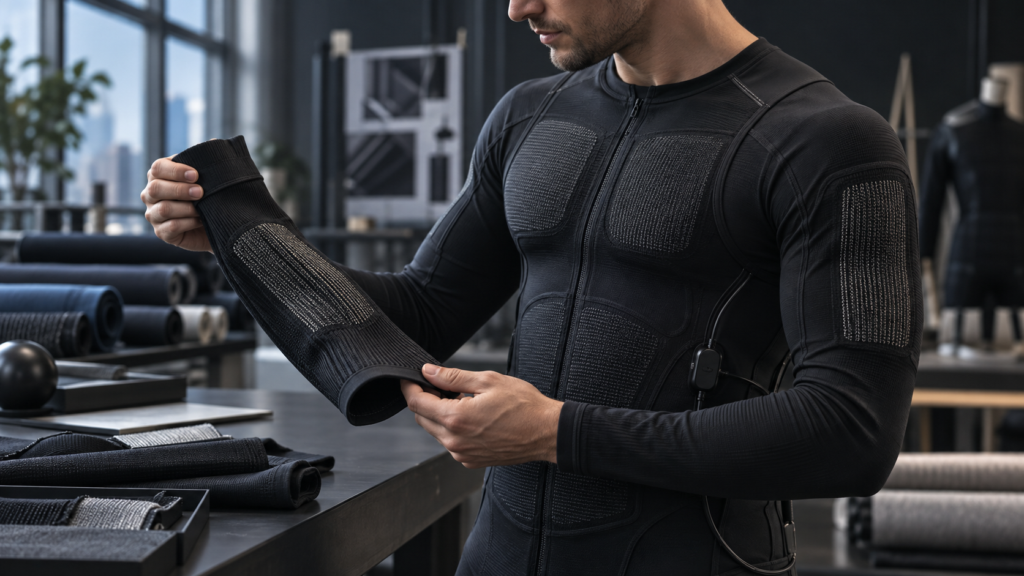
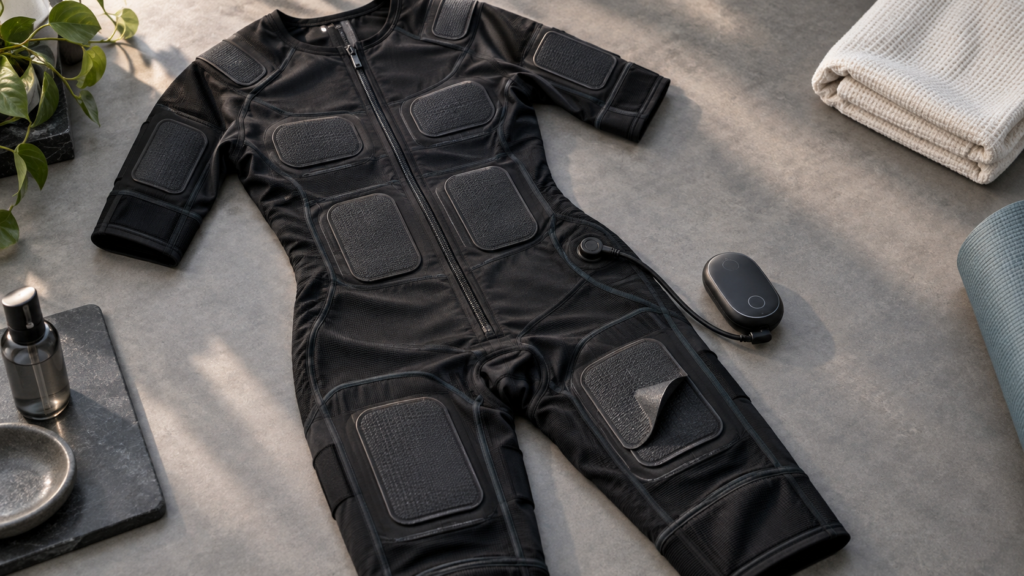
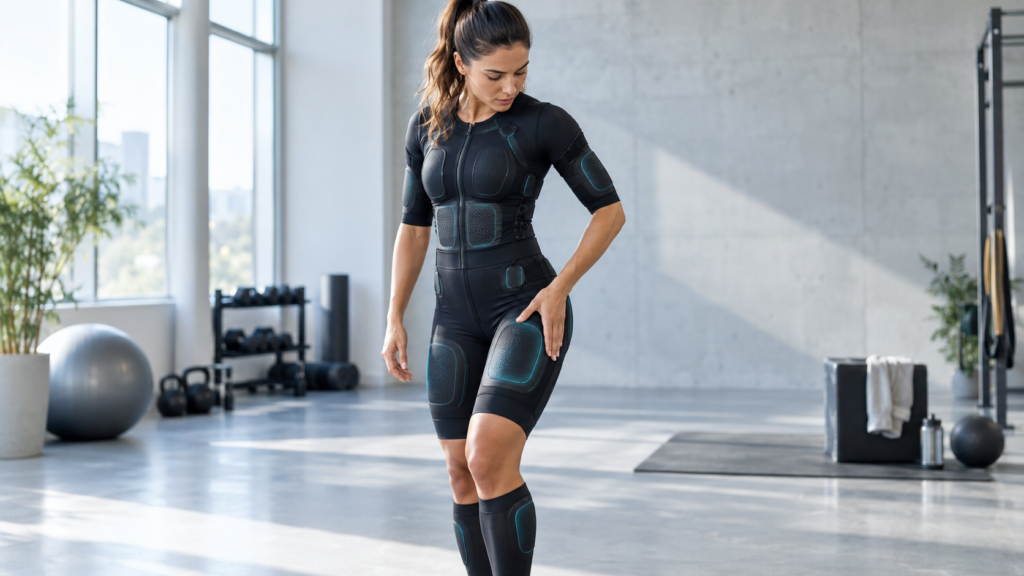
EMS, electrical muscle stimulation, works through a different door. Instead of your brain sending the signal that recruits fibers in Henneman’s usual order, EMS triggers contraction with an external electrical impulse applied through the skin. That changes the activation pattern.
Researchers still debate the specifics. Some describe EMS as pulling in fast-twitch fiber earlier than a light voluntary effort would, since those fibers respond readily to the current. Others argue the activation is essentially nonselective, firing fibers together rather than in the clean small-to-large sequence your nervous system uses. What both views share is that EMS engages muscle differently from ordinary movement, and that the contraction it produces tends to fatigue muscle faster.
Compare · Two ways to activate a muscle
Voluntary order vs. EMS activation
Voluntary movement
Ordered · small to largeSlow-twitch units come on first, fast-twitch join only as force demand rises. Smooth and graded.
EMS activation
Less orderly · more synchronousAn external impulse activates fibers more broadly at once, not in the nervous system’s usual sequence. This is why it fatigues muscle faster.
None of this locks you into one path. Knowing which fibers a muscle leans on just lets you train it for what you actually want it to do.
Ready to jump into EMS fitness? Check out our product and brand reviews to compare coverage, intensity control, and battery life across the top EMS suits on the market, or use our comparison tool to line up specs side by side and find your best fit.